Behavior
Rescue Dog Separation Anxiety: Signs and a Real Training Plan
Published · By Jeff Molitor
Rescue dog separation anxiety starts within minutes of you leaving. Film your dog first, then build alone time in tiny steps your dog can handle calmly.
The short answer
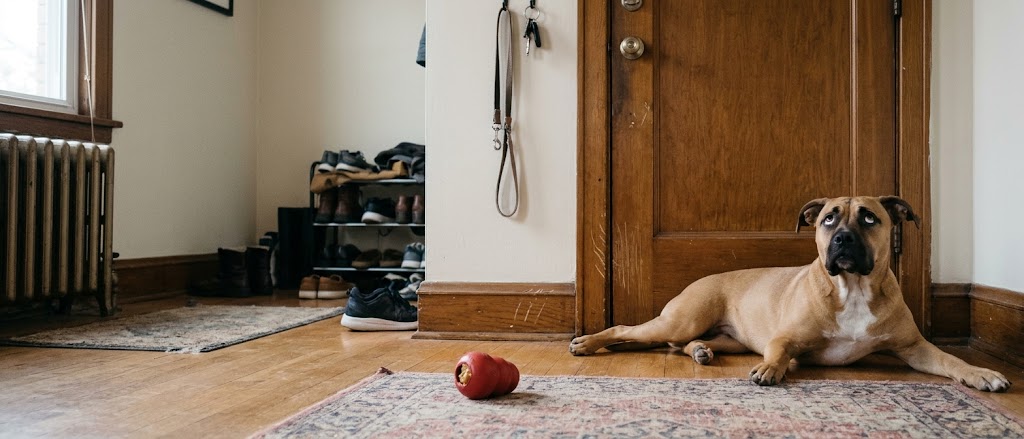
Helping a rescue dog with separation anxiety starts with filming the dog alone to confirm panic rather than boredom or crate stress. A graduated alone-time plan builds short absences a dog can handle calmly, then stretches the time slowly over weeks. A vet check comes first, since pain and stomach trouble can look like separation anxiety.
Rescue dog separation anxiety is real, but plenty of dogs who wreck the blinds while you're out are bored or hate the crate instead. Each problem needs a different fix, so a wrong guess can make rescue dog separation anxiety worse or waste months on the wrong one.
This Let Them Be Dog guide sorts real panic from boredom and crate stress. You'll get a camera test, a graduated alone-time plan and a clear line on when to call a vet or a certified behavior consultant.
How Do I Help My Rescue Dog With Separation Anxiety?
Short answer: figure out what you're dealing with, then practice leaving in doses so small your dog barely notices. It's annoyingly slow.
Book a vet visit first. A dog who pees on the rug while you're at work might have a bladder infection, not a broken heart.
Next, set up a camera and leave like you normally would. The footage tells you if you've got panic, boredom or a crate problem, so it gets its own section below.
Then stop leaving your dog alone longer than he can handle, and start the alone-time plan.
One note on timing. Crying in a crate beside your bed on night 1 is a different problem with its own playbook: what to do when a rescue dog cries at night. This post is about the dog who falls apart every time the front door shuts.
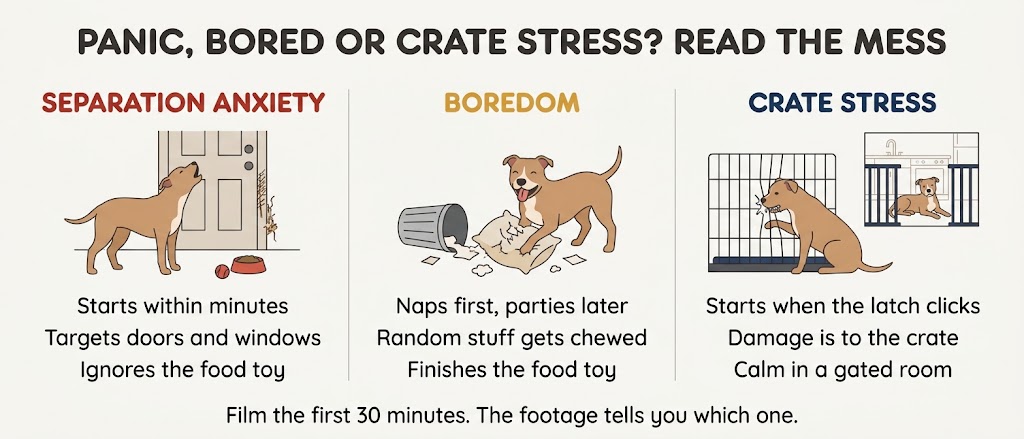
Is It Separation Anxiety, Boredom or Crate Stress?
Chewed blinds don't come with a label.
The same shredded cushion can come from 3 different dogs. One is panicking, one is bored out of his skull and one just hates being shut in a box.
A University of Lincoln team surveyed owners of more than 2,700 dogs from over 100 breeds. Their 2020 study on the root causes of separation anxiety found 4 forms of distress.
Some dogs want to get away from something in the house, and others want to get to something outside. Some react to outside noises. Some are just bored.
Professor Daniel Mills compared calling all of that "separation anxiety" to saying your dog has an upset tummy. True, sure. Not very useful.
True Separation Distress
This is the dog who can't cope without his person. The stress starts before you leave, when the shoes go on or the keys jingle. Once the door shuts, he paces, howls, drools or digs at the exits.
The tell is that it doesn't wind down. He's still going 20 minutes later, and the stuffed food toy sits there untouched. A dog in a panic doesn't eat.
Plain Old Boredom
Bored dogs make a mess too, just on a different schedule than panicked dogs. They tend to nap through your exit, wake up an hour later and go looking for something to do. Your shoes count as something to do.
Bored destruction is random: throw pillows, the trash, a TV remote. Not the door frame. The fix is boring in a good way, with a sniff walk, a food puzzle and a long chew before you head out.
A bored dog needs a job, not a diagnosis. Try the 10-minute sniff and puzzle games on our homepage before you leave, and see if the chewing stops.
Crate and Confinement Stress
Then there's the dog who's fine loose in the house and loses it in a crate. Bent wires, bloody gums, a blanket soaked in drool. Lots of shelter dogs spent weeks behind a gate, and some come home with the gate-rattling frustration kennel life teaches.
The test is simple. Swap the crate you bought before pickup day for a baby-gated kitchen. If your dog settles, it was the box, not you.
Crates help plenty of dogs. Forcing a panicking dog into one can make things worse, and dogs get hurt trying to break out.
| Clue | Separation Anxiety | Boredom | Crate or Confinement Stress |
|---|---|---|---|
| Before you leave | Follows you, pants or paces when the keys or shoes come out | Barely notices | Balks or freezes at the crate door |
| When it starts | Within minutes of the door closing | Often after a nap, once the dog wakes up looking for fun | As soon as the door latches, even with you in the room |
| What gets damaged | Exits: door frames, blinds, window sills | Random fun stuff: shoes, pillows, the trash | The crate or gate itself, plus gums, teeth and nails |
| Food toy left behind | Ignored | Finished fast, then the dog looks for more | Often ignored while confined |
| Over 30 minutes | Stays high or ramps up | Comes in bursts with naps in between | Calms down in a gated room or loose in the house |
| What helps first | A vet visit, then a graduated alone-time plan | Sniff walks, food puzzles and chews before you go | Swap the crate for a gated room, then retrain the crate slowly or skip it |
Some dogs show more than 1 pattern. Camera footage from the first 30 minutes after you leave is the best way to tell them apart.
What Are the Signs of Separation Anxiety in a Rescue Dog?
The signs bunch up around 2 moments: right before you leave and right after.
Before, your dog shadows you room to room while you get ready. He pants when you grab your keys, or he goes stiff and quiet on the couch.
After, the noise starts fast. Howling that rolls on and on, barking at the door, a whine on loop. Destruction aims at exits, like door frames, blinds and the bottom of the front door.
You might also find drool puddles, sweaty paw prints by the door and accidents from a dog who's house trained. Then comes a welcome fit for a soldier home from war.
Food is a big clue. A dog who skips the food toy only when he's alone is telling you something. A dog who skips every meal for days is a different story, and a new dog's appetite slump has its own playbook.
Timing matters too. Veterinary behaviorist Debra Horwitz wrote in 2001 conference notes that most dogs start separation-related behavior within 30 minutes of the owner leaving.
And it's common. A University of Bristol study funded by the RSPCA estimated that around half of dogs in the UK may show separation-related behavior at some point. The same 2010 research found dogs who got anxious alone also made more "pessimistic" choices in a food bowl test. The stress runs deeper than 1 rough afternoon.
Why Do Rescue Dogs Struggle More With Being Alone?
Think about your dog's last few months. A home, maybe a stretch as a stray, then a kennel with 40 barking neighbors. Then you.
Losing everything once can teach a dog that people disappear. Veterinary behaviorist Kenneth Martin made a similar point in 2016 conference notes for Canadian vets. Dogs with separation anxiety, he wrote, often were given up or had more than 1 owner.
That doesn't mean rescue dogs are broken. Most handle alone time fine.
Then we adopters make it worse, with love. We take 2 weeks off, spend every second together and go back to 9-hour days. The dog goes from never alone to alone all day, overnight.
Short departures during decompression help. A few 5-minute errands early on teach your dog that you always come back.
Clinginess can also show up late, during the month 2 velcro phase when a dog picks his person.
The good news is that it often eases with time. Our guide to how behavior shifts over a rescue dog's first 6 months covers that trend. Easing isn't the same as gone, though, and a dog in real panic shouldn't tough it out.
The calm your alone-time plan runs on starts with a dog who can relax on a mat. Practice the settle games in our training basics this week.
What Should You Look for on the Dog Camera?
You can't fix what you can't see, and a neighbor saying "he barks all day" isn't data.
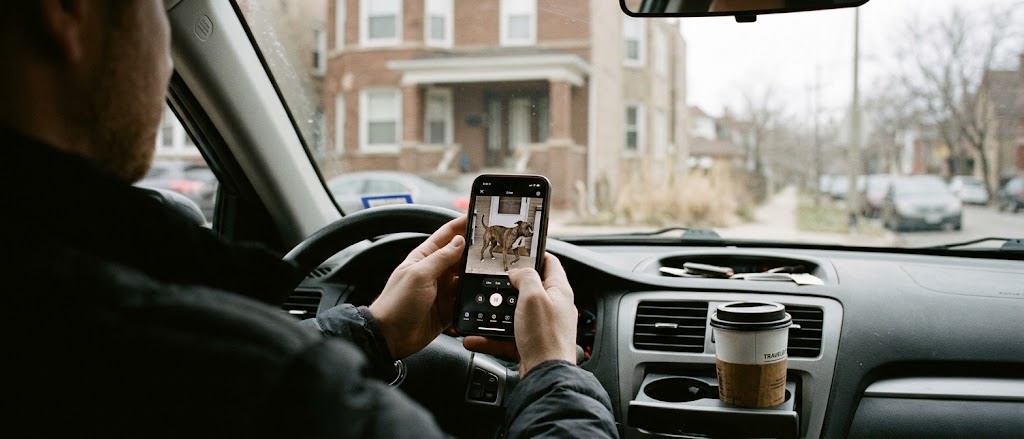
Any old phone or laptop works. Prop it where it can see the door and your dog's favorite spot, then start a video call to a second device or just hit record.
Leave the way you always do: shoes, keys, coat, door. Drive around the block if your dog knows the sound of your car. Watch at least the first 30 minutes.
Here's what to look for:
What happens before the door closes. Pacing, panting or following you means the worry starts with your routine.
How fast it starts.
Where the action is. Doors, windows and crate bars point to panic or confinement stress, while random stuff around the house points to boredom.
Whether he eats. A relaxed dog works on a stuffed food toy, and a panicking dog walks right past it.
Whether it winds down. Some dogs fuss for 2 minutes and then settle, and that's fine.
What sets off barking. If it starts with the mail truck, you're looking at noise reactivity, which needs its own fix.
His face and body. Drool, wide eyes, a tucked tail and lip licks mean real stress, even in a quiet dog.
Distress in the first few minutes points to separation anxiety. A dog who naps first and parties later is probably bored. Save the clips, because your vet will want to see them.
The Graduated Alone-Time Plan
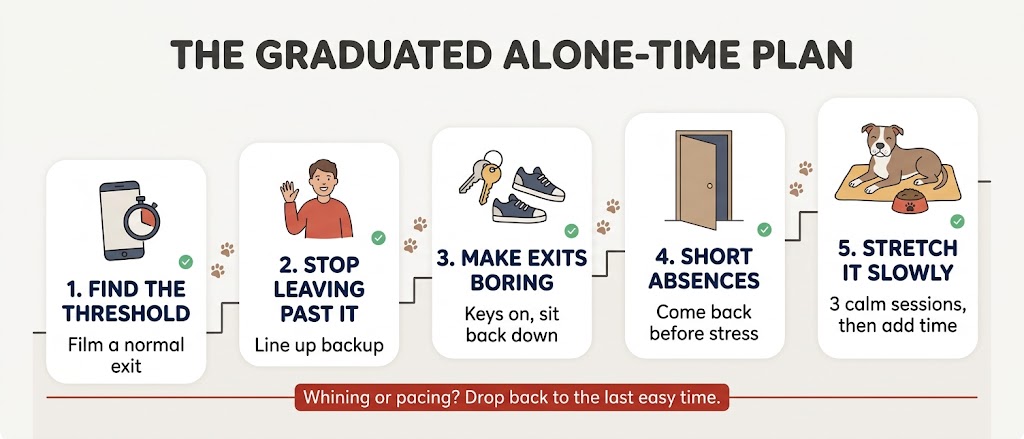
This is the "real training plan" part of the title. It's slow and dull, and it works for a lot of dogs with true separation distress. Plan on weeks to months. I don't make the rules.
Step 1: Find the Threshold
Use your footage. The threshold is how long your dog stays relaxed before the first sign of stress.
For some dogs that's 20 minutes. For some it's 8 seconds. Both are fine places to start, and every session begins below that number.
Step 2: Stop Leaving Past It
This is the hard one. Every full-blown panic undoes some progress, so during training your dog doesn't get left longer than his threshold.
Line up help: a friend, a neighbor, your mom, a sitter. It's a pain for a few months, and it's the step that makes the rest work.
Step 3: Make Exits Boring
Right now your keys, coat and shoes are fire alarms. Defuse them.
Pick up the keys and sit back down. Put on your shoes and fold laundry. Try and do a handful a day until your dog stops caring, and skip the big goodbye speech.
Step 4: Practice Short Absences
Now leave, briefly. Step out, close the door and come back before your dog gets worried, even if that's 5 seconds.
Watch on your phone. If he stays loose, walk back in like nothing happened. 1 session a day, 5 or 6 days a week, is plenty.
Step 5: Stretch It Slowly
Add time in tiny bites: a few seconds early on, a minute or 2 once you're past 10 minutes. Mix in easy reps so it isn't always harder. If yesterday topped out at 4 minutes, today might go 4 and a half, then 2, then 5.
Hold each new time until your dog stays relaxed 3 sessions in a row. If he whines, paces or stares at the door, drop back to the last easy time. Less big jumps and more easy wins gets you there faster.
Keep a simple log of each session. A vet or consultant will ask for it.
| Step | What You Do | Move On When | Back Up If |
|---|---|---|---|
| 1. Find the threshold | Film a normal departure and note when the first stress sign shows up | You know your starting number, even if it's 8 seconds | The footage is unclear. Film 1 more departure |
| 2. Stop leaving past it | Line up friends, family, a sitter or a ride-along so the dog isn't alone longer than the threshold | Real-life absences are covered for the next few weeks | A long absence can't be avoided. Expect a dip and restart at an easier time |
| 3. Make exits boring | Grab keys, put on shoes or touch the doorknob, then sit back down | The dog stays relaxed through the whole getting-ready routine | The dog starts pacing or following. Do fewer cues at a time |
| 4. Practice short absences | Step out, close the door and come back before any stress shows | The dog stays loose for 3 sessions in a row at that time | Whining, pacing or staring at the door. Return to the last easy time |
| 5. Stretch it slowly | Add a few seconds at first, then a minute or 2 past 10 minutes. Mix in shorter, easy reps | Each new time holds for 3 calm sessions | Progress stalls for a few weeks. Call your vet or a certified behavior consultant |
This plan is for true separation distress. Bored dogs need more enrichment, and crate-stressed dogs need a new setup first. Expect weeks to months, not days.
Got a return-to-work date coming? Start tiny exits now, and set the pace with Let Them Be Dog's settling-in plan for the first 2 weeks.
What Makes Separation Anxiety Worse?
Punishing the mess is the big one. You come home to a shredded couch and yell. Now your dog has learned that being alone is scary and your return is scary too.
Bark collars and spray collars might shut the noise off, but they don't touch the panic underneath. And crying it out just gives a panicking dog more practice at panicking.
Then there's the second dog. If your dog panics without you specifically, now you've got 2 dogs and the same problem.
Pheromone diffusers, calming chews and snug wraps help some dogs a little. Research on them is mixed, and none replaces the plan.
When Should You Call a Vet or a Behavior Consultant?
Call your regular vet before any trainer, since accidents can mean a bladder infection and chewing can mean a sore tooth.
Medication isn't failure. 2 drugs, clomipramine and fluoxetine, carry FDA approval for separation anxiety in dogs, and your vet decides if either one fits. Meds don't replace training. They turn the volume down enough for training to stick.
Get pro help fast if your dog gets hurt breaking out, can't handle 5 seconds alone or makes no progress after a few weeks.
A board-certified veterinary behaviorist is a vet with years of extra behavior training, and there aren't many. The ACVB's directory of board-certified veterinary behaviorists lists more than 100 worldwide. Many will consult with your regular vet by phone.
A certified behavior consultant is easier to find. Look for a CDBC from the International Association of Animal Behavior Consultants or a CBCC-KA from the Certification Council for Professional Dog Trainers. The IAABC suggests its certified behavior consultants bring at least 4 years and 500 hours of consulting experience.
Skip anyone who promises a fix in a weekend or reaches for shock, spray or prong collars. And with vet prices climbing faster than inflation, put behavior help in the budget before you need it.
What I've Seen at Adoption Showings
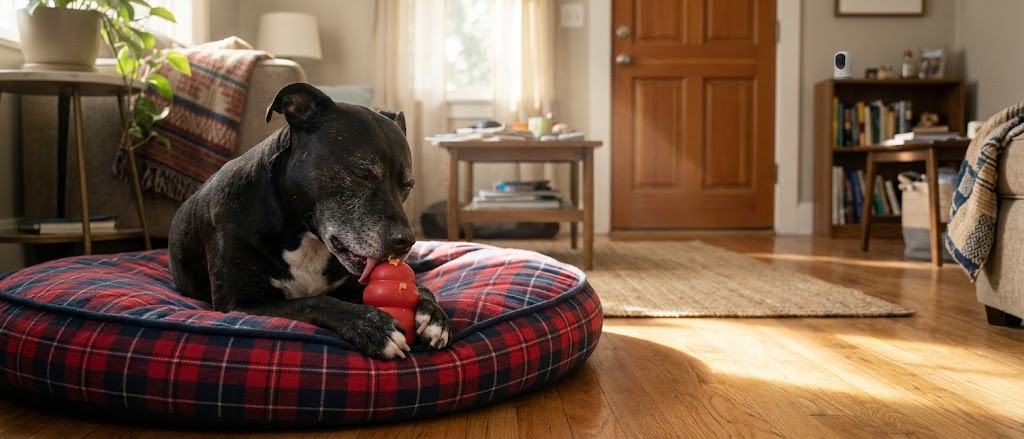
I adopted my first dog, Cooper Wonder, at 39. I've volunteered with Chicago shelter dogs since 2017, first at The Anti-Cruelty Society and now at Chicago Animal Care and Control. These days it's Oscar Wonder, my pibble, and Gary Wonder, our cat.
Dogs from a foster home with a real weekday schedule come with better answers, so ask the foster how the dog handled being left.
Short Exits, Long Game
Rescue dog separation anxiety gets better in seconds and minutes, not overnight. Film first, leave small and find more Let Them Be Dog guides for life after adoption day on the homepage.
Common questions
Will getting a second dog fix separation anxiety?
A second dog rarely fixes separation anxiety in a dog who panics without a specific person. A second dog can help some dogs who mainly dislike an empty house. Fostering a second dog for a few weeks is a safer test than adopting a companion on a hunch.
Does crate training help a rescue dog with separation anxiety?
Crate training helps some rescue dogs with separation anxiety and makes others worse. A dog who relaxes in a crate may feel safer there while alone. A dog who bends bars, drools heavily or gets hurt in a crate needs a gated room instead. Filming a rescue dog in both setups shows which one works.
Can separation anxiety in a rescue dog go away on its own?
Separation anxiety in a rescue dog sometimes eases as the dog settles in, but true panic rarely disappears without training. Mild clinginess in the first weeks often fades with a steady routine. A rescue dog who howls, drools or digs at doors every time the owner leaves needs a graduated alone-time plan and a vet visit.
How long can a rescue dog with separation anxiety be left alone?
A rescue dog with separation anxiety should be left alone only as long as the dog stays relaxed, which is the dog's current threshold. For some dogs the threshold is a few seconds, and for others it is an hour. Friends, family, sitters or bringing the dog along can cover longer absences while training continues.
Does medication help dogs with separation anxiety?
Medication helps many dogs with separation anxiety by lowering stress enough for training to work. Clomipramine and fluoxetine both carry FDA approval for separation anxiety in dogs. A veterinarian decides whether medication fits a specific dog. Medication works best alongside a graduated alone-time plan, not in place of one.
Should you ignore your dog when you leave and come home?
Calm, low-key departures and greetings work best for most dogs with separation anxiety. Long goodbyes and excited hellos can make comings and goings feel like a bigger event. Ignoring a dog completely is unnecessary. A quiet hello once the dog settles down keeps arrivals friendly without adding drama.
About the Author
I’m Jeff Molitor and I adopted my first dog at 39 (Cooper Wonder) and have volunteered with Chicago shelter dogs since 2017, first at The Anti-Cruelty Society and now at Chicago Animal Care and Control. I help with dog handling, agility, adoption showings and support, photography and marketing. I love all dogs, but I gravitate toward momma dogs, seniors, black pibbles and the ones with cropped ears. Basically whoever’s been overlooked the longest. Jeff is dad to Oscar Wonder (pibble) and Gary Wonder (our cat).
This article shares what we have learned from our own experience. It is not medical advice, and we are not veterinarians. If you have any concerns about your dog's health, please check with your vet.