Decompression
How Long Does It Take a Rescue Dog to Adjust? Watch the Dog, Not the Calendar
Published · By Jeff Molitor
A rescue dog usually learns a routine in a few weeks and feels at home in 3 to 6 months. See how long for a rescue dog to adjust, measured by behavior.

The short answer
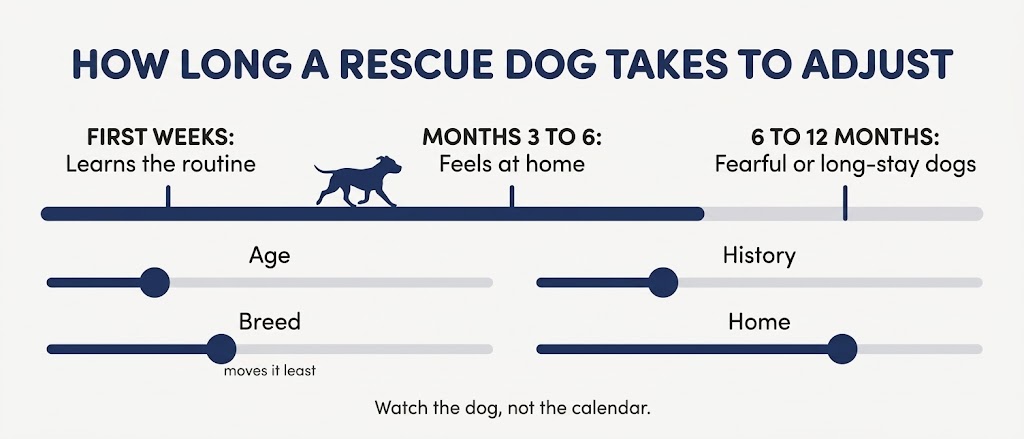
A rescue dog usually takes a few weeks to learn a new home’s routine and about 3 to 6 months to feel fully settled. Fearful, under-socialized or long-stay shelter dogs can need 6 months to a year to adjust. A rescue dog’s behavior is a better measure of adjustment than days on the calendar.
A rescue dog usually settles into a routine within a few weeks and needs about 3 to 6 months to feel fully at home. That’s my honest answer on how long for a rescue dog to adjust, and plenty of good dogs land outside that range.
One dog claims the couch by dinner. Another spends a month convinced the dishwasher is hunting him. Both are normal.
So this Let Them Be Dog guide skips the countdown. Age, history, breed and the home your dog lands in all stretch or shrink the timeline. Behavior is the only honest progress report, so you’ll get a scorecard instead of a calendar.
How Long Does It Take a Rescue Dog to Adjust to a New Home?
Here’s the short version. Then I’ll ruin it with nuance.
Most dogs learn the house rules fast. Within a few weeks your dog knows where breakfast happens and which door means outside. Routine is quick.
Feeling safe takes longer. Sleeping belly-up, relaxing when you walk past the food bowl and shrugging off a delivery driver usually show up somewhere between month 3 and month 6. For a shut-down or under-socialized dog, a full year isn’t weird.
The best data I’ve found comes out of Ohio State. Researchers followed 99 adopters from 5 Ohio shelters and surveyed them at 7, 30, 90 and 180 days after adoption. By the 6-month mark, 100% of the owners who answered said their dog had adjusted extremely or moderately well, according to Ohio State’s write-up of the study.
The catch: behavior kept changing at every check-in. Some things got better and some got louder, which I’ll get to.
If you want the stage-by-stage map, the 3-3-3 rule for rescue dogs walks through it day by day. This post covers why your dog might ignore that map completely.
The Calendar Is a Lousy Progress Report
I like calendars. I just don’t trust them with dogs.
Ask 5 shelter workers how long for a rescue dog to adjust and you’ll get 5 answers. A day count only tells you how long your dog has lived with you. 2 dogs on day 30 can look like different species, and both can be right on track.
The Ohio State team went a step further. In the university’s summary, the researchers said the popular 3 days, 3 weeks and 3 months timeline has no scientific basis.
I wouldn’t toss it, since it’s handy rescue wisdom. It just can’t tell you your dog is “behind.”
Calendars also make adopters panic at the worst moment. Week 3 hits, the dog barks at the mail carrier and somebody starts googling return policies. Meanwhile the dog is finally comfortable enough to have opinions.
So swap the countdown for a short list of behaviors. It’s the same advice I give about the dog you met at the shelter: watch what the dog does, not what the paperwork says.
If your dog comes home this week, start with our quiet-house basics for the first 14 days and let the calendar fend for itself.
How Does a Rescue Dog’s Age Change the Adjustment Timeline?
Age changes what’s hard for a dog, not just how long the hard part lasts.
Puppies Rebound Fast
Most puppies shake off a move in a couple days. They eat, play and crash in a heap by the weekend. The slow part is everything else: potty training, chewing and learning your ankles aren’t a toy. For a puppy, adjusting is mostly growing up.
Teenagers Test Everything
Adolescent dogs, roughly 6 to 18 months old, are the wild card. Plenty of shelter dogs land in this age range, and plenty of them get harder before they get easier. Expect selective hearing, counter surfing and big feelings on leash. That’s development, not a failed adjustment.
Adults Bring Their Habits
Adult dogs come with a history you mostly don’t know. Good habits show up early. Old fears tend to show up later, once the dog relaxes enough to let them out. Grown dogs are also the dogs who wait longest in U.S. shelters, so the patience pays off twice.
Seniors Need Comfort First
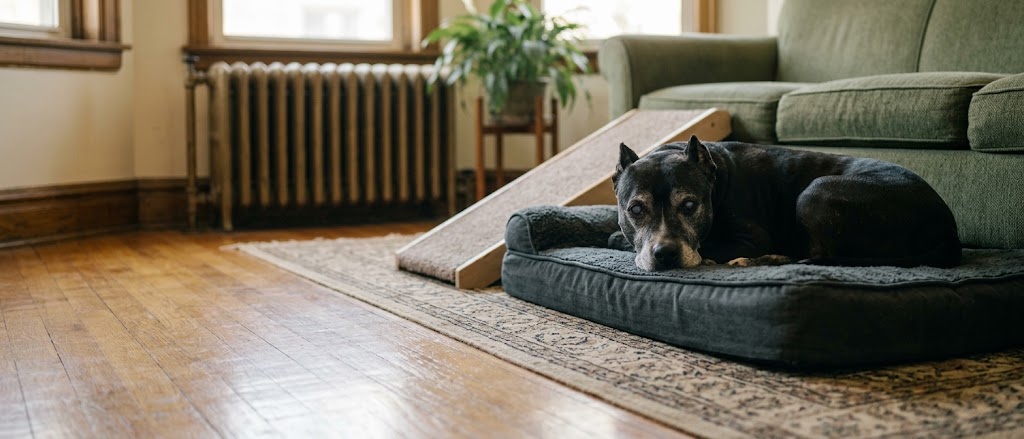
Senior dogs often settle in socially within days. Many have lived in homes, so the TV and the toaster are old news. What slows them down is the body: slick floors, stairs, cloudy eyes or sore hips. Rugs, a ramp and a vet visit in week 1 make a real difference.
How Does a Dog’s History Change How Long Adjustment Takes?
A dog surrendered by a family usually knows house life. Doors, stairs, dishwashers and the sound of a fridge opening are nothing new. These dogs often move fast, since they’re adjusting to new people, not to houses.
A long-time stray is different. A doorbell or a slick kitchen floor might be brand new. Some never learned to hold it indoors, since outside was the whole bathroom.
Then come former puppy mill breeding dogs and dogs pulled from hoarding cases. A study of 1,169 former breeding dogs living in homes found significantly more fear of strangers, other dogs and everyday noises than in typical pet dogs. They also had more house-soiling and compulsive staring. Lead researcher Franklin McMillan summarized the findings for Tufts University’s Collaborative for Shelter Dogs.
Dogs like that can take many months to feel safe in a living room. They aren’t slow. They’re grown adults seeing a couch for the first time.
Dogs who spent a few weeks in a foster home usually get the easiest start. Somebody already did the house-life homework, and the foster notes tell you exactly where the dog stands.
Does Breed Affect How Fast a Rescue Dog Settles In?
People love to ask whether pit bulls settle in fast or slow. Most of the answers are guesses.
Science has a clearer answer. A 2022 study in the journal Science, led by Elinor Karlsson at UMass Chan Medical School, paired more than 18,000 owner surveys with DNA from more than 2,000 dogs. Breed explained only about 9% of behavior differences between individual dogs, according to UMass Chan’s summary of the study.
Karlsson put it plainly: “A dog’s personality and behavior are shaped by many genes as well as their life experiences.” I’d frame that and hang it over every kennel row in Chicago.
Breed can nudge a few things. Herding types in that study tended to respond to cues more readily, and some traits like howling run in families. But no breed comes with an adjustment schedule stapled to its collar.
That goes double at a shelter, where breed guesses on kennel cards are just that. Your pibble never read the breed profile, and your hound mix didn’t either.
Give your dog something to do while settling in. Our 5-minute training games for brand new dogs build trust without piling on pressure.
How Does Your Home Environment Speed Up or Slow Down Adjustment?
Your home is the 1 factor on this list you actually control. That’s the good news and the homework.
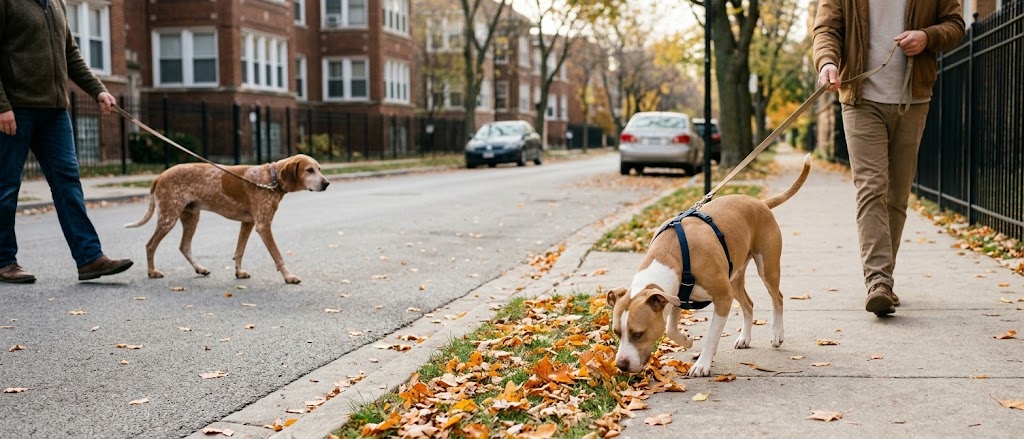
Noise is the big one. A 2-flat near the Blue Line, a neighbor’s TV through the wall and an elevator that dings every 4 minutes all add up. A white noise machine by the front door helps more than you’d think.
People count too. Toddlers, roommates on night shift or a revolving door of guests all give a dog more to process.
Resident pets change the math. A confident, easygoing dog at home can show a nervous newcomer how it’s done. A grumpy resident dog or a cat who hunts ankles can slow everything down, so plan on separate spaces for weeks either way.
Then there’s your schedule, ironically. A dog who gets 2 weeks of you at home and then 10-hour workdays has to adjust twice. Try and practice short absences early, before the real schedule kicks in.
Here’s how the 4 factors stack up side by side.
| Factor | Often Settles Faster | Often Takes Longer | What Helps |
|---|---|---|---|
| Age | Puppies, plus seniors who have lived in homes before | Adolescents around 6 to 18 months and adults with unknown pasts | Potty schedules for puppies, short training games for teens, rugs and an early vet visit for seniors |
| History | Owner surrenders and dogs coming from foster homes | Long-time strays, former puppy mill breeding dogs, hoarding cases and long-stay kennel dogs | Ask for intake and foster notes, and shrink the dog's world to 1 or 2 quiet rooms |
| Breed or type | Breed explains only about 9% of behavior differences between dogs | No breed comes with a set adjustment schedule | Watch the dog in front of you, not the label on the kennel card |
| Noise and space | A quiet house or unit with steady background sound | Busy streets, thin walls, elevators and train noise | White noise by the front door and walks at quiet times of day |
| People and pets | Calm adults and an easygoing resident dog | Toddlers, rotating guests, a grumpy resident dog or a cat who chases | Separate spaces, baby gates and parallel walks |
| Schedule | The same daily routine from day 1 | 2 weeks at home, then long workdays all at once | Short practice absences early, before the real schedule starts |
Every factor stretches or shrinks the timeline. Only the home environment is fully in your hands.
What Should You Track to Measure a Rescue Dog’s Progress?
A rescue dog adjusts in tiny, easy-to-miss steps. Eating the whole bowl in 5 minutes instead of 45. Sleeping with 1 ear down instead of 2 up. Laying flat out on the kitchen tile instead of curled in a tight ball.
None of that shows up on a calendar. Check 8 behaviors once a week and watch the trend, not the day. Bad days still happen in month 4.
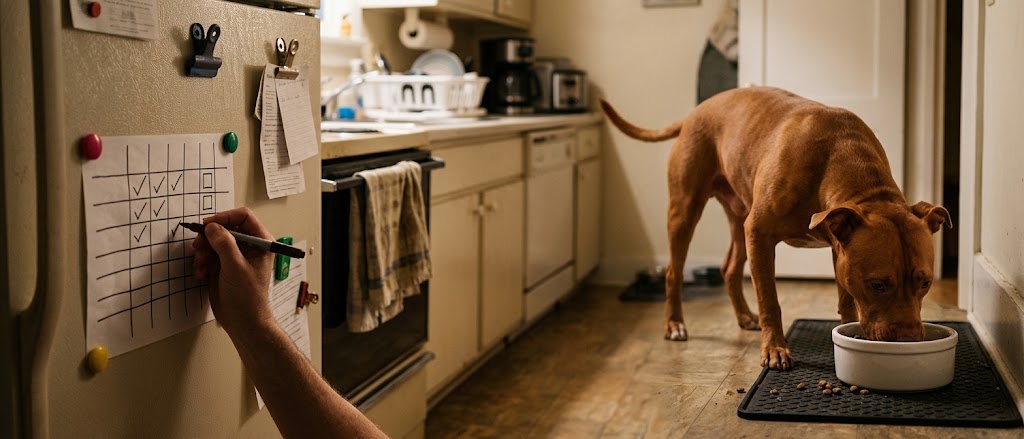
Appetite is usually the first thing to move, and appetite tends to come back in stages. A steady mealtime routine makes that progress easy to spot, since it’s the same bowl at the same time every day.
Here’s the scorecard I’d use.
| Behavior | Not Yet (0) | Sometimes (1) | Most Days (2) |
|---|---|---|---|
| Eating | Skips meals or needs coaxing | Eats most meals, slowly | Finishes meals without coaxing |
| Sleep | Naps with head up and wakes at every sound | Dozes deeply in a safe spot | Sprawls out or sleeps belly-up near people |
| Startle recovery | Hides or freezes for a long time after a noise | Recovers after a few minutes | Shakes it off within seconds |
| Choosing people | Stays across the room | Comes over for treats | Follows you and picks a spot nearby |
| Play | No interest in toys or games | Short bursts of play | Play bows, zoomies or toys dropped at your feet |
| Exploring | Sticks to 1 room or hiding spot | Explores with you nearby | Moves around the home freely |
| Walks | Freezes, pulls toward home or startles often | Sniffs some but jumps at big noises | Loose, sniffy and checks in with you |
| Alone time | Panics, cries or chews at doors | Whines briefly, then settles | Rests or naps while you're out |
Score once a week, out of 16. A total that climbs over a few weeks means your dog is adjusting, even with bad days in between.
And here’s how to score it without turning into a lab tech.
1. Pick 1 night a week, like Sunday, and score it then.
2. Give each behavior a 0 for not yet, a 1 for sometimes or a 2 for most days.
3. Add up the total and write 1 sentence about the best moment of the week.
4. Compare this week to last week only, never to some dog on Instagram.
5. Call your vet or a certified trainer if the total stalls or drops for a few weeks in a row.
Watch recovery hardest. Every dog startles, and a dog who shakes it off faster each week is adjusting, even if he still hates the garbage truck.
Why Do Some Rescue Dogs Seem to Get Worse After a Few Weeks?
This part freaks people out. Your dog was an angel for 3 weeks, and now he barks at your brother-in-law.
The Ohio State study saw it too. Owners reported increases in stranger-directed aggression, chasing and training difficulty at every check-in. Excitability and touch sensitivity were up at day 90 and stayed up at day 180.
In numbers, stranger-directed aggression went from 62% of dogs at adoption to 77% at 6 months, per the study release on EurekAlert. That survey category covers growling, snapping or biting at unfamiliar people, so it spans mild and serious cases.
Some things got better. Separation-related behaviors and clingy attention-seeking dropped by 6 months. About 75% of owners felt their dog’s behavior had improved, and 93.7% rated it excellent or good.
My read, as a volunteer and not a scientist: a stressed dog keeps his head down. A comfortable dog starts guarding the front window. Comfort comes first, then opinions, and opinions are trainable.
Still, don’t ignore it. A dog who growls at visitors needs space, management and a reward-based trainer, not a lecture. The early weeks are also when so many shelter returns happen, and a plan beats a panic.
New opinions around month 2 are normal. Burn them off with our sniff and puzzle games for a dog who’s finally relaxed, since a tired brain argues less.
Can You Speed Up a Rescue Dog’s Adjustment?
You can’t rush a rescue dog. You can stop slowing him down, and that’s most of the job.
Start with a quiet house. A 2-week decompression plan keeps guests, outings and handling low while your dog’s stress drains. Pair it with a calm first night and the gear on our pickup day shopping list, which keeps a nervous dog from bolting.
Keep the routine boring: same wake-up, same meals, same walk route. Predictable days give an anxious dog less to worry about.
Skip the shortcuts. Dog parks in week 1, surprise hugs and a welcome party feel like progress to people. To a new dog they’re homework.
And book a vet visit early. Pain from bad teeth, an ear infection or sore hips can look exactly like a dog who won’t settle. Fix the ouch and adjustment often speeds up.
Put the Calendar in a Drawer
Your dog’s pace is the right pace. Find more guides for the first months with a rescue dog on the Let Them Be Dog homepage, then go score this week’s wins.
Common questions
Do older rescue dogs take longer to adjust than younger dogs?
Older rescue dogs often warm up to new people faster than younger dogs but can take longer to learn a new layout. Many senior dogs have lived in homes before, so household sounds feel familiar. Stiff joints or weaker eyesight can make stairs and slick floors harder for a senior dog. A vet check in the first weeks helps rule out pain.
How long does it take a rescue dog to bond with a new owner?
Bonding between a rescue dog and a new owner often starts within the first few weeks and keeps deepening for several months. Early signs of a bond include following the owner from room to room and choosing to rest nearby. Hand feeding, short training games and a predictable routine help a rescue dog connect faster.
How long does it take a rescue dog to get along with a resident dog?
A rescue dog and a resident dog often need several weeks to a few months to settle into an easy relationship. Separate feeding spots, separate rest areas and short supervised time together lower tension early on. Parallel walks help 2 dogs get used to each other without pressure. Growling over food, toys or beds means the dogs need more space and a trainer's input.
How long does it take a rescue dog to learn a new name?
A rescue dog can learn a new name in a few days to a couple of weeks with short, upbeat practice. Saying the new name once and rewarding the dog for looking up teaches the name fastest. Using the new name only for good things, like meals and treats, keeps the name from turning into background noise.
Can a rescue dog adjust to apartment life?
Rescue dogs can adjust to apartment life, though hallway noise, elevators and close neighbors often stretch the settling period. A white noise machine near the door muffles footsteps and slamming doors. Quiet walk times, like early morning, help a nervous dog get used to the building. Many big rescue dogs, including pit bull mixes, live happily in apartments once a routine sets in.
How long should you give a rescue dog before deciding the match isn't working?
Adopters should usually give a rescue dog at least several weeks, plus help from the shelter or a trainer, before deciding a match isn't working. Many shelters offer post-adoption support for behavior questions. Bites or serious fights with a resident pet call for professional help right away. Calling the shelter before a return gives the dog a better shot at the next home.
About the Author
I’m Jeff Molitor and I adopted my first dog at 39 (Cooper Wonder) and have volunteered with Chicago shelter dogs since 2017, first at The Anti-Cruelty Society and now at Chicago Animal Care and Control. I help with dog handling, agility, adoption showings and support, photography and marketing. I love all dogs, but I gravitate toward momma dogs, seniors, black pibbles and the ones with cropped ears. Basically whoever’s been overlooked the longest. Jeff is dad to Oscar Wonder (pibble) and Gary Wonder (our cat).
This article shares what we have learned from our own experience. It is not medical advice, and we are not veterinarians. If you have any concerns about your dog's health, please check with your vet.