Dog Body Language
Dog Paw Facts: What Your New Dog's Paws Say About Stress, Comfort and Health
Published · By Jeff Molitor
Dog paw facts every adopter should know: sweaty paw prints signal stress, a lifted paw shows doubt and long nails change how a dog walks.
The short answer
A dog's paws can show stress through sweaty prints, doubt through a lifted front paw and discomfort through licking or limping. Paw signals make the most sense when read alongside the ears, tail, mouth and posture. New paw habits, like constant licking or slipping, deserve a closer look and sometimes a vet visit.
A dog's paws report stress, comfort and health as clearly as a tail or a face, if you know where to look. These dog paw facts come from Let Them Be Dog and from my years of walking shelter dogs in Chicago. New adopters get told to watch ears, eyes and tails. Fair enough.
But the floor keeps notes too: sweaty prints, a hovering front foot, nails that click like an old typewriter. Most of us never check the feet until one of them hurts. So this is the guide to checking the floor early, before a small paw signal turns into a big vet bill.
What Can a Dog's Paws Tell You About How the Dog Is Feeling?
Here's the short version. Paws send signals in 4 ways: moisture, position, touch tolerance and wear.
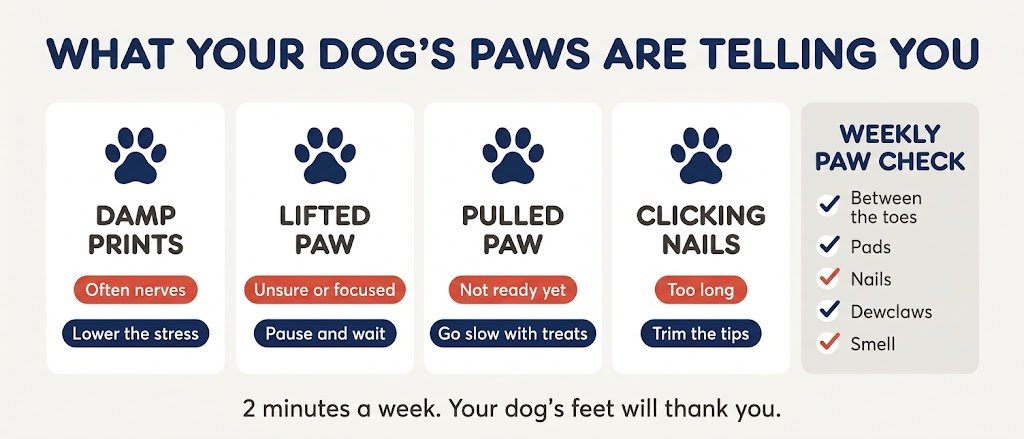
Damp prints usually mean nerves. A lifted foot means "hang on, I'm thinking." Yanking a paw out of your hand means "not yet." And nails, pads and gait show how the whole body feels about walking.
None of these mean much alone, since a dog can lift a paw over a squirrel or lick his feet after stepping in something gross. I read paws first, then I check the rest of the dog.
The Humane Society of Huron Valley in Ann Arbor lists sweaty feet among its fear and stress signs in an animal handling sheet on dog body language. It describes a dog who "leaves paw prints that evaporate quickly." The same sheet puts a paw lift on its list of calming signals.
Pinned ears plus damp prints is a worried dog. A loose body plus a lifted paw near the treat jar is a dog running a con.
For the rest of the picture, learn the ear, tail and mouth signals that go with it.
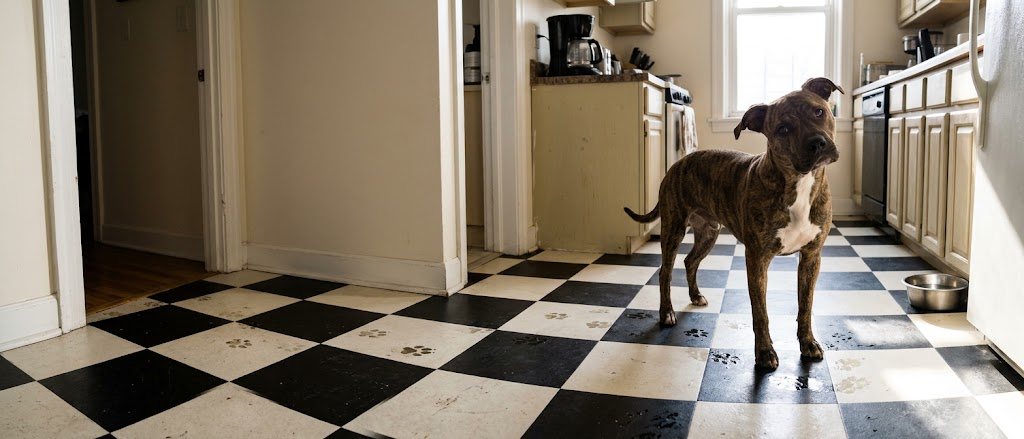
Why Does My New Dog Leave Sweaty Paw Prints?
Here's the dog paw fact that surprises most adopters: dogs do sweat, just not where you'd guess.
The pads hold a dog's main sweat glands, and they switch on when a jolt of adrenaline hits. Hot days make a little paw sweat too. But most of a dog's cooling happens with an open mouth and a lot of heavy breathing, so wet feet on a cool day point to feelings, not temperature.
Watch the steel exam table at the vet sometime. A nervous dog leaves 4 little damp ovals on it, and they vanish in seconds.
At home, check the kitchen tile in week 1, or the bathroom floor after a car ride. Those prints are a mood log nobody has to write.
The fix isn't drying the floor. It's lowering the stress: fewer visitors, quiet days and the same routine every day. Some of it is leftover strain from shelter life, the same stress that makes a good dog look wild in a kennel.
1 caution. If the paws stay damp when your dog is calm and sleepy, or the pads look red and raw, mention it at the next vet visit.
Finding damp prints all over the kitchen this week? Our slow-and-quiet game plan for a dog's first 14 days home cuts the stress behind them.
What Does a Raised Front Paw Mean in Dog Body Language?
The lifted paw is my favorite tell, because you can watch a dog think. 1 front foot floats an inch up, the dog goes still and something gets decided.
Context sorts out what. Picture a new dog meeting your roommate in the hallway. Paw up, ears back, eyes sliding sideways, a quick lick of the lips. That's "I'm not sure about you," and it's a pretty polite way to say it.
Now picture the same dog at the back door with a tennis ball in sight. Paw up, ears forward, weight leaning in, mouth shut tight with focus. That's a countdown to launch. Plenty of pit mixes pull this move at the treat drawer, too.
When the paw lifts in a tense moment, I stop moving toward the dog. I turn a little sideways, look away and let the dog pick the next step. Pushing in while the paw is up tends to turn "unsure" into "leaving."
A paw that stays up while walking is a limp, not a mood. Check for a splinter, a cut pad or a nail torn near the base, and call the vet if your dog won't put weight on it.
Why Won't My Rescue Dog Let Me Touch His Paws?
Think about what a paw means to a dog. It's how he leaves. Grab one, and you've taken his exit.
Paws are sensors, too, reading texture, temperature and pressure all day. Squeeze one and you're pressing on the dog's best source of news about the ground.
Then add history: rough nail trims, old injuries or a stray life with no handling at all. Pulling back is a sensible answer to every one of those.
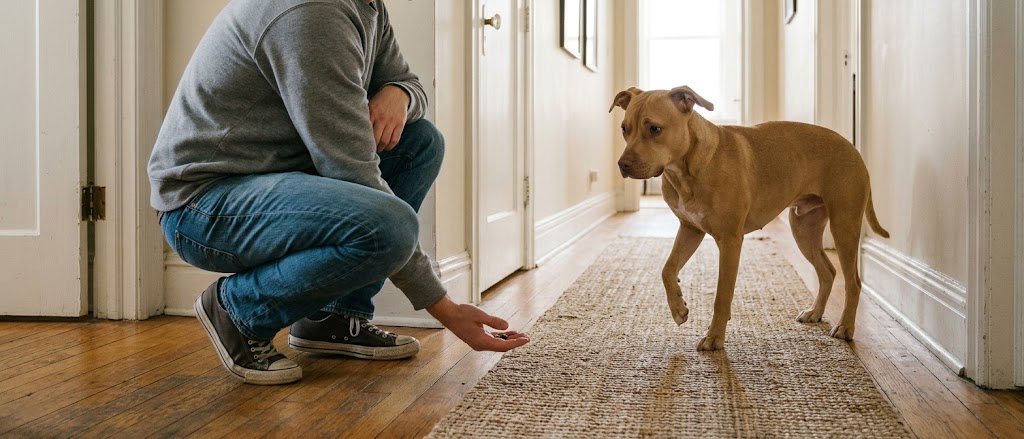
So don't take it personally, and don't win the tug-of-war. Respect the hands-off rules for weeks 1 and 2. Then start tiny.
Touch a shoulder, then give a treat. A few days later, slide your hand to the elbow and treat. Then the wrist. Then 1 second on top of the foot, paid with a treat that's way too good for 1 second of work.
Stop before your dog pulls away, not after. Lots of dogs need a couple weeks to let you hold a paw. Some take months, and both are normal.
If your dog growls, stiffens or freezes when you reach for a foot, stop right there. Call a reward-based trainer. That's information, not attitude.
Want a dog who offers you a paw instead of hiding it? Try our treat-and-touch games for nervous dogs a few minutes a day.
What Do Long Nails Do to the Way a Dog Walks?
You can hear this one before you see it. Click, click, click across the kitchen. That's a dog walking on his nails instead of his pads.
Pads are the grippy part, the dog's built-in sneaker tread. When nails get long, they reach the floor first and lift the pads off it. Now the dog is walking on hard nail over hardwood, which works about as well as dress shoes on ice.
Kellyn McNulty, DVM, of the Dog Aging Project, says keeping nails short is essential for a dog to use the pads for traction. She explains it in the project's guide to mobility tips for senior dogs. Grip matters even more for older dogs who already move a little slower.
Long nails change posture too. The toes get pushed up and spread apart, so the foot lands different than it should. Some dogs start skipping the slick rooms. Others just look stiff, and everybody blames age.
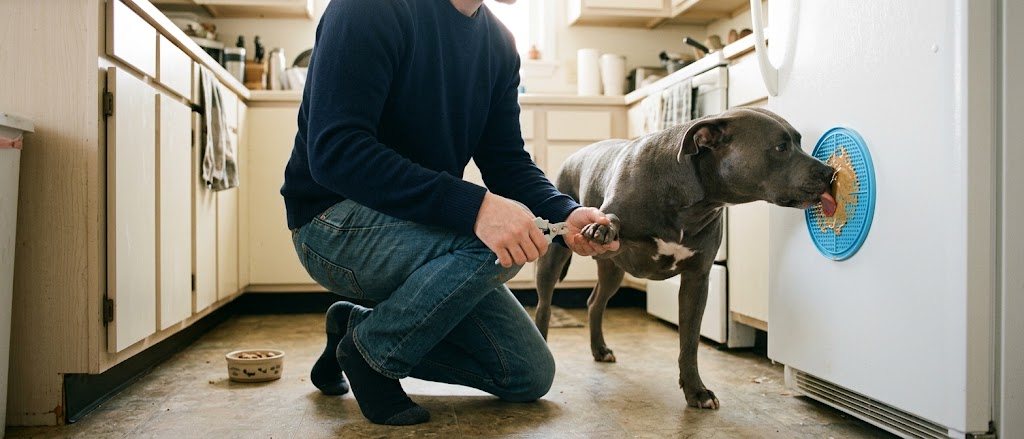
Shelter dogs often arrive with long nails, since a trim is a lot of handling for a stressed dog. Don't fix it all in 1 session.
McNulty's guide says overgrown nails need small trims, just the tip, every 1 to 2 weeks for several months. That keeps you from cutting the quick, the blood vessel and nerve inside the nail. Once the nails are short, a trim every 3 to 4 weeks keeps them there.
Nervous about clippers? A groomer or vet tech can do it while you hand out treats. Plan for it, since that's part of what nail trims and grooming add to the monthly dog budget.
Dog Paw Facts That Sound Made Up
Some of the best dog paw facts belong in a nature documentary.
A Built-In Heat Exchanger
In 2011, Hiroyoshi Ninomiya and his team at Yamazaki Gakuen University in Tokyo examined the blood vessels in 16 legs from 4 dogs. They found veins wrapped tightly around the arteries feeding the pads. Warm blood heading down heats the chilled blood heading back up, so the paw holds a steadier temperature.
Science News Explores has a plain-English write-up of the dog paw study. Penguins use the same setup in their feet, which is a fun thing to say at a dog park.
It's why a dog can stand on a frozen sidewalk longer than you could barefoot, but it doesn't make paws winter-proof.
Dewclaws Still Pull Weight
That claw up the inside of the front leg isn't decoration. Christine Zink, DVM, PhD, a canine sports medicine specialist, points out that front dewclaws have tendons attached, so muscles move them. In her view, they touch down when a dog runs hard and help steady the leg on sharp turns.
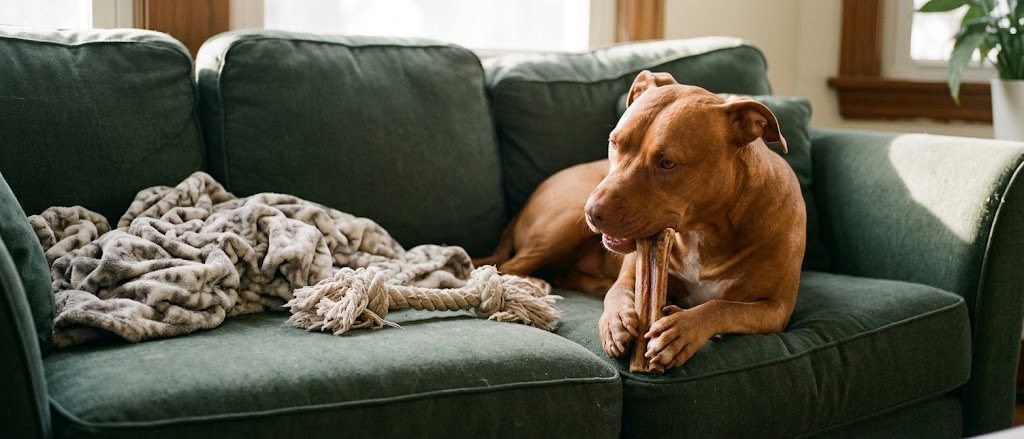
Watch a dog pin a chew between both front feet and you'll see the dewclaw doing grip work, too. Since dewclaws skip the floor on normal walks, they never wear down, so check them at every trim for curling or snags.
Scent Glands Between Toes
Dogs have scent and sweat glands in the pads and between the toes. That big backward kick after pooping isn't an attempt to bury anything. Your dog is spreading his smell and leaving a visible scrape for whoever sniffs by next.
A 2020 study in Scientific Reports backs up the smell part. Kari McClanahan and Frank Rosell of the University of South-Eastern Norway swabbed the paws of 96 dogs and let 48 other dogs sniff the samples. The sniffers reacted more strongly to paw scent from dogs of their own sex than to a plain ground swab.
So let the kick happen. Step out of the dirt spray and give him 5 seconds. It's basically his group chat.
Paws spread a dog's smell everywhere, so give his nose a job too. Our scatter-feeding ideas that put a dog's nose to work tire out a busy dog fast.
Licking Usually Means Itching
A little paw licking after a walk is grooming. Constant licking, chewing or rust-colored fur between the toes is something else. Vets look for allergies, an injury or pain first, since those are far more common than boredom.
Licking just 1 paw points to a problem in that foot, like a splinter, a cut or a sore nail. Stress licking happens too, but call it stress only after the vet rules out the itch.
What Should You Check on Your Dog's Paws Each Week?
Here's my 2-minute routine. Grab a handful of treats and good light, and do it after a walk, when your dog is tired and the treats feel like a bonus.
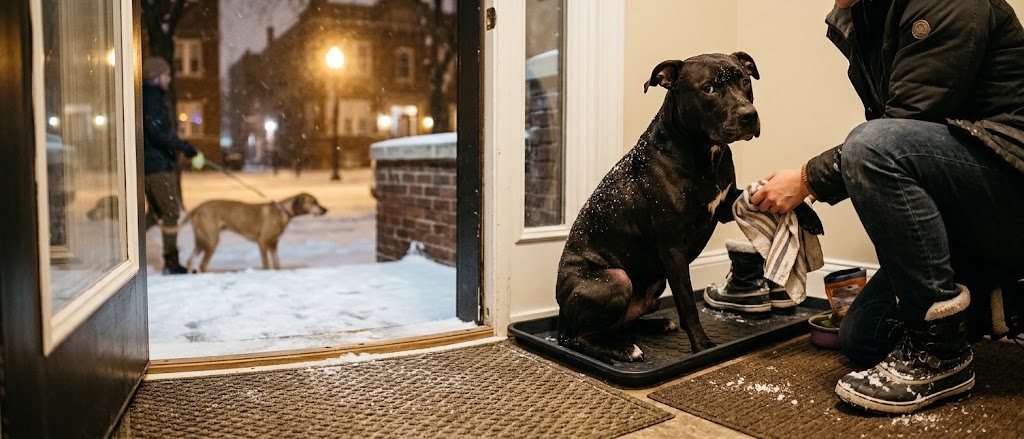
Chicago winters add a layer. Sidewalk salt and ice melt can irritate paws, and licking it off can upset a dog's stomach and mouth. Calico Schmidt, a clinical instructor, explains it on the University of Wisconsin School of Veterinary Medicine's winter hazards page. The page also says to wipe the feet, legs and belly after walks and check the pads for cracks, bleeding or ice.
UW veterinarian Sandi Sawchuk adds that dogs can get frostbite quickly even with padded feet. The heat exchanger buys time, not immunity.
- Spread the toes and look between them for burrs, salt crust, redness or a swollen bump.
- Run your thumb over each pad. Feel for cracks, cuts, blisters or a spot that makes your dog flinch.
- Look at the nails while your dog stands. If the tips touch the floor, it's trim time.
- Check both dewclaws for curling or splits.
- Sniff the feet. A light corn chip smell is normal, but a sour or rotten one means a vet visit.
- Watch your dog walk across the room. Note any limping, slipping or a paw held up.
- In winter, wipe off salt with a damp towel and dry between the toes.
Pay for every step with a treat, and quit early if your dog tenses up. Clippers sit on the can-wait side of the pickup day shopping list for a reason.
The UW vets suggest boots for short-haired, slender and older dogs who'll tolerate them. Expect the first walk in boots to look like a horse doing ballet.
| What You See | What It Often Means | What to Do |
|---|---|---|
| Damp paw prints on a hard floor | Nerves or fear, common in week 1 and at the vet | Lower the stress with quiet days and a steady routine |
| 1 front paw lifted while the dog freezes or looks away | Uncertainty about a person, place or sound | Stop, turn sideways and let the dog choose the next step |
| 1 front paw lifted while staring at a ball or squirrel | Focus and a countdown to move | Nothing to fix, just hold the leash |
| Pulling a paw away from your hand | Paw handling doesn't feel safe yet | Short touches paired with treats over several weeks |
| Licking or chewing 1 paw | Something stuck, a cut or a sore nail in that foot | Check between the toes and call the vet if it keeps up |
| Licking all 4 paws, rust-colored fur between toes | Itchy skin, most often allergies | Vet visit before calling it a behavior problem |
| Nails clicking on the floor | Nails long enough to touch down first | Trim just the tips every 1 to 2 weeks until short |
| Slipping on hardwood or tile | Long nails or hairy paws cutting traction | Trim nails and add rugs with grip backing |
| Big backward kick after pooping | Scent marking with glands in the feet | Give the dog 5 seconds and step out of the spray |
| Limping or licking after a winter walk | Salt burn, a cracked pad or an ice ball | Wipe and dry the paws and check each pad |
Paw Care After Pickup
Kennel cards never list dog paw facts like nail length or damp prints. The labels on a kennel card cover a dog's social life, so the paws are your job after pickup. Be patient, since trust in your hands builds on the dog's own timeline.
Start at the Floor
Your dog's paws have been filing reports since day 1, and these dog paw facts only help if you look. Next time you're on the floor together, take 2 minutes and read them. Then dig into the Let Them Be Dog guides for life with a newly adopted dog.
Common questions
Why do a dog's paws smell like corn chips?
A corn chip smell on a dog's paws is normal for most healthy dogs and comes from bacteria and yeast living on the skin. A strong sour or rotten odor is different, especially with redness, licking or discharge. A vet should check paws that smell bad and look irritated.
How often should you trim a rescue dog's nails?
Nail trims for a rescue dog usually happen every 3 to 4 weeks once the nails reach a healthy length. Overgrown nails need smaller trims every 1 to 2 weeks for several months, according to Dog Aging Project veterinarian Kellyn McNulty. Short sessions with treats work better than 1 long struggle.
Should a dog wear boots in winter?
Dog boots in winter help protect paws from ice, cold and sidewalk salt, especially for short-haired, slender and senior dogs. University of Wisconsin veterinarians suggest boots for dogs who will tolerate them. Dogs who refuse boots still need a paw wipe after every walk on salted sidewalks.
Why does my dog put his paw on me?
A dog puts a paw on a person most often to ask for attention, food, play or comfort. Pawing works because people usually respond, so the habit grows fast. A paw on the arm during a stressful moment can also be a request for reassurance. Asking for a sit and rewarding calm behavior gives a pushy pawer a better way to ask.
Can dogs get frostbite on their paws?
Frostbite can affect a dog's paws, ears and tail during long exposure to freezing temperatures. Pale, gray or hard skin that turns red and swollen as it warms is a common warning sign. A heat exchange system in the paws helps dogs handle cold ground for a while but does not prevent frostbite. A vet should see any dog with suspected frostbite.
Why does my dog lick his paws at night?
Paw licking at night often points to itchy skin from allergies, though boredom, stress or pain can play a part. Quiet bedtime hours give a dog nothing else to focus on, so the itch gets more attention. Red skin, rust-colored fur or a smell between the toes suggests allergies or infection. A vet visit should come before treating paw licking as a behavior problem.
About the Author
I’m Jeff Molitor and I adopted my first dog at 39 (Cooper Wonder) and have volunteered with Chicago shelter dogs since 2017, first at The Anti-Cruelty Society and now at Chicago Animal Care and Control. I help with dog handling, agility, adoption showings and support, photography and marketing. I love all dogs, but I gravitate toward momma dogs, seniors, black pibbles and the ones with cropped ears. Basically whoever’s been overlooked the longest. Jeff is dad to Oscar Wonder (pibble) and Gary Wonder (our cat).
This article shares what we have learned from our own experience. It is not medical advice, and we are not veterinarians. If you have any concerns about your dog's health, please check with your vet.