Behind the Shelter
The Power of Fostering a Dog: What Several Weeks on Your Couch Does for a Shelter Dog
Published · By Jeff Molitor
Fostering a dog opens a kennel, lowers stress and makes adoption far more likely. Here's what the research shows and how to start, even for an afternoon.

The short answer
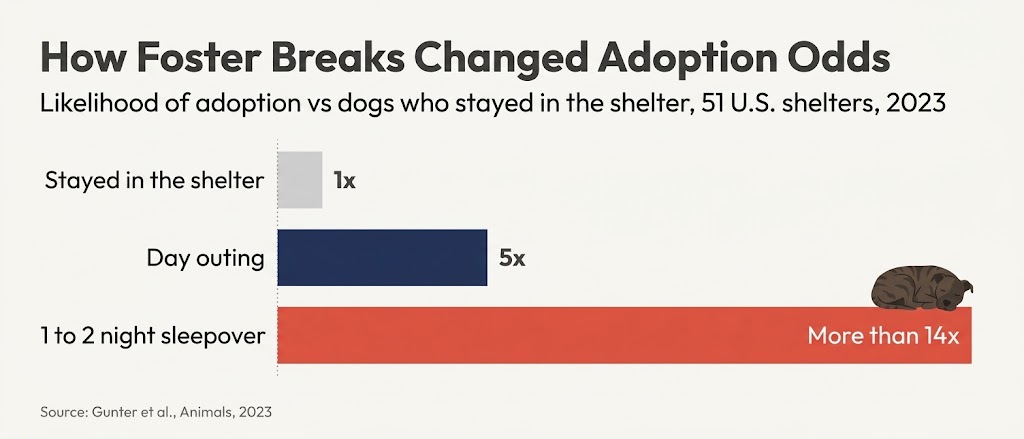
The benefits of fostering a shelter dog include an open kennel, lower stress for the dog and better odds of adoption. A 2023 study of 51 U.S. shelters found 1 to 2 night foster sleepovers made adoption more than 14 times as likely. Fostering a dog also gives adopters honest notes about how the dog acts inside a real home.
Fostering a dog is 1 of the most direct ways to save a shelter dog's life, and it's a lot more than a nice gesture. The benefits of fostering a dog start the minute a kennel opens and keep going until adoption day.
I've volunteered with Chicago shelter dogs since 2017. For years I thought fosters were just the nice people with spare couch space. Then I watched what a few weeks away from the kennel did to dogs I'd walked for months.
So this Let Them Be Dog post makes the full case. Your couch is a lifesaving tool. It just happens to have crumbs in it.
What Are the Benefits of Fostering a Shelter Dog?
Fostering gets sold like recycling: good for you, mildly inconvenient, nice to mention at brunch. That undersells it by a mile.
When you foster a dog, 4 things change at once. The shelter gets a kennel back. The dog gets real sleep, maybe for the first time in weeks.
Adopters get a description written by somebody who's watched the dog nap, eat and lose a fight with a squeaky toy. And the dog gets seen out in the world, where people who never planned to visit a shelter fall for him at a coffee shop.
The benefits of fostering a dog show up in the research too. A 2023 study in the journal Animals, led by Lisa Gunter, tracked 1,955 dogs on outings or sleepovers at 51 U.S. shelters. Researchers compared them with 25,946 dogs at the same shelters who stayed put.
Dogs who went on short outings were 5 times as likely to be adopted. Dogs who went on 1 or 2 night sleepovers were more than 14 times as likely. A 14x jump means a whole different future for a dog.
My favorite detail: only about 12% of sleepover dogs were adopted by the person who hosted them. The rest went home with someone who saw them, heard about them or read about them.
Call it rehab, marketing and real estate rolled into 1 dog bed. Babysitting doesn't come close.
How Does Fostering a Dog Open a Kennel at the Shelter?
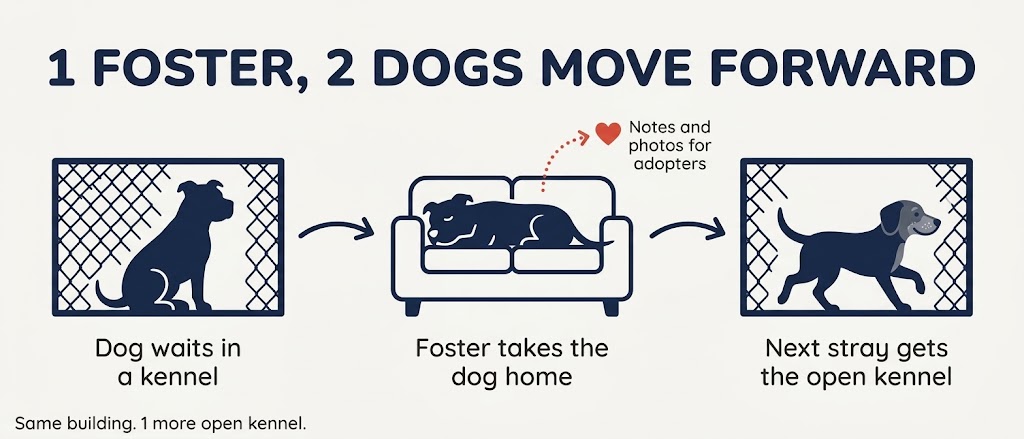
Let's talk real estate. A city shelter has a fixed number of kennels, and dogs don't stop showing up because the building is full.
Chicago Animal Care and Control is open admission. Strays, seized dogs and owner surrenders all come through the door on Western Avenue, ready or not. On a packed week, staff play kennel Tetris with living animals.
A foster home is basically a kennel with a couch and better snacks. When you take a dog home, that run gets cleaned and filled, sometimes within hours. You helped your foster dog and the next dog through the door, who you'll never even meet.
Rescues run on the same math. A rescue can only pull a dog from a crowded city shelter when it has a foster home lined up. No foster, no pull. That's why rescue groups beg for fosters online like it's a Black Friday sale.
It's the same chain behind why every adoption frees a run for the next dog, with a shorter lease. For scale, here's how many adult dogs are waiting in U.S. shelters this year.
Your foster doesn't have to stay long to matter. There's plenty of weeks when 1 open kennel is the whole difference.
Think the dog barking at the gate is "too much" to foster? Read what kennel stress does to a perfectly good dog before you scroll past him.
What Happens to a Shelter Dog's Stress in a Foster Home?
Shelters are loud, and I say that with love. Barking bounces off concrete, gates clang and somebody's always hosing down a run.
Researcher Lisa Gunter put it better than I can. "Trying to sleep in a shelter is like trying to sleep with noisy neighbors," she told Arizona State University's news team in 2019. That same piece notes dogs in homes sleep about 14 hours a day, while shelter dogs get just under 11.
Gunter's earlier work looked at 1 or 2 night sleepovers. Our rundown of a rescue dog's first 3 days, 3 weeks and 3 months covers that study. Short version: cortisol, a stress hormone, dropped during the sleepover and climbed right back after.
So her team tried a longer break. A 2026 weeklong fostering study in PeerJ followed 84 dogs from Pima Animal Care Center in Arizona and the Charlottesville-Albemarle SPCA in Virginia. Each dog spent 5 days in the shelter, 7 days in a foster home and 5 more days back at the shelter.
Cortisol was lower during the foster week than during either shelter stretch. The effect was about twice the size the team saw with 1 or 2 night sleepovers. Dogs also spent more time resting at home, plus more time in big, happy bursts of energy. Zoomies, basically.
More nights means more rest, and a rested dog meets adopters politely instead of pinballing. For the first few days, keep it boring on purpose. Our slow, quiet 2 weeks for a dog fresh out of the kennel works for foster dogs too.
Foster Notes Are the Best Adoption Ad a Dog Will Ever Get
Here's the part of fostering nobody brags about at parties. The notes.
Kennel Cards Tell Half
A kennel card gives you the basics. Age guess, weight, maybe "good with dogs?" with a question mark doing a lot of heavy lifting.
That isn't the shelter's fault. Staff meet dogs in the loudest, weirdest setting a dog will ever live in, so the gate-leaper might be a couch potato in disguise.
Adopters Read Real Life
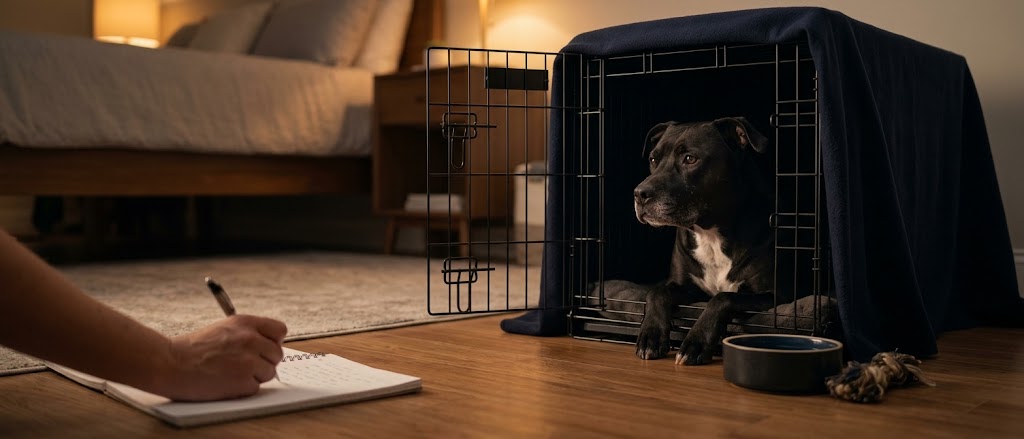
Foster notes fill that gap. "Crate trained, ignores the cat, sleeps until 7." That 1 line sells harder than any adoption photo I've ever taken.
Adopters don't want a dog's life story. They want to know if he'll pee on the rug, if he's fine alone during a workday and if he loses it at the mail carrier. A foster can answer all of that, because a foster lived it.
Couch Photos Win
A dog laying on a throw blanket, snoring, looks like a pet. A dog behind chain link looks like a problem, even when he isn't. Send the shelter your best couch photos and post them everywhere.
Most sleepover dogs in that 2023 study got adopted by someone other than the foster. Your notes and photos are how that someone finds him.
Here's what I'd track in a notes app during a foster stay.
| What to Track | What to Watch For | Sample Note |
|---|---|---|
| Sleep | Where the dog sleeps, how long and what time the dog wakes up | Sleeps in his crate with the door open until 7 |
| House training | Accidents, how the dog asks to go out and how long the dog can wait | No accidents since day 3. Stands by the back door to go out |
| Alone time | Crying, chewing or pacing when left alone for a short stretch | Napped the whole 3 hours I was at work |
| Other animals | Reactions to resident pets and to dogs passing on walks | Ignores my cat. Pulls toward other dogs, then sits for a treat |
| People | Greetings with visitors, kids and anyone in a hat or uniform | Wiggly with guests, settles on her bed in about 5 minutes |
| Leash and car | Pulling, stopping, car rides and any fear of traffic or noise | Loose leash after the first block. Sleeps in the car |
| Quirks | The funny, specific stuff an adopter will remember | Afraid of the dishwasher. Brings 1 shoe to the door every morning |
Write notes the same day, and send them to the shelter or rescue with 2 or 3 couch photos.
Saying yes to a foster dog this month? Grab our short shopping list for a dog's first week under your roof, then ask the rescue what they'll loan you.
Is Fostering a Dog a Good Way to See If You're Ready to Adopt?
Some of you are standing at the edge of the pool. You want a dog. You just aren't sure your life is ready for 1.
Fostering is the test drive. You learn what a 6 AM potty break feels like in a Chicago February. You learn whether your landlord meant it about the weight limit. And you find out if your cat is chill or quietly plotting.
If it doesn't work out, the dog goes back with great notes and you go back to sleeping in. Nobody failed, and the dog is easier to adopt now.
If it does work out, rescue people call that a "foster fail." Worst name ever. It's the best kind of failing there is.
Foster-to-adopt programs make that path official. You take the dog home as a foster, live together for a trial stretch and then sign adoption papers if it clicks. Rules and timelines vary a lot by group, so ask the coordinator before day 1.
1 tip from the adoption floor: be honest up front. If you secretly want to adopt, tell the rescue so they can match you with a dog who could stay. Me and every adoption counselor I know would take that honesty over a surprise.
What Are Short-Term Foster Options Like Sleepovers and Day Trips?
Not everybody can take a dog for weeks. Small apartment, heavy travel, a roommate who's "not a dog person." We'll pray for them. You can still get a dog out of the kennel for an afternoon.
At Chicago Animal Care and Control, it's called Doggie Day Out. Under CACC's Doggie Day Out program rules, approved adults 18 and older can take a long-stay dog out for up to 4 hours. The dog has to have been at the shelter more than 30 days. Outings run Tuesday through Thursday, checking out after noon and back by 4 PM.
To book one, email CACCFoster@cityofchicago.org at least 48 hours ahead. The rules are specific: no dog parks, no retractable leashes and no human food, except a Starbucks Puppuccino. I didn't write them, I just respect them.
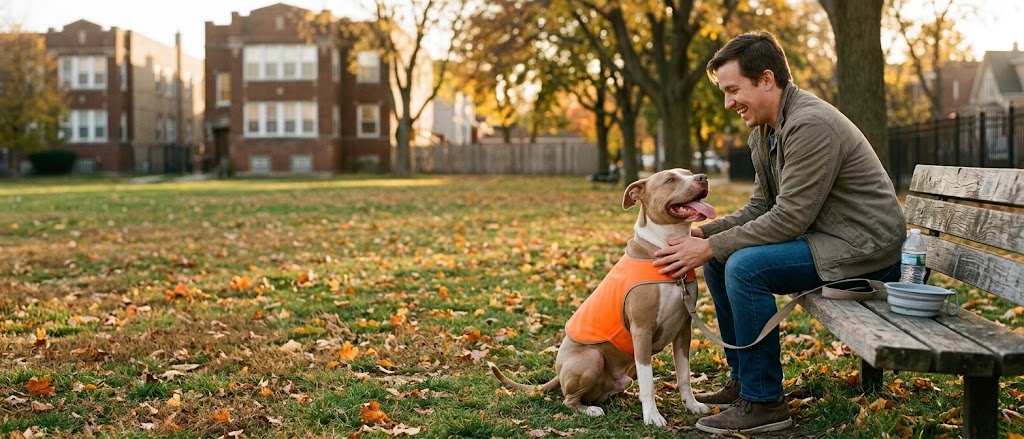
A day trip doesn't need an itinerary. A long sniffy walk, a nap on your floor and a pup cup is a dream afternoon for a dog who's lived in a run for a month. Try a few sniff-first games for a dog on a day pass and let him set the pace.
Sleepovers go 1 step further: 1 or 2 nights in your home, then back to the shelter with notes and photos. That's the setup that made adoption more than 14 times as likely in the 2023 study. Ask your local shelter or rescue if they run 1.
Here's what the first night under your roof usually looks like, 2 AM potty trip included.
| Foster Option | Time It Takes | Best For | What the Dog Gets |
|---|---|---|---|
| Day trip or outing | A few hours. CACC's Doggie Day Out runs up to 4 hours | Busy schedules, small apartments and first-timers | A break from the kennel, new people and fresh photos |
| Sleepover | 1 or 2 nights | Weekend helpers who want to try a dog at home | Real sleep, lower stress and notes from inside a home |
| Short-term foster | A few weeks, set by the program | People with flexible months and a little patience | Time to decompress and show a settled personality |
| Foster until adopted | Until the dog gets adopted | Steady households ready to show the dog at events | A home base, full notes and a steady advocate |
| Foster-to-adopt | A trial period, then adoption if it fits | Future adopters who want a test drive first | A real shot at a forever home with the foster family |
Program names, lengths and rules vary. Ask your shelter or rescue's foster coordinator what they offer.
What Should You Look for in a Dog Foster Program?
Not every foster program works the same way. Some rescues hand you a dog, a bag of food and a phone number. Others walk you through every step from pickup to adoption day.
Neither is wrong. But you deserve to know what you're signing up for before a 60-pound pibble is in your back seat, staring at you like you're his new mom.
Housing rules count here too. Breed and weight limits apply to foster dogs, and our look at landlord breed bans and rising dog costs explains how those rules keep so many dogs in kennels.
Here's what I'd ask, roughly in the order I'd ask it.
- Who pays for vet care, and which clinic do I use?
- Do you supply food, a crate and a leash?
- Who's my coordinator, and how fast do they usually text back?
- What do you know about this dog with kids, cats and other dogs?
- If it isn't working, how much notice do you need?
- Who runs adoption events and meet and greets, me or you?
- Can I adopt if we click? Ask now. Future you will thank you.
Write the answers down. When the dog eats a sock in week 2, you'll want that number fast.
Bringing a foster dog home soon? Start with tiny training wins a foster dog can show off at adoption events, because a dog who sits on cue gets noticed.
What I've Seen From the Shelter Side of Fostering
I've done dog handling, photos and adoption showings in Chicago since 2017, first at The Anti-Cruelty Society and now at CACC. So I see fostering from the kennel side.
The dogs I root for hardest are momma dogs, seniors, black pibbles and anyone with cropped ears. They tend to look worst in a kennel and best on a couch, which is exactly the gap a foster closes.
What Does Fostering a Dog Cost You?
Fostering isn't free. It's just usually not cash.
Time is the biggest cost. Walks, vet runs, a meet and greet on a Saturday you'd planned to spend horizontal. Patience comes next, because a stressed dog may have accidents, chew a shoe or cry the first few nights.
Then there's the goodbye. That's the expensive part.
A 2024 study from the University of Pennsylvania School of Veterinary Medicine followed 131 foster caregivers at 5 U.S. shelters, as dvm360 reported on the caregiver findings. Fosters reported better overall quality of life, with love and companionship doing most of the work. Some grieved when their foster was adopted, though most adjusted well.
The researchers were honest about the limits too. Fostering didn't notably improve caregivers' mental wellbeing scores, so I won't sell it as therapy. But 86% said they were likely to foster again. That's a better review than my dentist gets.
Shelter folks know that ache well. It's a cousin of the weight volunteers carry when a dog comes back, except this time the dog left for a reason worth celebrating.
So budget for the goodbye, and ask the rescue for adopter updates. The benefits of fostering a dog still outweigh 1 chewed shoe. Probably 2.
Your Couch Is Already Qualified
Ask your local shelter or rescue about fostering this week, even if it's just a 4-hour day trip. Find more guides for people opening their homes to shelter dogs on the Let Them Be Dog homepage, then go clear off that couch.
Common questions
How long does fostering a dog usually last?
Fostering a dog can last anywhere from 1 afternoon to several months, depending on the program and the dog. Day trips run a few hours and sleepovers run 1 or 2 nights. Standard foster placements usually last until the dog gets adopted, which often takes longer for big adult dogs.
Who pays for a foster dog's food and vet care?
The shelter or rescue that places a foster dog usually pays for the dog's vet care, and many also cover food. Some groups lend crates, leashes and bowls to foster families as well. Policies vary between organizations, so foster families should confirm costs and the approved vet clinic before taking a dog home.
Can you foster a dog if you rent?
Renters can foster a dog when the lease allows dogs and the foster dog meets any breed or weight limits. Landlord rules apply to foster dogs the same way they apply to owned dogs. Renters should get pet approval in writing and share the lease rules with the rescue before matching with a dog.
Can you foster a dog if you already have pets?
Families with resident pets can often foster a dog when the foster dog's history fits the household. Rescues try to match foster dogs that have known notes on cats or other dogs. Slow introductions, separate feeding spots and a crate or baby gate help keep the peace during the first days in a home with other animals.
Is it hard to give back a foster dog?
Giving back a foster dog is hard for many foster families, and some sadness after adoption day is normal. A 2024 study of 131 foster caregivers found some grieved when a foster animal was adopted, though most adjusted well. Asking the rescue for adopter updates and photos can make the goodbye easier.
What is a foster fail?
A foster fail is when a foster family adopts the dog it was fostering instead of passing the dog on to another adopter. Rescues generally welcome a foster fail, because the dog lands in a home that already fits. Foster-to-adopt programs make the switch official with a trial period and an adoption application.
About the Author
I’m Jeff Molitor and I adopted my first dog at 39 (Cooper Wonder) and have volunteered with Chicago shelter dogs since 2017, first at The Anti-Cruelty Society and now at Chicago Animal Care and Control. I help with dog handling, agility, adoption showings and support, photography and marketing. I love all dogs, but I gravitate toward momma dogs, seniors, black pibbles and the ones with cropped ears. Basically whoever’s been overlooked the longest. Jeff is dad to Oscar Wonder (pibble) and Gary Wonder (our cat).
This article shares what we have learned from our own experience. It is not medical advice, and we are not veterinarians. If you have any concerns about your dog's health, please check with your vet.