Meeting and Choosing a Shelter Dog
Don't Judge Me by My Kennel Presence
Published · By Jeff Molitor
A shelter dog tells the story behind jumping, mouthing and leash biting, and how to meet the calmer dog outside the kennel.
The short answer
Shelter dogs act differently in a kennel because noise, confinement and little exercise keep stress high for most of the day. Kennel noise in a 2006 shelter study regularly topped 118.9 decibels, louder than a jackhammer. Shelter dog behavior usually softens once a dog leaves the kennel and gets real rest.
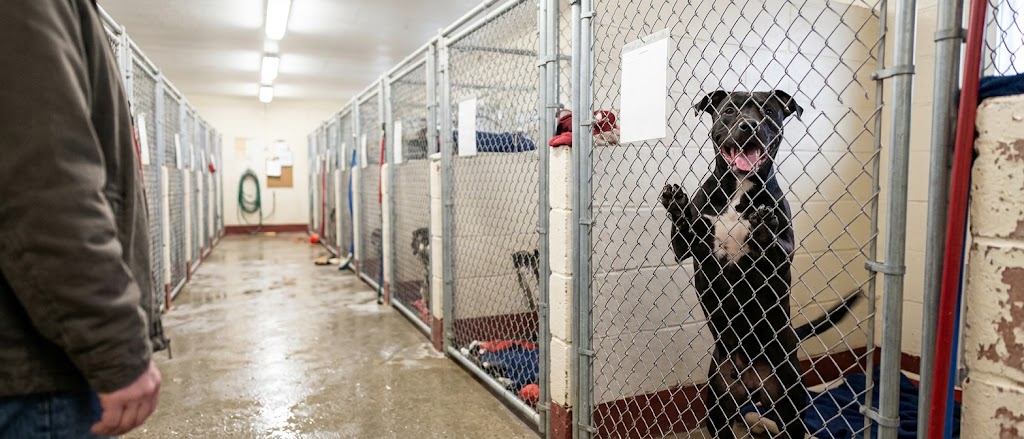
Shelter dog behavior like jumping, mouthing and leash biting is mostly stress, and the dog at my kennel isn't the dog you'd take home. I'm Tank, a 2-year-old black pit mix in Kennel 31, and I'd like a word about Saturday.
You walked up. I hit the gate like a 63-pound pinball.
Then you said "too much" and kept walking.
Fair enough. From your side of the chain link, I looked like a lot. So Jeff, a volunteer who writes for Let Them Be Dog, is typing this for me, because paws are terrible on keyboards. Here's the day I had, what each of those wild moves actually meant and how to meet the real me next time.
My Saturday Before You Walked Up to Kennel 31
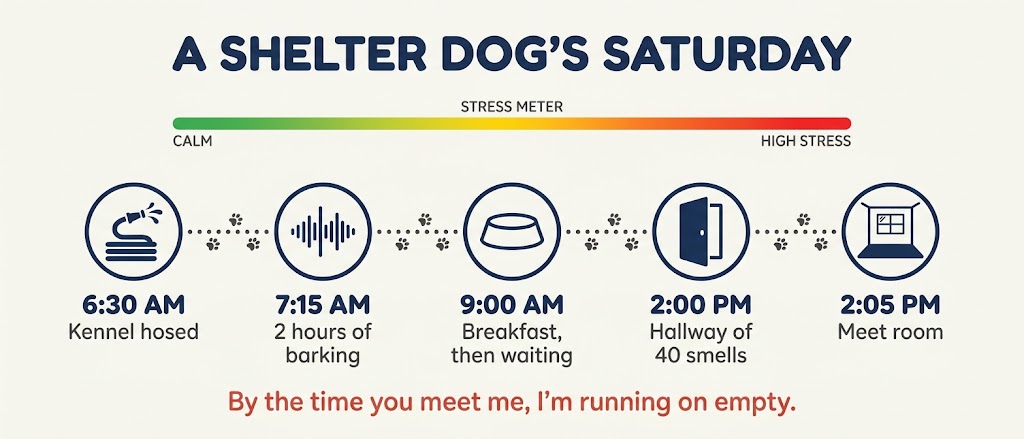
The lights came on at 6:30. Then the hoses.
Somebody sprayed my run while I balanced on my bed like it was a life raft. My paws stayed damp till lunch.
Then the barking started, and it wasn't mine at first. The beagle 2 doors down kicked it off around 7:15, the shepherd across the aisle joined in and pretty soon the whole row was going. It didn't really stop for about 2 hours.
Breakfast took me 4 seconds. After that came a long stretch of nothing, since there were only 2 volunteers on the floor and a whole building of dogs. I got less walks than I'd like this week, and I'm pretty sure everybody did.
Around 2 PM, a staff member led a stranger past my run. That was you. My whole body went zing.
Somebody looped a slip lead over my head and walked me down a hallway that smelled like 40 other dogs' worst days. Wet fur, bleach, fear pee and somebody's spilled kibble. Then came the meet room: small, bright, a squeaky chair, a drain in the floor and you, sitting very still and staring right at me.
I hadn't touched grass in 2 days. So yes, I lost it a little.
Why Do Shelter Dogs Act Differently in the Kennel Than at Home?
Picture spending every day in a room the size of a bathroom, parked next to the speakers at a rock concert. You can't leave or turn it down, and your neighbors scream all night.
That's my apartment.
Researchers from the University of Illinois and Colorado State University actually measured it. In their 2006 study, shelter noise regularly blew past the 118.9-decibel limit of their meter, according to a ScienceDaily summary of the shelter noise research. A jackhammer runs about 110 decibels. OSHA tells people to wear hearing protection above 90.
My ears are a lot better than yours, by the way.
The same research team found something I really like. Dogs who got grooming, petting and play on their second day in the shelter had much lower cortisol, the main stress hormone, on day 3. So a kind person with a little time turns the alarm inside me way down.
Then there's the gate. When I see something I want and a fence stops me, all that wanting turns into bouncing, barking and spinning. Trainers call it barrier frustration. I call it my whole life since August.
Add it up. By the time you meet me, I'm loud, short on sleep and ready to pop.
Most shelter dog behavior you see at the gate is a snapshot of a dog's worst hour, and Saturday was mine. A couch, a nap schedule and the first 3 months in a real house show the rest of me.
Adopting soon? Read what happens once a dog leaves the kennel row before you write anybody off.
Why Do Shelter Dogs Jump on People?
Okay, the gate thing. I own it.
You were the first new face I'd seen in 3 days, and I hadn't run since Thursday. My body had 2 settings, off and launch. The off switch was busted.
Jumping is how a lot of dogs say hello. Puppies jump to reach their mom's face, and some of us never got the memo that people prefer a polite sit. Nobody's had time to teach me yet. That's a training gap, and gaps close.
Jumping usually means a social dog with nowhere to put the feelings. It rarely means a power move, disrespect or a plan to flatten your grandma. The dogs who couldn't care less about people tend to stay in the back of the run.
If you want to see the other version of me, ask a volunteer to take me outside first. 10 minutes of sniffing burns off most of the launch. Then sit, ignore me for a minute and reward the moment all 4 feet hit the floor.
That's the whole recipe, honestly. Our polite-greeting training basics cover what to do once I'm home.
Why Are Shelter Dogs So Mouthy?
I put my mouth on your sleeve. Then your hand. Then your sleeve again.
I get it. Teeth are alarming. But look at what my mouth was actually doing: soft, wiggly and loose, like I was holding a tennis ball I didn't want to pop. A hard, fast bite from a stiff dog looks and feels completely different.
Dogs explore the world with our mouths the way toddlers use their hands. Add stress and a backlog of energy, and the mouth turns into a pressure valve. Young dogs do it the most. I'm 2, which makes me basically a teenager with a jaw.
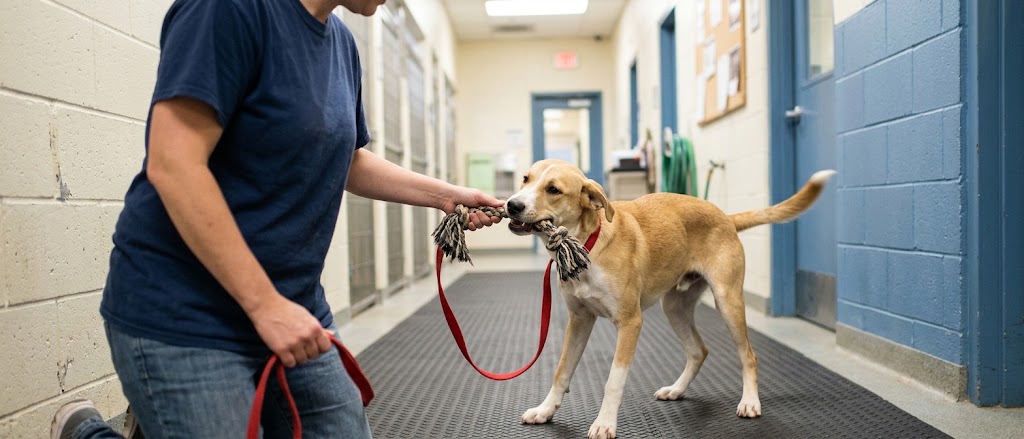
The fix is boring. Hand me something to hold. A rope toy in a meet room turns a mouthy dog into a dog with a job, and chewing calms a lot of us down.
Volunteers see this every single shift. Say a dog's mouth stays soft and he lets go the second you go still. Write "mouthy" in your notes, not "biter." Then ask the staff what they've seen on walks and in playgroup.
Why Do Shelter Dogs Bite the Leash?
Guilty again. The second that slip lead went over my head, I grabbed it and pulled like we were in a tug-of-war final.
My logic was solid. The leash means out, and out means everything. It was also the only thing in reach I was allowed to hold, so I held it. Hard.
Leash biting shows up most in young, smart dogs who've been stuck in a run with nothing to do. Some grab it on the way out, when excitement peaks. Others grab it on the way back in, because they really don't want to go back.
Volunteers have a simple trick. Bring a tug toy and trade, so the dog bites the toy instead of the leash, and keep walking. Our chew and tug games that save your leash give a dog like me a better outlet at home.
Leash biting says I'm bored and pumped up at the same time. It doesn't predict a lifetime of terrible walks. Give me a job and a nap, and the leash goes back to being a leash.
Picturing a dog like me on your couch? Here's what my first night in your house should look like, hour by hour.
Why Do Shelter Dogs Hump People During a Meet and Greet?
Let's get the awkward one over with. I humped your leg. In front of your mom.
I'm not proud. I'm also not trying to take over your household.
The UC Davis School of Veterinary Medicine puts it plainly in its guide to inappropriate mounting in dogs. "When a dog mounts a human, the impetus is typically stress, anxiety, or attention-seeking behavior." The same page says dominance is very rarely the cause.
So there you go. Overloaded dog, small room, too many feelings. Humping is a weird outlet, but it's an outlet. Some dogs spin, some bark and some of us go for the nearest shin.
If it happens, don't yell and don't laugh. Just stand up, turn away and give me a few seconds to reset. You can also ask whether I'm neutered yet, since UC Davis lists hormones in intact dogs as another cause.
Is the Quiet Dog in the Back of the Kennel Less Stressed?
Meet my neighbor in Kennel 32. We'll call her Mabel. She's a 9-year-old hound mix laying on her blanket with her face to the wall, and people walk by saying, "Aw, she's so calm."
She's checked out, and there's a difference.
A 2016 study in Frontiers in Veterinary Science tracked 12 dogs aged 8 and older at an animal protection center in Japan. Repetitive stress behaviors dropped from 35.7% of observations on day 1 to 2.6% by day 6, and time spent sleeping climbed from 0% to 42.7%. On day 7, though, their stress hormone levels were still more than 10 times higher than dogs coming in for training classes at the same shelter.
So the quiet dogs looked settled while their bodies stayed on high alert.
Looking checked out costs dogs time, too. In a 2014 study published in PLOS ONE, researchers filmed 289 dogs at Alachua County Animal Services in Gainesville, Florida. For dogs with less popular looks, leaning on the kennel wall pushed the median stay from 20 days to 50. Facing away from the front pushed it to 35.
The kicker is that jumping on the door didn't make a significant difference in that study. People weren't only skipping the loud dogs. They were skipping the sad-looking ones too.

Learn the quiet stress signals like lip licks and turned heads before you decide Mabel's the easy one. She might be. She might also need 2 quiet weeks at home before she trusts anybody, and if she skips a few dinners at first, that's part of the same story.
Grown dogs like Mabel and me wait a lot longer than puppies. The numbers on adult dogs stuck in shelters show how much longer.
How Should You Meet a Shelter Dog Who Seems Like Too Much?
First, my cheat sheet for decoding shelter dog behavior. Hold it up next to whatever you saw on Saturday, and you'll notice most of it points back to the same thing.
| What You Saw | What It Usually Means | What to Try or Ask |
|---|---|---|
| Jumping on the gate or on you | Excitement and stress with nowhere to go, plus no greeting manners yet | Ask for a walk first, then reward the moment all 4 paws hit the floor |
| Soft mouthing on hands or sleeves | Stress release, play or a young dog's overflow energy | Offer a rope toy, go still and ask what handlers see on walks |
| Grabbing or tugging the leash | Pent-up energy, excitement about going out or not wanting to go back in | Trade the leash for a tug toy and keep walking |
| Humping your leg | Stress, overexcitement or a bid for attention, and very rarely dominance | Stand up, turn away and give the dog a few seconds to reset. Ask about neuter status |
| Nonstop barking or spinning in the run | Barrier frustration, kennel noise and boredom | Ask to meet the dog in a yard or a quiet room |
| Lying in the back, facing the wall | Shut-down stress, which can look a lot like calm | Ask how the dog acts outside, with volunteers and in playgroup |
| Zoomies in the meet room | Relief after hours in a small run | Give it 15 minutes and watch how fast the dog settles |
A hard stare, a stiff body or growling deserves a conversation with shelter staff first. Patterns across several visits beat a single snapshot.
Now the part where you help me out. If I could fill out the adoption form myself, these are the steps I'd ask for, in this order.
1. Ask to meet me outside the kennel row, in a yard or on a walk around the block.
2. Ask a volunteer to walk me first, so I don't bring 2 days of energy into the room.
3. Sit down, turn a little sideways and let me sniff you before you reach for me.
4. Give me 15 minutes and watch how fast I come down after the first burst.
5. Ask who walks me most and what I'm like at 4 PM, when everybody's tired.
6. Ask about playgroup notes, foster stays or a day trip out of the building.
7. Come back for a second visit on a quiet weekday morning.
Step 4 matters most. Every dog gets excited, and the good news lives in how fast we recover.
From the Volunteer Holding Tank's Leash
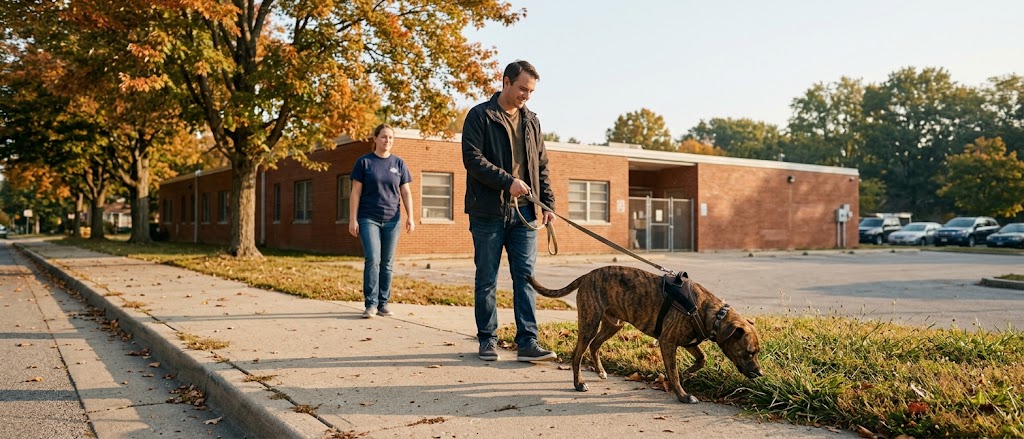
Jeff here. Tank is a composite of dogs I've walked since 2017, first at The Anti-Cruelty Society and now at Chicago Animal Care and Control. Every move he describes, I've watched in a meet room more times than I can count.
Come Back and Meet Me Outside
The dog at the gate is my worst hour, not my whole story. Grab our tools for meeting a shelter dog the right way on the Let Them Be Dog homepage, then come see the rest of me.
Common questions
Will a jumpy shelter dog calm down after adoption?
A jumpy shelter dog usually calms down after adoption once daily exercise, sleep and a steady routine replace kennel stress. Many newly adopted dogs jump less within the first few weeks home. Reward-based training that pays a dog for keeping 4 paws on the floor speeds up the change. A dog who still jumps constantly after 3 months may benefit from a certified trainer.
Does a mouthy shelter dog mean the dog will bite?
A mouthy shelter dog is not the same as a dog likely to bite. Soft, loose mouthing during play or excitement is common in young shelter dogs and usually fades with chew toys and training. Hard, fast bites, a stiff body or growling alongside the mouthing are different signals. Shelter staff can share what a dog's regular handlers have seen.
Why does a shelter dog bark and lunge at people through the kennel gate?
Barking and lunging at the kennel gate is often barrier frustration, a stress reaction to wanting something on the other side of a fence. Plenty of shelter dogs that bark at the gate greet people calmly once out of the kennel. Asking staff to show the dog in a yard or on a walk gives adopters a truer picture of shelter dog behavior outside the kennel.
Is humping in shelter dogs a sign of dominance?
Humping in shelter dogs is rarely about dominance, according to the UC Davis School of Veterinary Medicine. Mounting a person is typically driven by stress, anxiety or attention-seeking, while mounting another dog often comes from arousal, anxiety or play. Calmly standing up and turning away usually ends the humping without adding stress.
Why is a shelter dog calmer with a volunteer than with a potential adopter?
A shelter dog is often calmer with a familiar volunteer because the volunteer's routine, smell and handling style are already known. A potential adopter is one more unfamiliar person in a stressful week. Adopters can ask a trusted volunteer to stay for the first few minutes of a meet and greet to help the dog settle.
Can you foster or take a shelter dog on a day trip before adopting?
Many shelters offer foster-to-adopt programs, overnight sleepovers or day trips that let adopters see a dog outside the kennel. Program names and rules vary, so adopters should ask the adoption counselor what the shelter offers. A few hours on a quiet walk or a couch often reveal a calmer dog than the one in the run.
About the Author
I’m Jeff Molitor and I adopted my first dog at 39 (Cooper Wonder) and have volunteered with Chicago shelter dogs since 2017, first at The Anti-Cruelty Society and now at Chicago Animal Care and Control. I help with dog handling, agility, adoption showings and support, photography and marketing. I love all dogs, but I gravitate toward momma dogs, seniors, black pibbles and the ones with cropped ears. Basically whoever’s been overlooked the longest. Jeff is dad to Oscar Wonder (pibble) and Gary Wonder (our cat).
This article shares what we have learned from our own experience. It is not medical advice, and we are not veterinarians. If you have any concerns about your dog's health, please check with your vet.