Meeting and Choosing a Shelter Dog
Why Are Pit Bulls Discriminated Against? Breed Bans, Myths and What Adopters Should Know
Published · By Jeff Molitor
Pit bull discrimination starts with a guess. DNA shows shelter staff often mislabel pit bulls by looks, yet that label still drives breed bans and lease rules.
The short answer
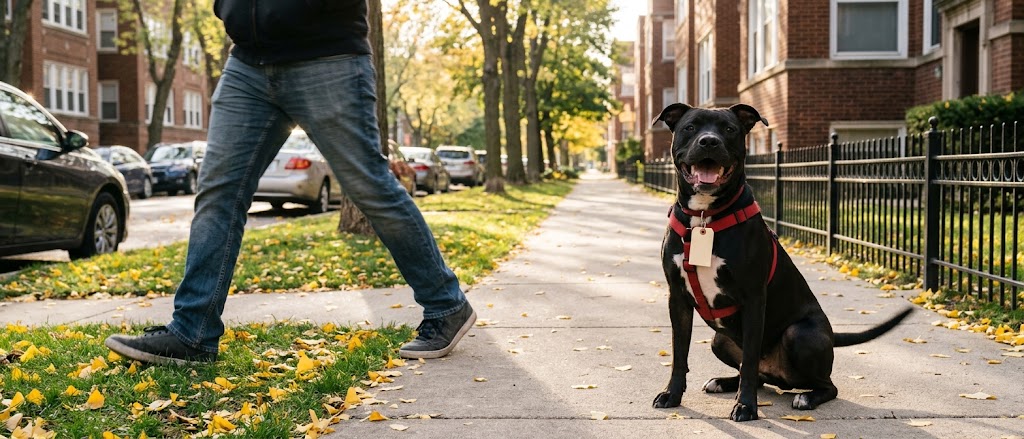
Pit bulls are discriminated against mostly because of a label based on looks, not on how an individual dog behaves. The pit bull reputation grew out of dogfighting headlines and myths that later shaped breed bans and lease rules. DNA research shows visual guesses about pit bull type dogs are often wrong, including guesses made by shelter veterinarians.
Pit bull discrimination usually starts with a guess about a dog's face, made before anybody meets the actual dog. I've watched that guess play out on Chicago shelter floors since 2017, and I go home every night to a pibble named Oscar.
Someone eyeballs a blocky head and writes "pit mix" on a kennel card. That label then rides along into city laws, lease rules and an adopter's gut reaction.
I'm Jeff, and this Let Them Be Dog guide covers the myths, the breed bans and what to check before you fall for a pit mix.
Why Are Pit Bulls Discriminated Against?
Start with the name. "Pit bull" isn't 1 breed. It's a loose bucket for American pit bull terriers, American Staffordshire terriers and Staffordshire bull terriers.
In real life the bucket gets bigger. Any dog with a wide head, short coat and a lot of chest can land in it, including boxer mixes and mutts with no bully breed at all.
The history doesn't help. The ancestors of these dogs were bred in 19th century England for bull baiting and, later, dogfighting. By the 1980s, dogfighting busts and attack stories had made "pit bull" a headline word, and the reputation stuck harder than dog hair on black pants.
Then the label started writing rules. Cities passed bans. Landlords added breed lists. Insurers asked about breeds on applications.
Every rule made pit bull type dogs harder to place, so more of them waited in shelters. A kennel row full of blocky heads then looks like proof to anyone who already believed the story. That loop is pit bull discrimination in a nutshell.
None of this means every pit mix is a saint. Some aren't, same as some beagles aren't. The label just tells you very little about the dog behind the gate.
Can Anyone Actually Tell a Pit Bull Just by Looking?
Short answer: not even the pros.
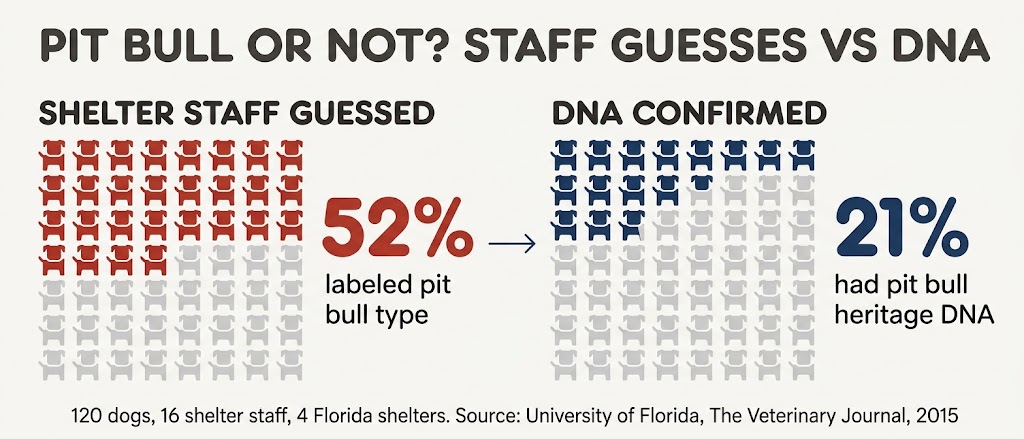
In University of Florida's research on pit bull identification, 16 experienced shelter workers, including 4 veterinarians, guessed the breeds of 120 dogs at 4 Florida shelters. Then the team ran DNA on every dog. The study, published in The Veterinary Journal, found staff called 52% of the dogs pit bull type, while DNA put the number at 21%.
1 in 3 dogs with no pit bull heritage DNA got called a pit bull by at least 1 staff member. And 1 in 5 dogs that did have that DNA got missed.
I'm not throwing shade at intake staff. Those calls get made fast, with a line out the door and a stray sniffing everybody's shoes.
That matters because "pit" on a card doesn't stay on the card. A city ordinance, a lease or an insurance form may treat the guess like a fact. The UF researchers said it plainly: visual breed ID shouldn't be the basis for public policy.
The study authors had a great line for this: "Mixing breeds is not like mixing paint." A dog with a little bully breed DNA can look like a lab. A dog with none can look like the poster child for the label.
I translated the rest of the kennel card, from "dog selective" to "no cats" in its own post.
A label is a guess, and good manners are proof. Start with our loose-leash walking and polite greeting basics and let your dog do the arguing.
Which Pit Bull Myths Do People Still Believe?
Myth 1: Locking Jaws
There's no lock. Dr. I. Lehr Brisbin of the University of Georgia studied pit bull skulls and found nothing that works like one. Pit bull jaws work like every other dog's jaw.
What people mean by "lock" is grip and shake, which is behavior. Terriers do it with toys. Labs do it with your sock.
Myth 2: The Nanny Dog
This one sounds sweet, which is why it sticks. The story says Victorian families used pit bulls as babysitters. They didn't. The earliest known source is a 1971 New York Times dog column quoting a Staffordshire bull terrier breeder who called the breed a "nursemaid dog."
The nanny myth hurts dogs too. It sets them up as furry babysitters, and no dog of any breed should be left alone with a toddler.
Myth 3: Raising Fixes Everything
"It's all how you raise them" is the friendly myth. It's said with love, and it's half right.
Genes matter, they just don't line up neatly with breed labels. A 2022 study in Science looked at more than 18,000 dogs. UMass Chan Medical School researchers found breed explained only about 9% of behavior differences between individual dogs. I covered that study when I wrote about why breed tells you so little about how a new dog will settle.
Every dog is a mix of genes, age, history and luck. A couch-raised dog can still fear men in hats. Shelter adopters rarely know the history anyway, so judge the dog in front of you.
Myth 4: Snapping Without Warning
Dogs almost always warn first. The UK vet charity PDSA lays out a canine ladder of communication that starts with yawning, blinking and nose licking. It climbs through looking away, walking away and stiffening up before it ever gets to a growl, a snap or a bite.
"No warning" usually means nobody caught the early rungs. Or someone punished the growl, and the dog learned to skip it.
A kennel makes this harder, since stressed dogs act weird behind a gate. Here's why a dog's kennel behavior isn't the whole dog and what to watch for instead.
| The Myth | What's Actually True | What to Do Instead |
|---|---|---|
| "Pit bulls have locking jaws" | No dog breed has a jaw that locks. Grip and shake is behavior, not anatomy. | Teach a "drop it" trade with a better treat |
| "Pit bulls were nanny dogs" | The nickname traces to a 1971 newspaper dog column, not to Victorian nurseries | Supervise every dog around kids, whatever the breed |
| "It's all how you raise them" | Genes, age and history all shape behavior, and breed explains only about 9% of differences between dogs | Judge the individual dog in front of you |
| "They snap without warning" | Most dogs climb a ladder of signals first, from nose licks and looking away to stiffening up and growling | Learn the early signals and never punish a growl |
| "You can tell a pit bull by looking" | Shelter staff labeled 52% of dogs pit bull type in a Florida study, while DNA found 21% | Treat the breed line on a kennel card as a guess |
| "Pit bull is 1 breed" | The label covers several breeds plus any dog who looks like them | Ask the shelter how the dog acts, not what it is |
Any dog of any breed can bite. A dog's own history, health and behavior tell you far more than a breed label.
What Does Breed-Specific Legislation Actually Do?
Breed-specific legislation, or BSL, comes in a few flavors. Some laws ban pit bull type dogs outright. Others allow them with strings attached: special permits, registration, muzzles in public, liability insurance or a cap on how many you can own.
Most of these laws cover any dog who looks mostly like 1 of the named breeds. So an officer looks at a dog and decides. After the Florida study, you can guess how that goes.
The costs aren't small. Prince George's County, Maryland, estimated its pit bull ban cost about $3 million a year to enforce. Its old rules also made owners of registered dogs carry $1 million in liability coverage.
After Denver ended its ban, the city required a breed-restricted permit, a microchip and a limit of 2 pit bulls per household. Owners can ask to drop the permit after 3 years with no incidents.
Here's my problem with all of it. A dog who bites deserves a response, whatever he looks like. A dog who has never hurt anyone shouldn't need a permit because of his cheekbones.
Breed-neutral dangerous dog laws already handle the first dog. They judge what a dog did, not his face.
A ban can end overnight, but a label sticks around. See why black pibbles and cropped-ear dogs still wait the longest, then ask to meet 1 of them first.
Where Have Pit Bull Bans Been Repealed?
The trend is moving our way. Slowly.
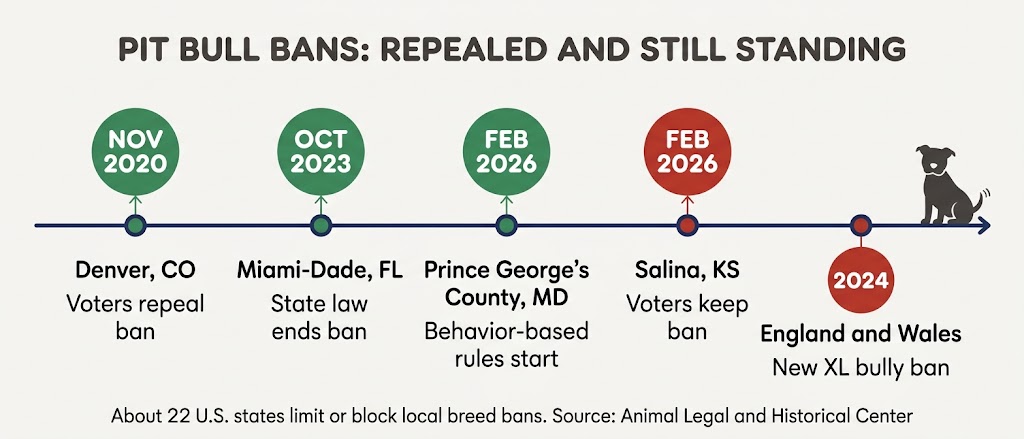
Denver banned pit bulls in 1989. In November 2020, voters passed Ballot Measure 2J with about 66% voting yes, and the ban ended in January 2021.
Miami-Dade County also banned pit bulls in 1989. A Florida law wiped that ban out on October 1, 2023, and it stopped public housing authorities from banning dogs by breed, weight or size.
Prince George's County, Maryland, ended a 27-year-old ban when its council voted 7-0 on November 18, 2025. The Prince George's County pit bull fact sheet says behavior-based rules replaced the ban on February 2, 2026. A council member estimated 20,000 to 30,000 pit bull type dogs lived there anyway, ban or no ban.
States are doing the heavy lifting. The Animal Legal and Historical Center's list of states that limit breed-specific laws counts about 22 states with some kind of anti-BSL law.
Illinois is on that list. I'm not a lawyer, but the state's Animal Control Act says local dog rules can't be specific to breed. It also says a dog can't be declared vicious because of breed alone. Chicago adopters won't run into a city pit bull ban. Your lease is a different animal.
Some places went the other way. Salina, Kansas, voted 56.4% to keep its 2004 pit bull ban in February 2026, and the question can't come back until 2036. England and Wales banned XL bully dogs in 2024.
BSL isn't dead. It just got less popular.
| Place | Ban Started | What Happened | Status |
|---|---|---|---|
| Denver, Colorado | 1989 | Voters passed Ballot Measure 2J in November 2020, with about 66% voting yes | Repealed in January 2021, with a breed-restricted permit and a 2-dog limit |
| Miami-Dade County, Florida | 1989 | A Florida law ended local breed bans and public housing breed, weight and size limits | Repealed October 1, 2023 |
| Prince George's County, Maryland | About 27 years before repeal | The county council voted 7-0 on November 18, 2025 to end the ban | Behavior-based rules took effect February 2, 2026 |
| Salina, Kansas | 2004 | Voters chose to keep the ban, 56.4% to 43.6%, in February 2026 | Still standing, and the question can't return until 2036 |
| England and Wales | 2024 | XL bully dogs were added to the Dangerous Dogs Act ban list | A new breed ban, with exemption certificates for existing dogs |
About 22 U.S. states limit or block local breed-specific laws, including Illinois. Leases, HOAs and insurers can still set their own breed rules.
What the Kennel Floor Taught Me About Labels
I've volunteered with Chicago shelter dogs since 2017, first at The Anti-Cruelty Society and now at Chicago Animal Care and Control. A lot of my favorite dogs had "pit" somewhere on the card.
I gravitate toward black pibbles and the ones with cropped ears.
Oscar came to me in July 2024 as a heartworm-positive foster through Dark Horse Dogs. By December 2024 he was a Wonder for good.
How Does Pit Bull Discrimination Follow a Dog Home?
City law is only the first gate, and there's a few more behind it. Your landlord can write breed rules into a lease, and a condo board can put them in the bylaws. An insurer might ask about breeds. And if you move, the next town might still have a ban.
How rental breed bans keep pit bulls in shelters walks through the Illinois insurance law and the "it's my insurance" excuse landlords love. Our stats post shows how many rentals still restrict breed or weight, and the numbers aren't pretty.
What I'll add is the order. Check every gate before you meet the dog, because a "no" after you've fallen in love is the worst kind. It also sends a lot of dogs right back to the shelter.
| Who | What They Control | What to Check or Ask |
|---|---|---|
| Your state | Whether cities and counties may pass breed bans at all | Illinois blocks local rules that are specific to breed |
| Your city or county | Bans, permits, muzzle rules or household limits where state law allows them | Search your city or county name plus "animal ordinance," and check again before a move |
| Your landlord | Breed lists and weight limits written into the lease | Search the lease for "breed" and "pit bull," and get pet approval in writing |
| Your condo board or HOA | Breed or size rules in the bylaws, even for owners | Ask for the current pet rules before you apply to adopt |
| Your insurer | How a dog's breed or history affects a homeowners or renters policy | Ask your agent how breed is handled, and get the answer by email |
| The shelter or rescue | Adoption steps, like landlord approval or a meet with your resident dog | Ask what paperwork they need and who knows the dog best |
This table is general information, not legal advice. Rules change, so confirm each one where you live.
Thinking about a pit mix but stuck on what you've heard? See why adopting beats buying for you and the dog, then go meet a few in person.
What Should You Check Before Falling for a Pit Mix?
I'll be honest, nobody does this part in the right order. You see a goofy face on a shelter website, and suddenly you're picking out names on the train.
So do the boring stuff first. It takes about an hour. Heartbreak takes way longer.
Once the paperwork's clear, flip it. Stop caring about the breed line and start caring about the dog.
1. Read your lease. Search it for "breed," "pit bull," "aggressive breeds" and weight limits. Get any pet approval in writing, with the dog's name.
2. Check HOA or condo rules. Owners aren't off the hook. Bylaws can restrict breeds too.
3. Look up your local dog ordinance. Search your city or county name plus "animal ordinance." Do it again before any move.
4. Call your insurance agent. Ask how the company handles dog breeds, and get the answer in an email.
5. Ask the shelter for everything. Intake notes, behavior notes, playgroup reports, foster updates. Then talk to whoever knows the dog best.
6. Meet the dog more than once. Go for a walk outside the kennel. Watch for loose wiggles, soft eyes and how fast the dog bounces back from a loud noise.
7. Ask about a trial run. Many shelters offer day trips, sleepovers or a few weeks as a foster before you commit.
8. Plan the first weeks. A new dog needs quiet time, so read up on giving a new rescue dog a calm, low-pressure start.
That last step matters more for pit mixes. A stressed dog pushed too fast confirms every stereotype in the neighbor's head. A dog given time to settle becomes the best ambassador on the block.
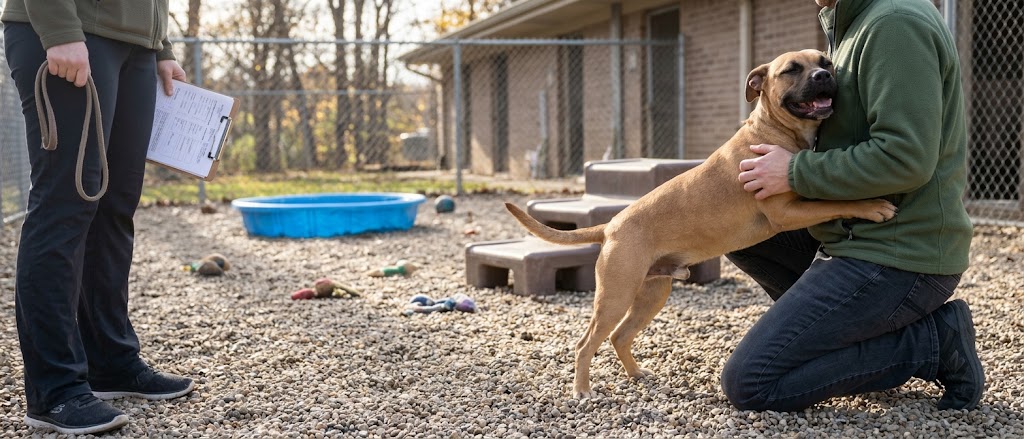
Meet the Dog, Not the Label
Pit bull discrimination runs on guesses, and the cure is meeting the actual dog. Check your lease, check your town, then go say hi to the blocky head everyone else walked past. The rest of our guides for bringing a shelter dog home will help with what comes next.
Common questions
Are pit bulls more dangerous than other dogs?
Pit bull type dogs have not been shown more dangerous than other dogs in controlled studies, a 2014 American Veterinary Medical Association review found. The same review notes that pit bull type dogs show up more often in reports of the most severe injuries. Breed labels in bite reports mostly come from visual guesses, which DNA research shows are often wrong.
What breeds count as a pit bull?
The pit bull label usually covers 3 breeds: American pit bull terriers, American Staffordshire terriers and Staffordshire bull terriers. A pit bull is a loose type of dog rather than 1 breed. Many laws and leases also include any dog that looks mostly like those breeds. The United Kennel Club registers the American pit bull terrier, while the American Kennel Club does not.
What is the difference between breed-specific and breed-neutral dog laws?
Breed-specific laws regulate dogs by breed or appearance, while breed-neutral laws regulate dogs by what each dog actually does. A breed-neutral dangerous dog law applies to any dog with a bite or attack record, whatever the dog looks like. Breed-neutral rules also cover leash laws, licensing and owner responsibility for damage. Prince George's County, Maryland, swapped its pit bull ban for behavior-based rules in 2026.
Does a DNA test prove a dog is not a pit bull?
A dog DNA test can show breed ancestry, but a DNA test may not settle a pit bull dispute with a landlord. Many breed rules define pit bulls partly by appearance, so a dog who looks the part can still get flagged. DNA results also say little about behavior, since breed explained only about 9% of behavior differences in a 2022 Science study.
Are pit bulls good with kids?
Pit bull type dogs can be wonderful with kids, but each dog's comfort with children depends on the individual dog, not the breed label. The nanny dog idea is a myth, and no dog of any breed should be left alone with young children. Shelter staff and foster homes can share how a specific dog has handled kids, noise and touch.
Is it okay to list a pit mix as a different breed on a rental application?
Listing a pit mix as a different breed on a rental application can backfire, since a lease violation can cost an adopter the home. Many landlords will meet a dog in person or review a pet resume with training and vet records. Honest paperwork protects the adopter and keeps the dog out of a return.
About the Author
I’m Jeff Molitor and I adopted my first dog at 39 (Cooper Wonder) and have volunteered with Chicago shelter dogs since 2017, first at The Anti-Cruelty Society and now at Chicago Animal Care and Control. I help with dog handling, agility, adoption showings and support, photography and marketing. I love all dogs, but I gravitate toward momma dogs, seniors, black pibbles and the ones with cropped ears. Basically whoever’s been overlooked the longest. Jeff is dad to Oscar Wonder (pibble) and Gary Wonder (our cat).
This article shares what we have learned from our own experience. It is not medical advice, and we are not veterinarians. If you have any concerns about your dog's health, please check with your vet.