Health
Adopting a Heartworm-Positive Dog: The Crate Rest Months Nobody Prepares You For
Published · By Jeff Molitor
Adopting a heartworm-positive dog means months of strict, vet-ordered rest. Calm enrichment and a daily breathing check get a young dog through it safely.
The short answer
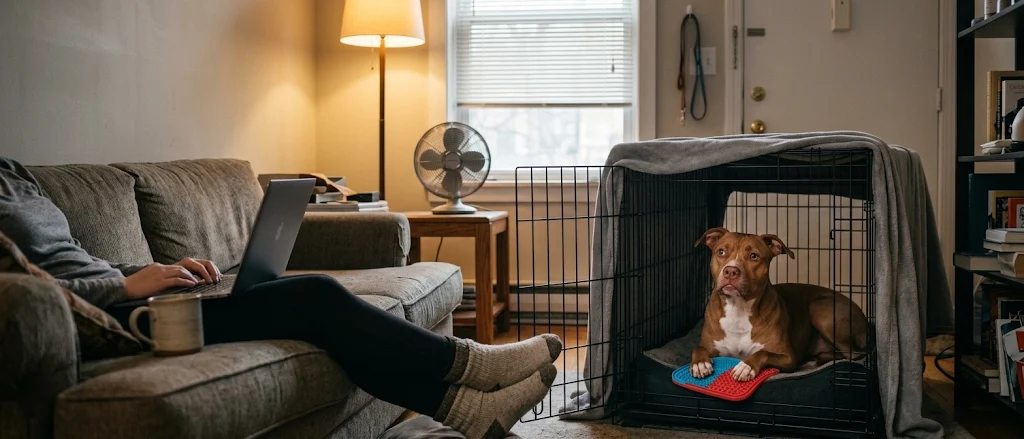
Adopting a heartworm-positive dog makes sense for a home that can enforce strict, vet-ordered rest for several months. Heartworm treatment works best when a dog's heart rate and activity stay low the whole time. A calm household with a flexible schedule and a vet budget suits a heartworm-positive dog best.
Adopting a heartworm-positive dog is mostly a test of how long you can keep a happy dog bored on purpose. The shots take an afternoon at the vet. The hard part of adopting a heartworm-positive dog is the rest, and there's a lot of it.
Most of what ranks for this topic is a vet explaining the drug protocol. Useful, sure. It just doesn't help at 4 PM on a Tuesday, when your 2-year-old pit mix is spinning circles in her crate.
This Let Them Be Dog guide is the couch-side version. You'll get a rest setup, a week-by-week plan to fill in with your vet, calm enrichment and a way to tell cabin fever from a call to the vet.
Should I Adopt a Heartworm-Positive Dog?
My answer is yes, if you go in knowing what you're signing up for. The treatment isn't the scary part. The calendar is.
Heartworm is a parasite spread by mosquitoes, and our glossary covers what heartworm positive means on shelter paperwork. For adopters, the part that matters is simple. As the worms die, pieces of them move into the lungs, and exercise makes that more dangerous.
Veterinary behaviorist Debra Horwitz explained the stakes in dvm360's guide to surviving heartworm confinement. Exercise or excitement that raises the heart rate can push worm fragments into small blood vessels in the lungs.
She also suggests calling it "rest time for recovery" instead of cage rest. It sounds less like a prison sentence, which helps.
So the real question isn't whether the dog is worth it. They almost always are. The question is whether your house can stay boring for the full rest period your vet sets.
Be honest about 4 things before you sign. Can someone handle leash-only potty breaks? Does the dog settle in a crate, or will you need a closed room?
Who pays for treatment, the shelter or you? And is anybody in your house going to sneak her a game of fetch? I made my broader case for the shelter dogs with medical notes in another post, so I'll leave it there.
If those answers come back as a shrug, fostering a shelter dog before you commit lets you test drive the rest months.
What Does Strict Rest Actually Look Like With a Young Dog?
Picture your dog's normal day. Now delete every fun part that involves legs.
No fetch. No backyard laps. No greeting you at the door like you just got back from a year at sea. Stairs and couches become a negotiation.
Uri Donnett is the chief veterinarian at the Dane County Humane Society in Madison and sits on the American Heartworm Society board. He wrote a 2026 guide for vets on keeping heartworm patients calm. He notes the AHS guidelines start restriction at diagnosis. It runs until 6 to 8 weeks after the last melarsomine injection, the drug that kills adult worms.
The weird part is the dog usually feels fine. That's the whole problem.
A senior dog on rest naps and thinks it's a spa weekend. A 2-year-old pit mix carrying the kennel-built energy a young shelter dog brings home thinks it's jail. Expect zoomie attempts by week 2. By week 3 you'll get loud sighs and a long stare that says you ruined her life.
Rest also overlaps the quiet first 2 weeks every new dog needs after adoption. A new dog is supposed to have a dull house anyway.
Your job is to fill those hours with things that use the nose and mouth instead of the legs.
Stock up on brain work before rest starts. Our homemade muffin tin and towel-and-box puzzles work for a dog who isn't allowed to run.
What Should a Heartworm Rest Setup Include?
Donnett is blunt about crates. A dog who isn't used to one may panic and fight to get out, which is more exercise than any walk and a good way to get hurt. So the crate question gets settled in week 1, not on injection day. You want small, quiet and close enough that she can hear you typing.
Crate Dogs Stay Crated
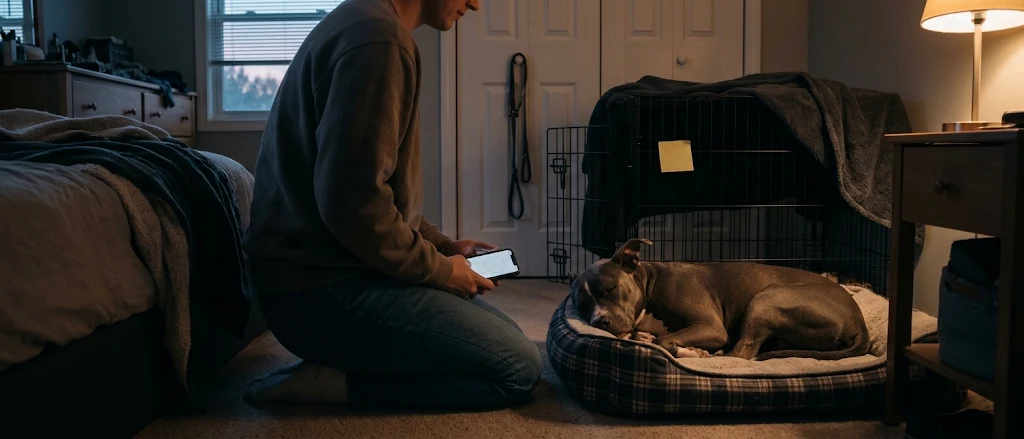
If she already naps in an open crate, great. Size matters more than usual, since she'll spend a lot of hours in there. Get a wire crate big enough to stretch out in, cover 3 sides and park it where she can see you.
Room Dogs Get Gated
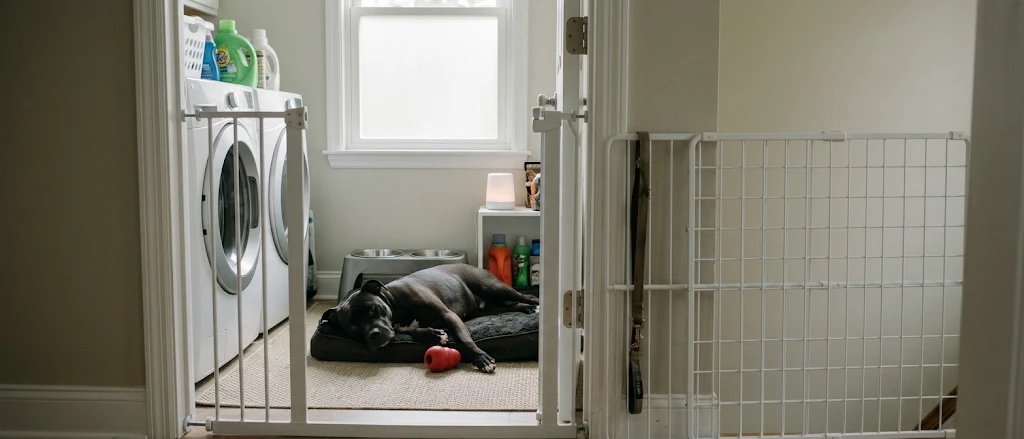
Some dogs dig at the crate door, chew the bars or leave puddles of drool. That dog gets a small room instead. A laundry room or a bedroom with the bed blocked off both work. I wrote up the gated corner for dogs who panic in a crate for night 1, and the same idea holds for months.
Clear out anything she can jump on. Lay rugs on slick floors so a sudden spin doesn't turn into a slide.
Block the Window
A squirrel is cardio. Horwitz suggests keeping the crate away from windows, and Donnett recommends temporary window film if the view sets off barking.
Here's what goes in the rest zone:
- Crate or small room, sized so she can lie flat on her side
- A thick bed and 1 blanket that smells like home
- A water bowl she can't flip
- 2 kinds of long-lasting chews, rotated so neither gets old
- A lick mat and a rubber food toy that lives in the freezer
- A fan or white noise machine
- Window film or closed blinds
- A short leash hanging by the door, so potty breaks start leashed every time
The Week-by-Week Heartworm Rest Plan
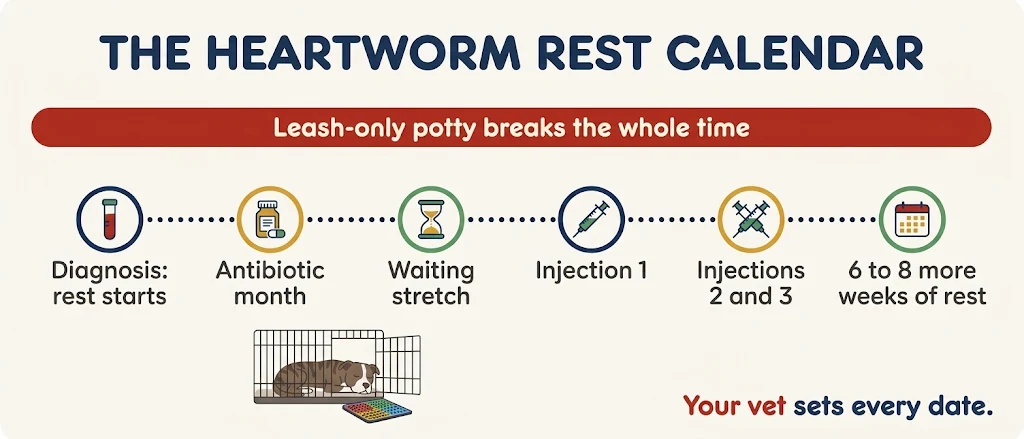
Your vet sets the dates. This plan just tells you what each stretch feels like from the couch.
The standard American Heartworm Society protocol takes about 3 months from the first pill to the last shot. That's according to parasitologist Andy Moorhead of North Carolina State University and former AHS president Chris Duke. Their 2025 Q&A on heartworm treatment in Today's Veterinary Practice walks vets through it. Rest keeps going for weeks after that last shot.
Shelters sometimes start treatment before you meet the dog, and some use a shorter 2-injection version. Moorhead and Duke say it cuts the worm count by about 90%, versus 98% to 99% for 3 injections. Ask which one your dog got.
Ask your vet for the dates that apply to your dog and tape the plan to the fridge. This outline is general, not a schedule for an individual dog.
1. Diagnosis week. Rest starts the day the test comes back positive, before any shots. Leash-only potty breaks start now, and so does crate training or the room setup. Confirm the start date with your vet.
2. The antibiotic month. Pills and preventive happen at home. She feels great, so build the enrichment routine now. Ask your vet which weeks the antibiotic covers.
3. The waiting stretch. Same rules. Practice the settle cue until it's boring. Your vet can tell you how long the gap lasts between the last antibiotic dose and the first injection.
4. First injection. Expect a sore lower back near the shot and a sleepy day or 2. Watching her breathing starts to matter a lot here. Ask your vet for the injection date and whether your dog will stay overnight.
5. Between injections. Worms are dying now, so rest gets stricter, not looser. Keep visitors low and the doorbell off. Confirm how long this stretch lasts for your dog.
6. Injections 2 and 3. Another sore back, then the longest quiet stretch. Your vet sets both dates, which are often 1 day apart under the standard protocol.
7. The final rest stretch. This is where adopters slip, because the dog seems totally normal. Don't. AHS guidance continues rest for 6 to 8 weeks after the last injection, but your vet sets the end date.
8. Slow return and retest. Your vet brings exercise back in steps. Prevention stays on for life. Ask for the retest date, which should be no sooner than 9 months after the last injection.
| Stretch | Allowed | Off Limits | Watch For | Date to Confirm |
|---|---|---|---|---|
| Diagnosis to first pill | Leash-only potty breaks, crate or room time, chews and lick mats | Running, fetch, off-leash yard time, dog play | How the dog handles the crate or room | Ask your vet for the start date |
| Antibiotic month | Same as above, plus short settle and trick sessions | Stairs at full speed, jumping on furniture | Upset stomach or skipped meals while on the antibiotic | Ask which weeks are covered |
| Waiting stretch before injection 1 | Same rules, practice the potty routine until it's dull | Visitors who rile the dog up | Weight creeping up from extra treats | Confirm the length of this stretch |
| Injection 1 and the weeks after | Crate or room rest, quiet chews, short leashed potty trips | Any excitement that raises the heart rate | Cough, fast or labored breathing, fever, lethargy, a sore back that gets worse | Confirm the date and overnight care |
| Injections 2 and 3 and the weeks after | The strictest rest of the whole plan | Doorbells, visitors, zoomies, play | Same signs as after injection 1 | Confirm both injection dates |
| Final rest stretch, usually 6 to 8 weeks after the last injection | Rest continues even though the dog seems fine | "Just 1 quick game of fetch" | Restlessness, which is normal, versus the signs above, which aren't | Get the vet's activity-clearance date |
| Slow return and retest | Activity in steps, only as your vet clears it | Jumping straight back to running or dog parks | Retest no sooner than 9 months after the last injection | Put the vet's retest date in your phone |
A solid settle cue makes every one of these weeks easier. Practice it with our positive reinforcement and crate training resources, a few minutes at a time.
What Enrichment Keeps a Dog Busy Without Raising Her Heart Rate?
My test is simple. If she's lying down or standing still while she does it, it's probably fine. If she's bouncing, it isn't.
Spread 3 or 4 short sessions across the day. Mornings are for food puzzles. Evenings are for chews.
Nose Work, Lying Down
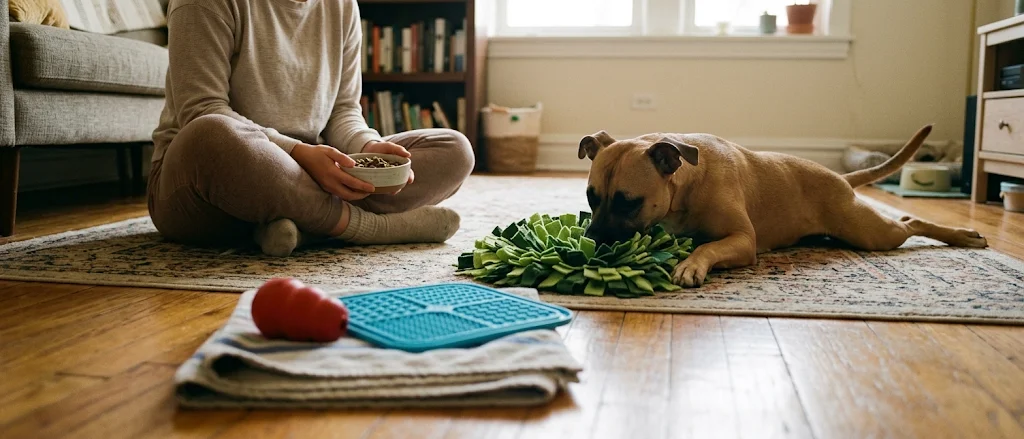
Sniffing is the best tool you've got. Serve a meal in a snuffle mat, or roll kibble up in a towel. Donnett suggests snuffle mats with food tucked into the folds, which slows down a fast eater too.
Licking and Chewing
Licking and chewing calm a dog down, they're basically a dog's version of knitting. Smear wet food on a lick mat. Stuff a rubber toy with kibble and a spoonful of wet food, then freeze it overnight.
Count the calories. A dog who can't exercise gains weight fast, so pull treats out of her daily food instead of adding extra.
Tricks That Barely Move
Horwitz recommends teaching a "settle and relax" cue on a soft bed. She also likes tiny tricks like a chin rest, a nose touch and a paw shake. 5 minutes of this tires out a young dog more than you'd expect.
Sit to down to sit, done 10 times, is fine. Anything with spinning, jumping or chasing a lure is not.
Sounds and Company
Donnett mentions classical music or audiobooks during the strictest stretch. I'd add a fan for white noise. Keep visitors rare, since a new person at the door is the most exciting thing in a resting dog's week.
What she wants most is you, nearby. Work from the couch next to the crate. That counts.
| Activity | Verdict | Why |
|---|---|---|
| Snuffle mat meal | Calm enough | The nose does the work while the dog stays put, and it slows down fast eaters |
| Lick mat with wet food | Calm enough | Licking settles most dogs, and it works lying down |
| Frozen stuffed rubber toy | Calm enough | Long, slow chewing in the crate or bed. Count the food toward daily calories. |
| Settle cue, chin rest, nose touch, paw shake | Calm enough | Brain work with barely any movement, in 5-minute sessions |
| Classical music, audiobooks or a fan | Calm enough | Background sound covers hallway noise and outside triggers |
| Rolled-towel kibble puzzle | Watch the dog | Fine for a calm unroller. Stop if the dog starts pouncing or tossing the towel. |
| Puzzle toys that roll across the floor | Watch the dog | Chasing a rolling toy turns into running fast |
| Scatter feeding around the house | Too much | A treasure hunt means trotting room to room |
| Tug, fetch, flirt poles or laser pointers | Too much | Each one spikes the heart rate in seconds |
| Visitors and dog play dates | Too much | New people and dogs are the most exciting thing in a resting dog's week |
These verdicts are general guidance based on Donnett and Horwitz. Check any new activity with your vet first, especially if it makes your dog bounce, bark or pant.
How Can You Tell Restlessness From a Heartworm Complication?
A bored dog is often loud. A sick dog may get quiet.
Restless looks like whining at the crate door, sighing like a teenager and chewing the bed. She still eats, still wants the lick mat and still greets you with her whole back end.
A complication looks different. The Merck Veterinary Manual's pet owner pages list coughing, spitting up blood, labored or rapid breathing, lethargy, poor appetite and fever. Merck says these problems can show up anywhere from several days to 6 weeks after treatment.
That's why the weeks after each injection get the closest watching. Dying worms are moving into the lungs right then.
Learn her normal resting breathing now, while she's healthy. Count her breaths for 30 seconds while she sleeps and double it. Ask your vet what change from that normal number should trigger a call, and write the answer on your fridge plan.
The hard case is the dog who gets quieter, because settled and sick can look alike. Check her gums, offer a favorite treat and watch her chest.
If she skips the treat or breathing looks like work, call. When in doubt, call rather than waiting.
Watch the injection site, too. A little soreness for a few days is common. Swelling that keeps growing, or a dog who yelps when she lies down, gets a call.
| What You See | What It Likely Means | What to Do |
|---|---|---|
| Whining, sighing or pacing, with normal eating and breathing | Boredom and cabin fever | Add a lick mat or chew session and check the daily routine |
| Digging at the crate door, chewing bars, heavy drool | Crate panic, which is exercise in itself | Switch to a small room and ask your vet about calming help |
| Sleepy and sore for a day or 2 after an injection | Common after the shot | Keep resting and call if soreness gets worse or is not improving |
| Swelling at the injection site that keeps growing, or yelping when lying down | Injection-site pain beyond normal soreness | Call your vet today |
| Any new cough | Possible lung reaction to dying worms | Call your vet today, even if it's mild |
| Skipping meals, fever, unusual tiredness | Possible treatment complication | Call your vet today |
| Fast or labored breathing at rest, spitting up blood, pale or bluish gums, collapse | Possible emergency | Go to your vet or an emergency clinic now |
This table is not a diagnosis. When in doubt, call your vet.
How Do You Handle Potty Breaks, Zoomies and the Doorbell?
Potty breaks are where most rest plans fall apart. The door opens, the air smells like squirrel and suddenly you're water skiing.
Keep it short and dull. Leash goes on before the door opens, even with a fenced yard. Walk to 1 spot, wait, praise and head back in. Donnett's advice is short, controlled leash walks for bathroom breaks instead of free yard time.
A Chicago winter makes this easier, since nobody wants to linger anyway. Check how long a short-coated dog can handle wind chill on a potty trip before January hits.
Zoomies have a tell. Watch for the play bow and the wild eyes. Get a chew in her mouth before the launch, not after.
If she launches anyway, don't chase. To a dog, being chased is the best game ever invented. Stand still, go boring and hand over something to lick.
The doorbell is sneaky. Turn off the chime, tape a note on the door for deliveries and save friend visits for later. Horwitz recommends limiting visitors during treatment.
Time alone is fine for most dogs on rest, as long as she's safe in her zone. If she comes apart every time you leave, read up on telling crate stress apart from separation panic before you assume the worst.
Keep your vet's number, the nearest emergency clinic and your retest date on 1 sheet. Our Vet Care Resources download is a good place to start.
What Happens After Heartworm Rest Ends?
The last day of rest isn't a party, sorry. Your vet brings activity back in steps, usually longer leash walks first.
Moorhead and Duke say to retest no sooner than 9 months after the last injection, since an early test can come back falsely positive. Put that date in your phone the day of the last shot.
Prevention keeps going for life, every month, all year. A dog who already did heartworm treatment once shouldn't have to do it twice.
Dog play comes back last. If there's another dog at home, the 2 of them have probably been staring at each other through a gate for months, so wait for your vet's go-ahead.
Budget for the long tail, too. Rechecks, the retest and monthly prevention add up. Ask your vet for a written estimate for those costs. For routine care, it's worth looking at low-cost clinics and vet school hospitals.
Then you finally meet the dog you've been babysitting. Some come out of rest calmer, because they learned to settle. Others come out like a soda can shaken for 4 months.
Be Boring on Purpose
Adopting a heartworm-positive dog means a few months of boring in exchange for a dog who gets the rest of her life back. When your vet clears exercise, start with sniff walks that tire a dog out without the sprinting.
Common questions
How long does crate rest last for a heartworm-positive dog?
Crate rest for a heartworm-positive dog usually lasts several months under American Heartworm Society guidelines. Activity restriction starts at diagnosis and continues until 6 to 8 weeks after the final melarsomine injection. The standard heartworm treatment protocol itself takes about 3 months. A treating veterinarian sets the exact start and end dates for each dog.
Can a heartworm-positive dog live with other dogs during treatment?
A heartworm-positive dog can share a home with other dogs during treatment as long as the dogs don't play, wrestle or chase. Heartworm does not spread directly from dog to dog, because mosquitoes carry the parasite. Separate rooms, baby gates and leashed potty breaks keep a resting dog calm when a second dog lives in the house.
Can I adopt a heartworm-positive dog if I work full time?
Adopting a heartworm-positive dog while working full time can work when the dog rests calmly alone and someone handles midday leash potty breaks. A dog walker hired for heartworm rest should know the no-running rule and keep each break short. A heartworm-positive dog who panics alone in a crate needs a new setup and a vet conversation before treatment starts.
Is coughing normal after a heartworm injection?
Any new cough after a heartworm injection deserves a call to the veterinarian, even a mild one. Frequent coughing, spitting up blood, labored breathing, fever or lethargy can signal a heartworm treatment complication. The Merck Veterinary Manual says heartworm treatment complications can appear anywhere from several days to 6 weeks after treatment.
Can a heartworm-positive dog take calming medication during rest?
Calming medication during heartworm rest should come only from the treating veterinarian, who knows the dog's heart and lung health. Shelter veterinarian Uri Donnett lists trazodone, gabapentin and some benzodiazepines as options vets may consider. Medication works alongside a quiet room, low-movement enrichment and training, not as a replacement for them.
Does the shelter pay for heartworm treatment after adoption?
Heartworm treatment costs after adoption depend on the shelter or rescue, and policies vary widely. Some shelters finish heartworm treatment before a dog goes home, while others help pay for treatment afterward. Adopters should ask in writing which steps are done, which protocol was used and who covers follow-up visits and the retest.
About the Author
I’m Jeff Molitor and I adopted my first dog at 39 (Cooper Wonder) and have volunteered with Chicago shelter dogs since 2017, first at The Anti-Cruelty Society and now at Chicago Animal Care and Control. I help with dog handling, agility, adoption showings and support, photography and marketing. I love all dogs, but I gravitate toward momma dogs, seniors, black pibbles and the ones with cropped ears. Basically whoever’s been overlooked the longest. Jeff is dad to Oscar Wonder (pibble) and Gary Wonder (our cat).
This article shares what we have learned from our own experience. It is not medical advice, and we are not veterinarians. If you have any concerns about your dog's health, please check with your vet.