Shelter Trends
Why Adult Dogs Are Stuck in U.S. Shelters: 2026 Data and What Adopters Can Do
Published · By Jeff Molitor
Adult dogs make up 66% of dogs waiting in U.S. shelters. A look at the national numbers, Chicago and what adopters can do.
The short answer
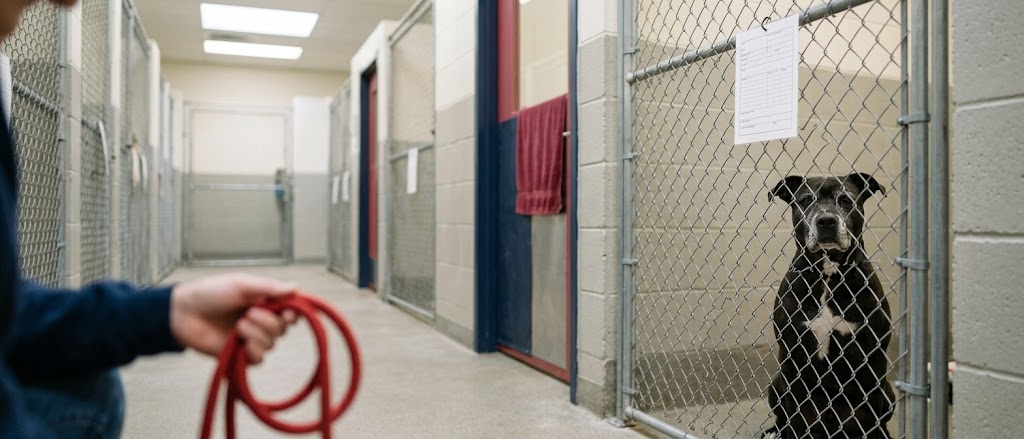
Shelter Animals Count reports 236,000 adult dogs waiting in U.S. shelters and rescues at mid-year 2026, or 66% of all dogs in care. Steady intake, lagging adoptions, slower transfers and housing restrictions leave many adult dogs waiting for homes.
Adult dogs are piling up in U.S. shelters in 2026, and the newest shelter dog statistics show why. Shelter Animals Count's mid-year data counts 236,000 adult dogs in care and waiting, which is 66% of every dog still looking for an outcome.
Puppies get adopted. Grown dogs wait.
I've volunteered with Chicago shelter dogs since 2017, so I've watched this happen 1 kennel card at a time. This Let Them Be Dog report pulls the national numbers, zooms in on Chicago Animal Care and Control and ends with what you can do about it. Spoiler: you don't need to adopt 6 dogs. 1 is plenty.
How Many Dogs Are in U.S. Animal Shelters in 2026?
The short answer is about 358,000 dogs. The long answer needs a calculator.
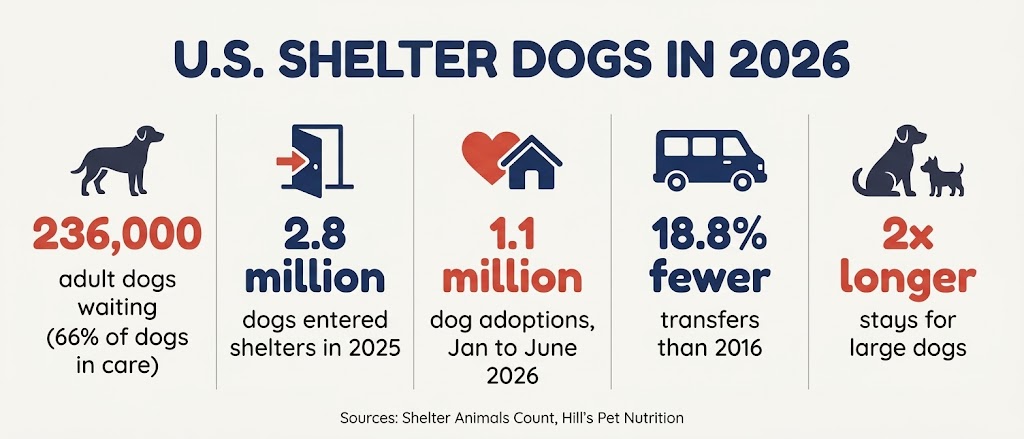
Shelter Animals Count runs the national database that most shelters report into. Its 2026 mid-year summary, released October 6, 2026, says 236,000 adult dogs were in care and waiting. That's 66% of all dogs in care, which works out to roughly 358,000 dogs total. I did that math, so blame me, not them.
That's a snapshot, though. Over a full year the flow is way bigger. Shelter Animals Count's 2025 Annual Data Report estimates 2.8 million dogs entered shelters and rescues in 2025. The ASPCA's summary of that data says about 2 million dogs were adopted, 542,000 went home to their owners and 320,000 were euthanized.
There's good news in there. Dog euthanasia dropped nearly 7% from 2024 to 2025, and the combined dog and cat euthanasia rate fell from 10% in 2019 to 8% in 2025.
The bad news is the line at the front door. The mid-year summary found 213,000 more animals entered shelters than left them in the first half of 2026. That figure counts cats and dogs together, but a 70-pound dog takes up a lot more room than a kitten.
Why Are So Many Adult Dogs Stuck in Shelters?
There's no single villain here, just 3 slow leaks in the same boat.
Adoptions Haven't Caught Up
Dog adoptions hit 1.1 million in the first half of 2026. Sounds great until you read the next line, where Shelter Animals Count notes that total is still 72,000 adoptions below 2016.
Meanwhile, dog intake stayed "relatively stable," in Shelter Animals Count's words. So the same number of dogs keep walking in the front door, and less of them walk out the back with a new family.
Transfers Slowed Way Down
A transfer is when a crowded shelter sends a dog to a rescue or another shelter with room. Transfers work. Shelter Animals Count says about 94% of transferred animals end up adopted.
But transfers in 2026 are running 18.8% below 2016 levels, or 117,000 fewer animals getting a ride out. Rescues are full too. Can't really blame them, they've got their own kennel math to do.
Small Dogs Leave First
Puppies and little dogs fly off the adoption floor. Shelter Animals Count's 2025 report says the dogs transferred out of shelters were mostly small and medium dogs.
So the dog left behind tends to be grown, big and a little goofy on leash. Basically my type.
Thinking about an adult dog? Our guide to how grown rescue dogs settle in walks through the first 3 days, 3 weeks and 3 months.
Do Big Dogs Wait Longer in Shelters?
Big dogs wait longer. It's not even close.
Hill's Pet Nutrition's 2026 State of Shelter Pet Adoption Report found large dogs spend about twice as long in shelters as medium and small dogs. Hill's counts a dog as large at 61 pounds or more. Those big guys make up 26% of shelter and rescue intakes.
The strange part is that people say they want big dogs. In the same report's survey of 2,000 Americans, 35% said they'd prefer to adopt a large dog.
So the problem isn't love. It's landlords, small cars and the fear of getting dragged down the block. That last one is fixable with a good harness and our leash and training basics.
Best Friends Animal Society says the average adult shelter dog weighs about 44.6 pounds, based on admissions data from nearly 300 U.S. shelters.
Now look at how apartment size limits hit big shelter dogs. Best Friends says typical rental weight limits land in the 40 to 50 pound range. The average shelter dog is sitting right on that line, and 1 extra winter of snacks pushes him over.
Big dogs also look scarier in a kennel. A 70-pound dog jumping at the gate reads as "too much," when he's just thrilled somebody stopped.
How Do Rental Rules Keep Shelter Dogs From Getting Adopted?
If you rent, you already know this pain.
Michelson Found Animals' 2025 Pet-Inclusive Housing Trends Report says 80% of rentals that allow pets still enforce breed restrictions. 64% impose weight limits. And 72% of renters say finding pet-friendly housing is hard.
Best Friends cites Pet-Inclusive Housing Initiative data showing less than 10% of rental properties have no breed or weight rules at all. Under 10%. Your odds are better finding street parking near Wrigley on a game day.

Housing doesn't just keep dogs from leaving shelters. It sends them in. A Best Friends review of 1.1 million owner-surrender records found housing was the second most common reason people gave up a pet, at nearly 14% of cases.
The rules hit some dogs harder than others. Pit bull type dogs, big dogs and dogs with cropped ears get crossed off a list before anyone meets them. In 2025, a CACC spokesperson told WTTW that landlords barring pit bulls is part of what's driving surrenders in Chicago.
I'm a little biased, since my dog Oscar is a pibble. Most of the pibbles I've handled are dangerous to exactly 1 thing, and it's an unguarded sandwich.
What Do the 2026 Shelter Dog Statistics Show at a Glance?
Here's every national figure from this post in 1 table. Screenshot it, cite it or wave it at the cousin who thinks "all shelter dogs are broken."
Quick note on where these come from. Shelter Animals Count gathers data from more than 13,000 shelters and rescues, then builds national estimates from it. So treat these as the best numbers available, not a headcount of every kennel in America.
| Measure | Number | Period | Source |
|---|---|---|---|
| Dogs entering shelters and rescues | 2.8 million | 2025 | Shelter Animals Count 2025 Annual Data Report |
| Dogs adopted | About 2 million | 2025 | Shelter Animals Count 2025 Annual Data Report |
| Dogs returned to owners | 542,000 | 2025 | ASPCA summary of Shelter Animals Count data |
| Dogs transferred to other groups | 530,000 | 2025 | ASPCA summary of Shelter Animals Count data |
| Dogs euthanized | 320,000 (down nearly 7% from 2024) | 2025 | ASPCA summary of Shelter Animals Count data |
| Dog adoptions | 1.1 million (72,000 below 2016) | January to June 2026 | Shelter Animals Count 2026 Mid-Year Data Summary |
| Adult dogs waiting for outcomes | 236,000 (66% of dogs in care) | Mid-year 2026 | Shelter Animals Count 2026 Mid-Year Data Summary |
| All dogs waiting for outcomes | About 358,000 | Mid-year 2026 | Let Them Be Dog estimate from Shelter Animals Count figures (236,000 / 0.66) |
| Shelter transfers vs. 2016 (cats and dogs) | 18.8% lower (117,000 fewer animals) | 2026 | Shelter Animals Count 2026 Mid-Year Data Summary |
| More animals in than out (cats and dogs) | 213,000 | January to June 2026 | Shelter Animals Count 2026 Mid-Year Data Summary |
| Large dogs (61 lb or more) | 26% of intakes, about 2x longer stays | 2026 report | Hill's Pet Nutrition 2026 State of Shelter Pet Adoption Report |
Shelter Animals Count builds national estimates from data shared by more than 13,000 shelters and rescues. Figures are estimates, not a full headcount.
Lined up like this, the pattern is hard to miss. Fewer dogs are dying in shelters than in 2019, which is real progress. But most of the dogs doing the waiting are adults.
Ready to meet a grown-up dog? Read what pickup night actually looks like before you head to the shelter, so night 1 isn't a guessing game.
Chicago Shelter Dog Statistics: What CACC's 2025 Numbers Show
National numbers get abstract fast. So let's go to my backyard: Chicago Animal Care and Control on South Western Avenue.
CACC is the city's open-admission shelter. It takes in strays, seized animals and surrendered pets, whether the kennels are full or not.
And the kennels have been very full. Axios Chicago reported in March 2026 that CACC took in more than 17,000 dogs and cats in 2025, up from about 14,500 in 2019. Nearly 3,800 were euthanized, almost double the 2019 total.
PAWS Chicago's 2025 report on its 360@CACC program puts the exact intake at 17,788 live cats and dogs. That's up 16.6% from 2024 and 51% over 2022.
Here's where dogs fall behind cats.
| Measure | Dogs | Cats |
|---|---|---|
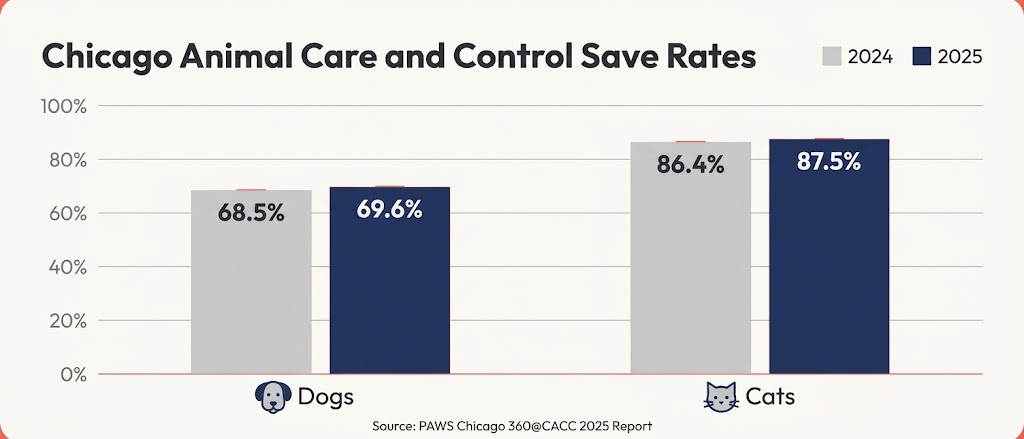
| Save rate in 2025 | 69.6% (68.5% in 2024) | 87.5% (86.4% in 2024) |
| Adoption growth vs. 2024 | Up 6% (73 more dogs) | Up 30% (534 more cats) |
| Transfer growth vs. 2024 | Up 27% (823 more dogs) | Up 19% (783 more cats) |
| Added euthanasias vs. 2024 | 268 more (up 11%) | 110 more (up 13%) |
Source: PAWS Chicago, Chicago Animal Care & Control and 360@CACC 2025 Annual Report. Total CACC intake was 17,788 live cats and dogs, and total euthanasias were 3,758.
Read that save rate twice. CACC's save rate for dogs was 69.6% in 2025, compared with 87.5% for cats. Roughly 3 in 10 dog outcomes at CACC weren't live ones, while for cats it was closer to 1 in 8.
Dog adoptions grew just 6% while cat adoptions jumped 30%. Transfers did the heavy lifting for dogs, rising 27%. WTTW also reported that dogs made up 60% of CACC's 2,455 euthanasias back in 2024.
The same PAWS report says money and housing problems account for 1 in 3 owner surrenders at CACC. That's the national rental story, playing out on Western Avenue.
What I See From Inside the Kennels at CACC
I volunteered at The Anti-Cruelty Society from 2017 to 2023 and have been at CACC since 2023. Dog handling, agility, adoption showings, photos. If it involves a leash, I'm probably there.
Numbers tell you how big the problem is. Kennels tell you what it feels like.
The dogs I root for hardest are momma dogs, seniors, black pibbles and anyone with cropped ears. Basically whoever's been there the longest. Not by accident, they're also the dogs these numbers describe.
Is Adopting an Adult Shelter Dog a Good Idea?
Biased volunteer alert. But let me make the case anyway.
A puppy is a mystery box. Nobody knows the final size or energy level yet, including the puppy.
An adult dog is what you see. Staff and volunteers have watched that dog for weeks and can usually tell you if he likes cats, hates the vacuum or melts for a butt scratch.
Adult dogs also skip the worst puppy stuff. No 3 AM potty trips every 2 hours, no shark teeth on your ankles and usually less chewed baseboards.
There is a catch, and I'd be lying if I skipped it. Adult dogs come with history. Some need time to trust you, and plenty will skip a meal or 2 at first. Our guide to a new dog skipping dinner the first few days covers what's normal.
Then there's the math. Every adult dog adopted opens a kennel for tomorrow's stray, and in a full shelter that matters more than any check I could write.
Worried an adult dog won't show his real self right away? Our 2-week quiet plan for a newly adopted dog gives a grown shelter dog time to relax.
What Should You Look for When Meeting an Adult Shelter Dog?
Kennel behavior lies. A dog spinning in circles and barking at the gate might be the chillest dog in the building once he's outside.
So ask to meet him in a play yard or a quiet room. Give it 15 minutes, since the first 5 are just sniffing and zoomies.
Here's my short list from years of adoption showings at The Anti-Cruelty Society and CACC.
- Ask how long the dog has been at the shelter and whether he's spent time in foster.
- Read the intake notes, then ask what's changed since.
- Watch how fast the dog settles after the first burst of excitement. Recovery tells you more than the jumping does.
- Bring everyone who lives with you, and set up a meet with your resident dog if you have one.
- Ask the volunteers too. We see these dogs on walks, in the yard and at 4 PM when everyone's tired.
- Check your lease for breed and weight rules before you fall in love. Do it first. Seriously.
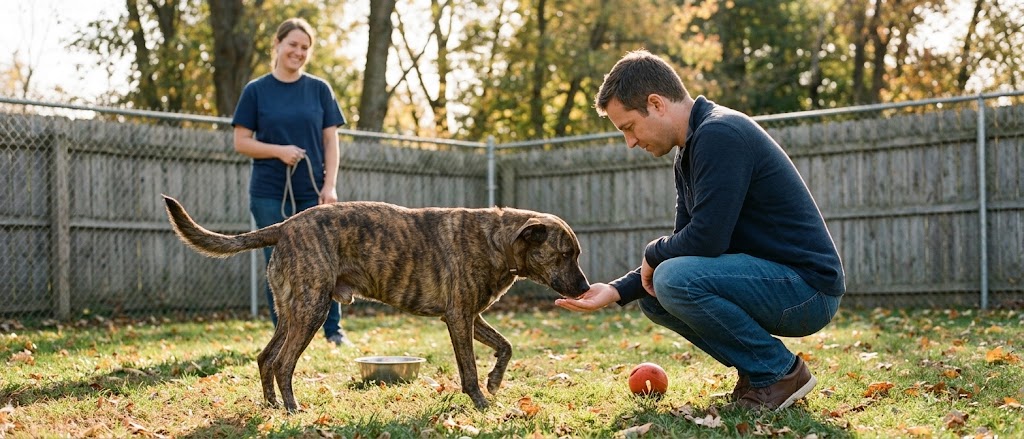
1 more tip. Ask staff which dogs have waited the longest. They always know, and those dogs are often great once they're out of the noise. If tummy trouble worries you, our post on stomach upsets in the first weeks home has you covered.
How Can You Help Shelter Dogs If You Can't Adopt Right Now?
Not everybody can adopt right now. A strict lease, a travel schedule, a cat who'd file for divorce. Totally fair.
Fostering is the closest thing to adopting without the forever part. You take a dog home for a few weeks and the shelter gets an open kennel. The next adopter gets real notes like "house trained, scared of the dishwasher." Many shelters and rescues cover food and vet care for fosters, so ask yours.
Volunteering is the other big one. A walk, a yard session or a decent photo can get an overlooked dog noticed. Shelters love homemade enrichment too, and our simple sniff and puzzle ideas work in a kennel.
Then there's the stuff you can do from the couch.
Share adoptable dogs from your local shelter's page, especially the long-stay adults
Order supplies off a shelter's wish list, since CACC told CBS Chicago in 2025 it was running low on pet food for families in crisis
Tell your landlord or building manager you want pet-inclusive rules
Drive for a rescue that pulls dogs from a full city shelter
Rescues that pull from city shelters need fosters most of all, since every foster home means 1 more transfer.
Go Meet the Dog Who's Been Waiting
The numbers are huge, but the fix starts small: 1 adult dog and 1 empty kennel. Find checklists for your first weeks with a grown rescue dog on the Let Them Be Dog homepage.
Common questions
How many dogs are euthanized in U.S. shelters each year?
About 320,000 dogs were euthanized in U.S. shelters and rescues in 2025, according to Shelter Animals Count data shared by the ASPCA. Dog euthanasia fell nearly 7% from 2024 to 2025. The combined dog and cat euthanasia rate in U.S. shelters dropped from 10% in 2019 to 8% in 2025.
What is the most common outcome for dogs in U.S. shelters?
Adoption is the most common outcome for dogs in U.S. shelters, with about 2 million dogs adopted in 2025. Shelter Animals Count data also shows 542,000 dogs returned to their owners and 530,000 dogs transferred to other organizations that year. Strays are 6 times more likely to be reunited with owners if the stray is a dog rather than a cat.
Why do people surrender dogs to shelters?
People surrender dogs to U.S. shelters because of housing limits, veterinary costs and behavior challenges, according to the ASPCA. A Best Friends Animal Society review of 1.1 million owner-surrender records found housing was the second most common reason, at nearly 14%. Owner surrenders made up 30% of U.S. dog and cat intake in 2025.
How long do dogs stay in shelters before adoption?
Length of stay for dogs in U.S. shelters depends on size, age and the shelter, and no single national average covers every dog. Hill's Pet Nutrition's 2026 report found large dogs stay about twice as long as small and medium dogs. Shelter Animals Count reported shorter median stays from intake to adoption across every organization type in 2025.
Are animal shelters more crowded now than before the pandemic?
Many U.S. animal shelters are more crowded in 2026 than before the pandemic, especially with adult dogs. Shelter Animals Count found 213,000 more animals entered shelters than left in the first half of 2026. Chicago Animal Care and Control took in more than 17,000 dogs and cats in 2025, up from about 14,500 in 2019.
Is Chicago Animal Care and Control a no-kill shelter?
Chicago Animal Care and Control is an open-admission city shelter, which means it takes in strays, seized animals and surrendered pets even when full. CACC's save rate for dogs was 69.6% in 2025, compared with 87.5% for cats, according to PAWS Chicago's 360@CACC report. Open-admission shelters cannot cap intake the way many private shelters do.
Where do U.S. shelter dog statistics come from?
Most national shelter dog statistics come from Shelter Animals Count, a national database for animal sheltering data and a program of the ASPCA. Shelter Animals Count builds national estimates from data shared by more than 13,000 shelters and rescues. City shelters like Chicago Animal Care and Control also publish their own intake and outcome reports.
About the Author
I’m Jeff Molitor and I adopted my first dog at 39 (Cooper Wonder) and have volunteered with Chicago shelter dogs since 2017, first at The Anti-Cruelty Society and now at Chicago Animal Care and Control. I help with dog handling, agility, adoption showings and support, photography and marketing. I love all dogs, but I gravitate toward momma dogs, seniors, black pibbles and the ones with cropped ears. Basically whoever’s been overlooked the longest. Jeff is dad to Oscar Wonder (pibble) and Gary Wonder (our cat).
This article shares what we have learned from our own experience. It is not medical advice, and we are not veterinarians. If you have any concerns about your dog's health, please check with your vet.