Family & Other Pets
Introducing a Shelter Dog to Your Cat Without Chaos: A Step-by-Step Plan for the First Weeks
Published · By Jeff Molitor
Introducing dog to cat goes best in stages: scent swapping, gate sightings and leashed sessions. Some shelter dogs aren't cat-safe, and a hard stare shows it.
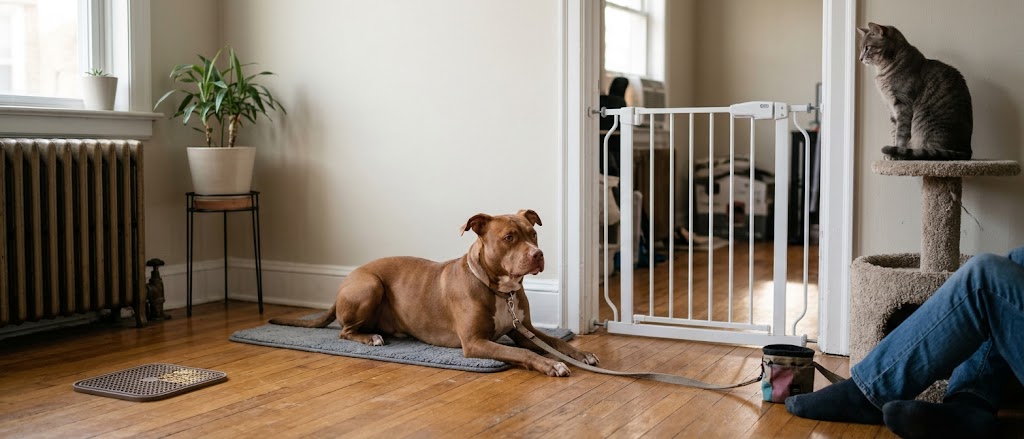
The short answer
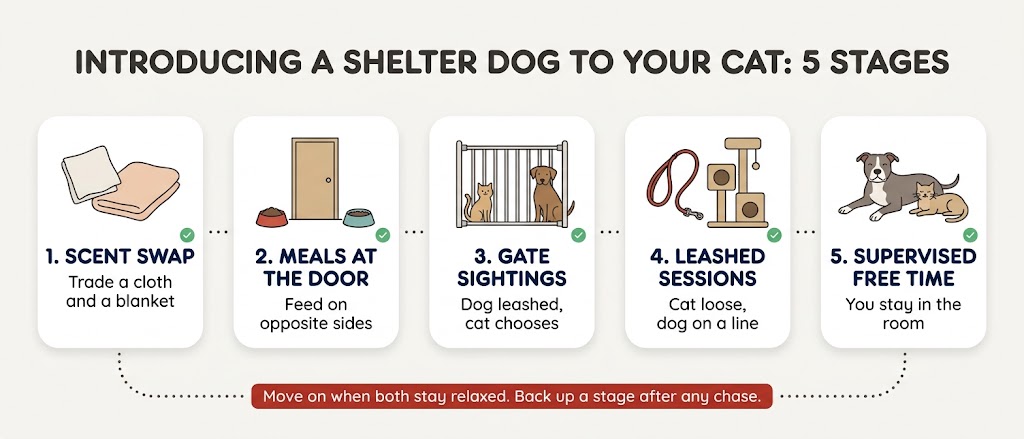
Introducing a new dog to a cat works best in 5 stages: separate rooms, scent swapping, gate sightings, leashed sessions and supervised free time. Each stage of a dog and cat introduction lasts until both animals stay relaxed, which takes days for some pairs and months for others. A shelter dog should start the visual part of a cat introduction after a few calm days of decompression at home.
Introducing a shelter dog to your cat works best as a slow, staged plan, since a stressed new dog and a suspicious cat make a lousy first date. Most advice on introducing dog to cat assumes a puppy or a dog with a known past, and a shelter dog is neither.
I live this one. My pibble Oscar shares a house with Gary Wonder, a cat who considers himself management.
This Let Them Be Dog plan walks through baby gates, scent swapping and leashed sessions, stage by stage. It also covers what a "cat tested" note can't promise. And some dogs just aren't safe with cats, so I'll show you how to tell. A wrong guess here costs a cat, not a couch cushion.
How Do I Introduce My New Dog to My Cat?
Short version: slow, then slower.
The plan has 5 stages. The dog and cat live apart at first. Then they swap smells, see each other through a gate and share a room with the dog on a leash. Free time together comes last, and only with you watching.
Behavior moves you forward, not the calendar. A dog who glances at the cat and goes back to his chew is ready. A dog who stares like the cat owes him money is not.
Shelter dogs add a wrinkle most guides skip. Your new dog just left a loud kennel, and he's running on fumes. A cat on day 1 stacks a big new stressor on top of all that.
So give him a few days of the quiet 2-week stretch every new shelter dog needs before the gate sightings start. Scent swapping can begin right away, since it asks nothing of him.
The cat gets a vote too. Cats set the pace in mixed homes. A cat who spends 3 days under the bed is telling you to slow down, and you should listen.
Is It Easier to Add a Dog When the Cat Lived There First?
Good news: the cat was probably there first.
Researchers at Tel Aviv University studied dogs and cats sharing a home. Their 2008 study in Applied Animal Behaviour Science found pairs did better when the cat was adopted before the dog. Pairs also did better when they met young, up to about 6 months for cats and 1 year for dogs.
Most pairs also learned to read each other's body language, which is impressive. A swishing tail means opposite things to each species.
Shelter adopters rarely get to line up a 10-month-old dog with a 4-month-old kitten. But "cat first" is on your side.
A 2018 University of Lincoln survey in the Journal of Veterinary Behavior asked 748 owners about their pets. More than 80% said their cat and dog were comfortable together. Only 3% said the 2 couldn't stand each other.
The twist: cats were about 3 times more likely to threaten the dog than the other way around. Fewer than 10% of cats and about 1% of dogs ever hurt the other animal, the researchers reported.
So the cat runs this. Plan around the cat.
The best cat-safety skill is a dog who looks back at you. Practice the name and look-at-me games in our training basics for a few days before the first gate sighting.
What Should You Ask the Shelter Before Bringing a Dog Home to a Cat?
A "cat tested" note sounds official. Sometimes it means 1 staff member walked a dog past the office cat on a Tuesday.
That's not a knock on shelters. Cat safety is just hard to test, and researchers at Canisius University said so in their study of how dogs react to cat sights, sounds and smells. No validated method predicts how a shelter dog will act around cats unless his history is known.
They tested 69 pet dogs, and the dogs reacted more to recorded cat sounds than to a lifelike cat doll or the smell of cat urine. Dogs with a history of hurting cats or other small animals spent the longest orienting toward those sounds.
So treat any cat note as 1 clue, not a verdict. I already covered how shelters decide a dog gets a "no cats" tag, so here I'll stick to what to ask.
Where did the cat info come from? A past owner, a foster, a staff test or a guess. Ask who saw it.
What happened, exactly? "Fine with cats" could mean he ignored a sleeping cat or played gently with foster kittens.
How does he act with squirrels and small dogs? Lunging and freezing on walks count.
Has he lived in a foster home with cats? That's the best evidence you'll get. If not, ask about a foster-to-adopt trial.
Can I meet him outside the kennel? Kennel noise hides the real dog, and that's why kennel behavior can fool you.
What happens if it doesn't work? Ask about returns now.
How Should You Set Up Your Home Before Pickup Day?
Do this before the dog is in your car. Assembling a baby gate while a 60-pound pit mix supervises is not the vibe.
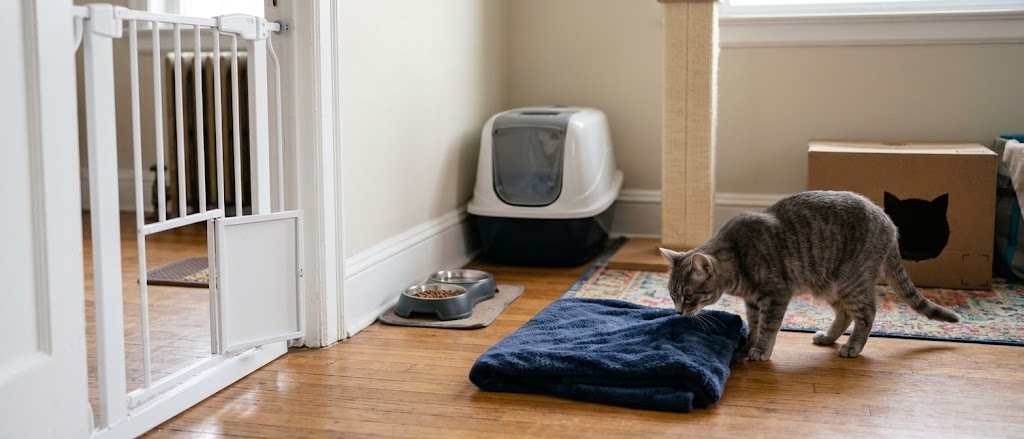
Start with the cat's base camp. Pick 1 room the dog never enters and stock it: litter box, food, water, a scratching post and a hiding spot. Move the cat in a few days early so it feels normal.
Then gate it. A pressure gate with a small cat door works. So does a regular gate mounted about 5 inches off the floor, so the cat can slip under and the dog can't. Tall dogs can hop short gates, so buy taller than you think.
Go vertical everywhere else. Cat trees, cleared shelves and the top of the fridge give a cat an exit in every room. A cat with a high exit stays calmer, and a calm cat is less likely to bolt. Bolting is what turns a curious dog into a chasing dog.
Last, think like a dog with a snack problem. Cat food is candy to dogs, and the litter box is, well, worse. Keep both behind the gate.
Your new dog needs a quiet zone of his own too, and the first-night setup for a rescue dog works fine for it.
Still shopping for gates and crates? Grab our pickup day list of what a rescue dog actually needs and set up the cat's room first.
The 5-Stage Plan for Introducing a Dog to a Cat
Each stage below has a rule for moving on and a rule for backing up. Backing up is normal, and it's how most pairs get there. Blue Cross, the UK pet charity, notes that some dog and cat introductions take several months.
Try and keep every session short. 5 calm minutes beats 30 tense ones.
Stage 1: Scent Swapping
Swap smells before anyone sees anyone. Rub a soft cloth on the cat's cheeks and leave it near the dog's bed. Do the reverse with the dog's blanket in the cat's room.
Blue Cross also suggests petting 1 animal and then the other without washing your hands in between. Move on when both sniff the swapped item and wander off bored.
Stage 2: Meals Through a Door
Feed them on opposite sides of a closed door. Start the bowls far apart and inch them closer over a few days. Food makes the other animal's smell mean something good. Move on when both eat normally right by the door.
Stage 3: Gate Sightings
Swap the door for the gate. Leash the dog, sit a good distance back and let the cat choose how close to come. Toss the dog a treat every time he looks at the cat and then looks away.
Move on when the dog can lie down near the gate while the cat walks past.
Stage 4: Leashed Room Sessions
The cat comes out. The dog stays on a leash or a lightweight house line you can step on, with a chew or lick mat across the room. The cat needs high perches and an open exit. Move on after several sessions in a row where the dog stays loose, even when the cat moves fast.
Stage 5: Supervised Free Time
Drop the leash but leave the house line on. Stay in the room and separate them every time you leave the house, even for 10 minutes. Plenty of homes keep the gate up for good.
| Stage | What You Do | Move On When | Back Up If |
|---|---|---|---|
| 1. Scent swapping | Swap a cloth rubbed on the cat's cheeks and the dog's blanket between rooms | Both sniff the swapped item and wander off bored | Either one hisses, growls or avoids the item. Keep it farther away for a few days |
| 2. Meals through a door | Feed both on opposite sides of a closed door, inching the bowls closer | Both eat normally right by the door | Either one stops eating near the door. Move the bowls back |
| 3. Gate sightings | Leashed dog, open door, baby gate in place. Treat the dog for looking at the cat and looking away | The dog can lie down near the gate while the cat walks past | The dog stares hard, whines or lunges, or the cat hides for hours. Add distance or return to stage 2 |
| 4. Leashed room sessions | Cat loose with high perches and an exit. Dog on a leash or house line with a chew | Several sessions in a row where the dog stays loose, even when the cat moves fast | The dog fixates or lunges, or the cat stops coming out. Go back to the gate |
| 5. Supervised free time | Leash off, house line on, you in the room. Separate them whenever you leave | There's no finish line. Keep supervising, and keep the gate if it helps | Any chase happens. Return to leashed sessions for a few days |
Keep sessions short. Some pairs move through all 5 stages in a few weeks, and some need several months.
How Long Does It Take a Dog to Get Used to a Cat?
I wish I had a number for you. The honest answer is weeks for a lot of pairs and months for some. The cat often needs longer than the dog, and a cat who's been the only pet for 8 years is allowed to stay offended a while.
A mellow dog and a confident cat might cruise through all 5 stages in a few weeks. A bouncy young dog and a cat who's never met a dog can take a couple of months, sometimes longer.
Shelter dogs run on their own clock. Plenty mind their manners at first and get bolder as they relax. That's the 3 days, 3 weeks, 3 months curve, and it matters here.
The dog who ignored the cat in week 1 may get curious in week 4, once he feels at home. So don't pull the gate because week 1 was easy. Hang out at stage 4 or 5 a little longer than feels necessary.
Our guide to how long most rescue dogs take to settle covers what tends to shift and when.
Rushing is how cat introductions go sideways. Read the homepage guide to a calm first 2 weeks, then let the boring sessions do their job.
How Can You Tell If a Shelter Dog Isn't Cat-Safe?
This is the part most guides tiptoe around. Some dogs shouldn't live with cats. Not "need more time." Shouldn't.
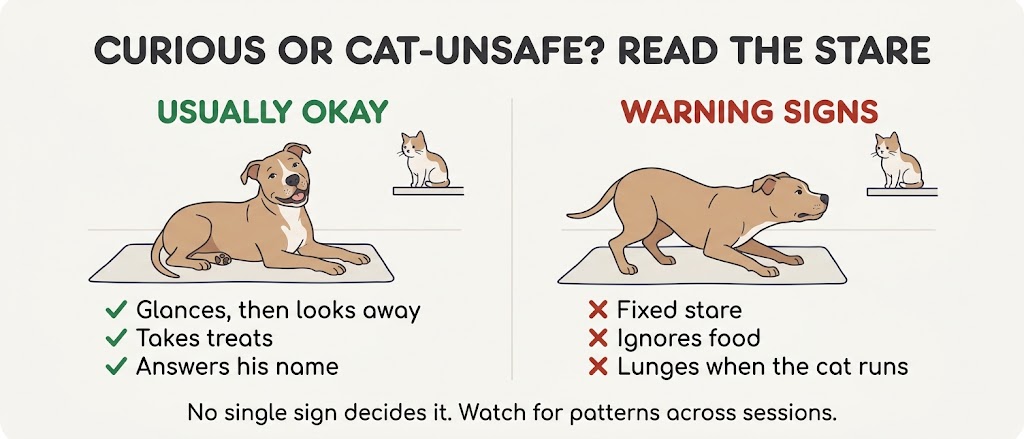
There's 2 kinds of staring. Curious staring comes with a soft body, blinking, maybe a head tilt and a quick look away. Predatory staring is stiff and silent. The mouth closes, the ears go forward and the dog stops hearing his own name.
Watch what happens when the cat moves fast, because chasing is where trouble lives. A dog who quivers, whines, drops low or lunges when the cat runs is showing prey drive. Management and training can help, but they can't guarantee a cat's safety.
Food tells you a lot. A dog who takes a treat near the cat is still in thinking mode. A dog who suddenly ignores chicken is too locked in to learn anything.
Small signals add detail too, and what a lifted front paw is telling you applies here. Play isn't automatically safe either, a play bow at a cat can turn into a body slam, and a 60-pound dog can hurt a 10-pound cat without meaning to.
My line is simple. If the dog has hurt a cat before, or a few weeks of real work never produce several calm sessions in a row, it's not a match. Calling it is the kind thing for all 3 of you.
| Moment | Usually a Good Sign | Warning Sign |
|---|---|---|
| First look at the cat | A glance, then a look away | A fixed stare that won't break |
| Face and ears | Soft eyes, blinking, maybe a head tilt | Mouth clamps shut, ears pin forward |
| Body | Loose, wiggly or flopped on a mat | Frozen, trembling or dropped into a low crouch |
| When the cat runs | Watches, then settles again | Quivers, whines or lunges to follow |
| Treats nearby | Takes food and answers a cue | Ignores even chicken |
| Cat sounds from another room | Ears flick toward a meow, then he goes back to his chew | Locks onto the sound and stays there |
| Play | Gentle, brief and easy to call off | Body slams, pinning or chasing that won't stop |
No single sign decides it. Look for patterns across several sessions. A dog with a history of hurting a cat needs a cat-free home.
What Should You Do If Your Dog Chases the Cat?
It'll probably happen once. Breathe.
Step on the house line or grab the leash. Don't grab the dog's collar mid-chase, since hands get bitten in a scramble. Calmly lead the dog to another room and let the cat reach high ground.
Skip the yelling. From the dog's side, the cat showed up and then a human exploded. That makes the cat feel like bad news, the opposite of what you're building.
Afterward, look at the setup. Maybe the session ran long, the cat sprinted past at close range or the doorbell had the dog wound up.
Then go back a stage for a few days.
If chasing keeps happening, bring in help. A certified reward-based trainer or a veterinary behaviorist can watch your actual animals in your actual living room. It helps to know what a trainer actually costs before you need one.
A cat who stops eating or skips the litter box after a scare needs a call to the vet.
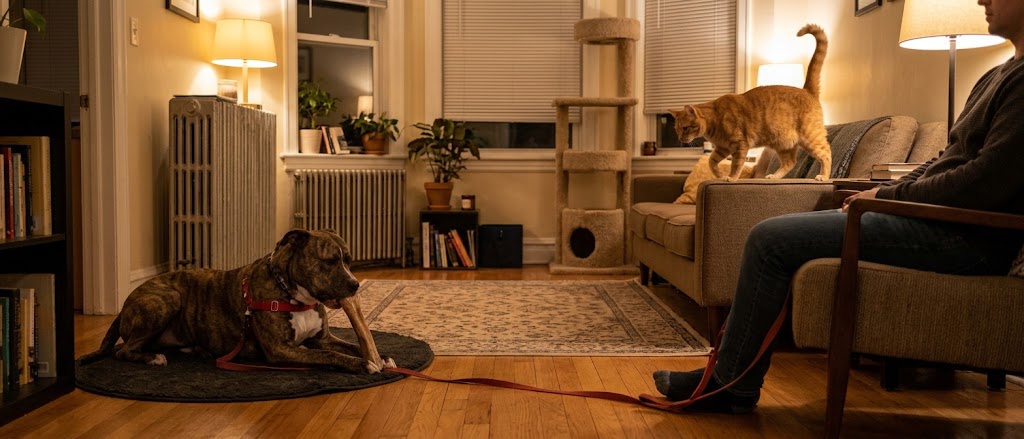
Life With Oscar and Gary Wonder
I adopted my first dog, Cooper Wonder, at 39. Today the house belongs to Oscar Wonder, my pibble, and Gary Wonder, our cat. Mostly Gary.
I've volunteered with Chicago shelter dogs since 2017, first at The Anti-Cruelty Society and now at Chicago Animal Care and Control. At adoption showings, "Is he good with cats?" comes up all the time.
"The best cat introductions are boring," says Jeff Molitor, a Chicago shelter volunteer since 2017. "If you're bored, the cat is probably fine."
Slow Is the Shortcut
Introducing dog to cat on a shelter dog's timeline takes weeks, and every boring gate session counts. When the cat's up on the cat tree and the dog's snoring on his bed, you won. Find more Let Them Be Dog guides for the first months with a shelter dog on the homepage.
Common questions
Can a dog with a high prey drive live with a cat?
A dog with a high prey drive can sometimes live with a cat, but only with strict management and plenty of dog-free space for the cat. A dog with a history of injuring a cat belongs in a cat-free home. A certified trainer can help judge borderline cases.
Is a dog who lived with cats before automatically safe with a new cat?
A dog who lived with cats before is not automatically safe with a new cat. A dog who ignored a calm older cat may still chase a young, zippy one. Past cat experience is a good sign, but a new dog and cat still need a staged introduction.
Can you leave a new dog and a cat home alone together?
A new dog and a cat should not be left home alone together until weeks of supervised sessions go smoothly. Many households separate a dog and cat with a closed door or a gate whenever nobody is home, sometimes for good.
What should you do if your cat hides or stops eating after the new dog arrives?
A cat who hides after a new dog arrives needs more dog-free space and a slower introduction. Hiding for a day or 2 is common while a cat adjusts. A cat who stops eating or stops using the litter box needs a call to the vet, since cats can get sick quickly without food.
Should a dog wear a muzzle when meeting a cat?
A basket muzzle can add a safety layer during a dog and cat introduction, but only for a dog already trained to wear one comfortably. A muzzle put on in a hurry adds stress. A muzzle also does not stop chasing or pinning, so leashes, gates and supervision still come first.
Should you let a dog and cat work it out on their own?
Letting a dog and cat work it out on their own is risky, because 1 bad chase can shape how both animals feel for months. A large dog can injure a cat quickly, even during play. A staged introduction prevents a bad first impression that is hard to undo.
About the Author
I’m Jeff Molitor and I adopted my first dog at 39 (Cooper Wonder) and have volunteered with Chicago shelter dogs since 2017, first at The Anti-Cruelty Society and now at Chicago Animal Care and Control. I help with dog handling, agility, adoption showings and support, photography and marketing. I love all dogs, but I gravitate toward momma dogs, seniors, black pibbles and the ones with cropped ears. Basically whoever’s been overlooked the longest. Jeff is dad to Oscar Wonder (pibble) and Gary Wonder (our cat).
This article shares what we have learned from our own experience. It is not medical advice, and we are not veterinarians. If you have any concerns about your dog's health, please check with your vet.