Volunteer Life
The Return Hurts Most: Shelter Volunteers, Compassion Fatigue and the Guilt We Don't Owe
Published · By Jeff Molitor
Why a returned adoption hits shelter volunteers so hard, how burnout differs from compassion fatigue, and why the guilt was never ours to carry.
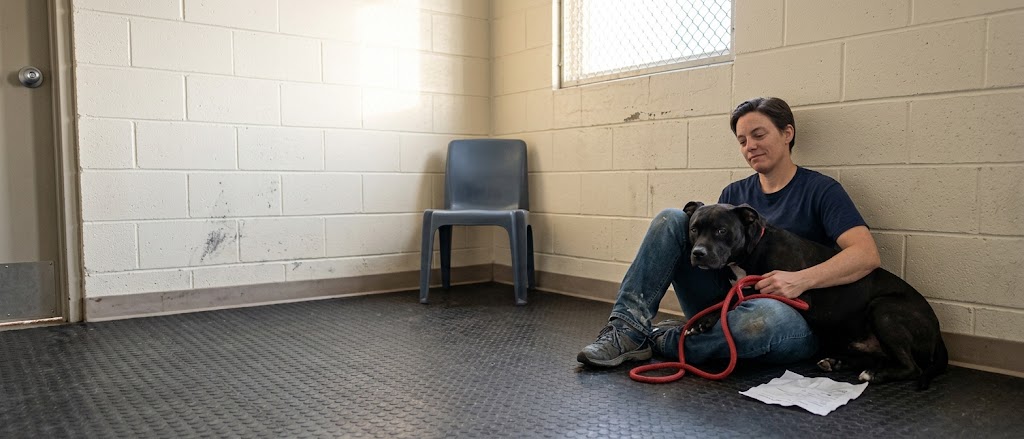
The short answer
Shelter volunteers feel guilty about returned dogs because the adoption showing is the moment volunteers can see and replay. Volunteers usually have little control over intake, medical care, matching or the adopter's home. Guilt after a return reflects how much a volunteer cares, not proof the volunteer failed.
Shelter volunteers take a returned adoption harder than almost anyone, and most of that guilt was never ours to carry. Animal shelter volunteer burnout doesn't usually come from the dog hair or the 7 AM shifts. It comes from the text that says your favorite dog is back.
I've done adoption showings in Chicago since 2017. The return still gets me every time.
So this Let Them Be Dog post is for the volunteers who replay a showing in the shower for 3 days. It's also for adopters, who rarely see how many people are pulling for their new dog. A showing is 1 hour of a dog's story. A return is a whole chain of things going sideways, and we're 1 link.
The Text That Ruins a Perfectly Good Tuesday
Let me tell you about Duke. He's a composite, built from a bunch of dogs I've walked, so no real dog's business is getting aired here.
Duke is a 4-year-old black pit mix with cropped ears and a head like a cinder block. He leans. Full body, all 68 pounds, right into your shins.
I showed him on a Saturday to a couple who laughed at every dumb thing he did. He rolled over in the play yard. He sneezed on the guy's shoe. They signed the papers before I'd even finished the "he's not a fan of cats" talk, and I drove home doing a little dance in my car.
Then Tuesday at 2:14 PM, my phone buzzed.
"Duke's back."
That's the whole text. No context, no details, just 2 words and a sinking feeling that lasts the rest of the week.
Within about 4 minutes I'd already decided it was my fault. I should've pushed harder on the cat thing. I should've noticed the guy checking his phone during the walk. I should have seen it.
Every volunteer I know has a Duke. Most of us have several.
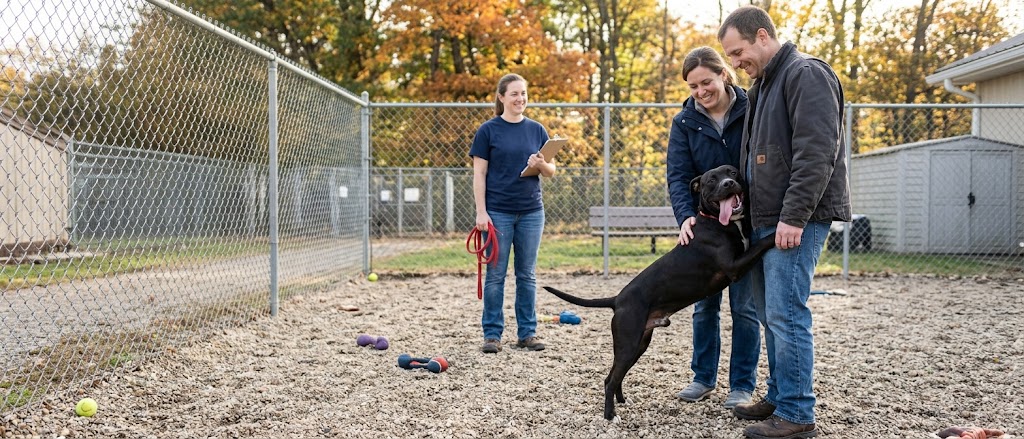
Why Do Shelter Volunteers Feel Guilty When an Adopted Dog Is Returned?
The showing is the part we can see. That's the whole problem.
A volunteer is right there when the leash changes hands. We're in the photo, holding the "I got adopted!" sign. So when a dog comes back, our brains rewind to the one scene we starred in and start editing it.
We don't replay the intake exam, though, or the behavior notes, or the adoption counselor's 20-minute conversation we never heard. We definitely don't replay what happened inside a stranger's apartment on night 3. Nobody gave us that footage.
Researchers have noticed the gap between what volunteers carry and what they control. A 2021 study of animal shelter volunteers in Michigan, summarized by Faunalytics, noted that volunteers usually have less say in shelter decisions than employees do. The authors linked better organizational support to lower compassion fatigue.
Less control and the same amount of love is a rough combo. It's how a person who spent 45 minutes in a play yard ends up feeling responsible for 3 weeks they weren't there for.
Volunteers also get attached in a weird, specific way. Staff juggle 100 dogs. A volunteer might walk the same 6 every Saturday for 2 months, so each of us are basically that dog's weekend person. When the dog comes back, it feels personal because, honestly, it kind of is.
But feeling responsible and being responsible are 2 separate things. It took me years to really get that.
Adopting a dog like Duke? Plan for the quiet first 14 days that keep a new dog home, because most rough starts happen right there.
What Is Animal Shelter Volunteer Burnout, and How Is It Different From Compassion Fatigue?
People use these terms like they mean the same thing. They overlap, but the source is different, and so is the fix. It's also different than most people expect.
Burnout is about the load. It's the 3rd weekend in a row covering an empty shift. It's the email asking for "just 1 more" walker, and the sense that kennels fill faster than anyone can empty them. You get tired, then cranky, then a little numb.
Compassion fatigue is about the caring itself. It builds from absorbing animal suffering week after week: the scared dogs, the injured ones, the ones who stop eating. It shows up as dread before a shift, or crying at a dog food commercial for no reason.
Shelter workers report a lot of both. In a 2023 survey of 243 staff members at 122 U.S. shelters, published by Faunalytics in 2025, 53.5% scored high for burnout. More than 90% scored high for secondary traumatic stress, among the highest levels the author had seen in published research.
Those are paid staff, but volunteers stand right next to them every shift.
| Question | Volunteer Burnout | Compassion Fatigue |
|---|---|---|
| Where it comes from | Workload, short staffing, empty shifts and a shelter that never gets less full | Caring for scared, sick or neglected animals week after week |
| How it feels | Tired, cranky, a little numb, dreading the shift schedule | Heavy, sad, on edge, replaying a dog's face at 2 AM |
| What a return does | Feels like 1 more thing on a full plate | Feels personal, like the volunteer let the dog down |
| What usually helps | Fewer shifts, firmer boundaries, a role change | Support groups, rest, debriefs and hearing about the dogs who stayed home |
The fix depends on which one you've got. Burnout usually wants fewer shifts and better boundaries. Compassion fatigue usually wants support, rest and someone who gets it.
How Many Hands Touch a Single Shelter Adoption?
Here's the exercise that finally helped me. I sat down and listed every person who touched Duke's adoption. I stopped counting at 15.
Before the Showing
Duke came in as a stray. An intake officer scanned him for a chip and wrote down the first notes. A vet team checked him over, vaccinated him and scheduled surgery.
Behavior staff watched him with other dogs. Kennel staff fed and cleaned up after him twice a day. A photographer, sometimes me, tried to make a 68-pound leaner look like a catch. Somebody wrote his bio.
The Showing Itself
Then I got my hour. An adoption counselor handled the paperwork and asked questions about the home, the schedule, the other pets. Their questions shaped the match far more than my play yard tricks did.
After the Car Door Closes
This is the part nobody at the shelter controls. A brand new dog walks into a house with new smells, new rules and maybe a cat staring from the stairs.
The adopter's patience matters here. So does their landlord, their work schedule, their roommate's opinion and whether anyone gave Duke a quiet first week. A lot of returns get decided in this window, and I wasn't in the room for a second of it.
| Who | What They Shape | What They Can't See |
|---|---|---|
| Intake staff | First notes, chip scan, where the dog came from | How the dog acts once the stress wears off |
| Vet team | Exam, vaccines, surgery, medical notes | Health issues that show up weeks later at home |
| Behavior staff | Playgroup notes, handling notes, match advice | How the dog handles a cat, a toddler or a dishwasher |
| Kennel staff | Daily care, feeding, cleaning, kennel routine | The dog outside the kennel row |
| Showing volunteer | 1 hour of introductions in a yard or meet room | The adopter's home, schedule, landlord and other pets |
| Adoption counselor | Screening questions, paperwork, the final match | How honest every answer on the form was |
| Adopter and household | Patience, routine, decompression, training, budget | Weeks of notes from people who knew the dog first |
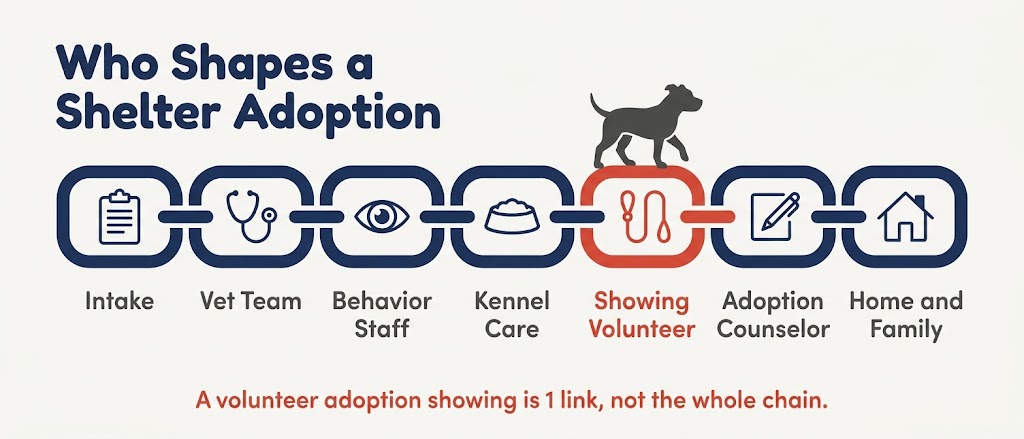
When you see the chain on paper, blaming the showing starts to look a little silly. That's the point.
Volunteers can only do so much in an hour. Adopters can do a lot more with training help for the weeks after adoption, so start there before day 1.
Why Do Adopted Dogs Get Returned to Shelters?
Returns happen a lot more often than adopters think, and the research says so pretty plainly.
A 2022 study in Scientific Reports reviewed earlier research and put the return range at 7% to 20% of all adoptions. The authors then looked at 1,999 people who returned animals to a South Carolina shelter between 2015 and 2019. That shelter's overall return rate was 9.2%.
Across dogs and cats, behavior topped the list at 32.8% of returns. Problems with pets already in the home came next at 21.5%. Changes in the owner's own life, like a move or a new job, made up 11.2%.
The timing got me. On average, those animals went back after just 8.68 days.
8 days. Most new dogs are still figuring out which door leads outside. Our guide to what weeks 1 through 3 really look like explains why so many dogs act strange that early.
A lot of returns happen before the dog has unpacked, so to speak. The first night alone can rattle an adopter who wasn't ready for whining at 3 AM, and a first night that doesn't go sideways takes some planning.
None of that was decided in my play yard. It was decided by a stressed dog and a stressed human trying to figure each other out on day 4.
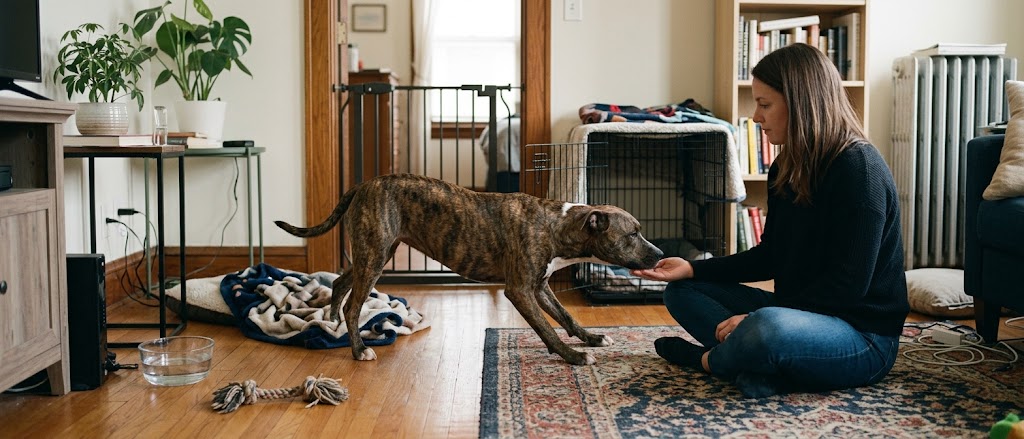
Does a Returned Dog Mean the Volunteer Failed?
Nope, and I spent years acting like the answer was yes.
Think about what a return actually brings back. He came back with notes: crate trained in 2 days, terrified of the dishwasher, absolutely not okay with the cat. That's information no kennel could've told us.
Those notes make the next showing better. My last showing doesn't get a grade from them.
The adopters aren't villains, either. The Scientific Reports authors wrote that unsuccessful adoptions are stressful for many owners. Plenty of people walk back through the shelter door feeling awful.
And some of them try again. 10.5% of the owners in that study adopted from the same shelter within 12 months of the return. Owners who returned an animal because of its health had about 4 times the odds of adopting again compared with owners who returned for behavior.
Duke's second showing went differently. The new adopter had no cats and a lot of time. Between you and I, I think he leaned on her harder than he ever leaned on me.
If you're the person who met a dog like Duke and walked away, remember that the dog you met behind the kennel gate is rarely the dog you'd live with.
What Should Volunteers Look for in a Shelter That Has Their Back?
You can't stop every return. You can pick a shelter that doesn't leave you alone with one.
A 2025 study in Human-Animal Interactions surveyed 143 shelter and rescue workers and volunteers. The most frequent stressor was pressure to place animals in homes. The most stressful moments were euthanasia, losing an animal they couldn't save and seeing abuse.
When asked what would help, respondents most wanted support groups. Not yoga, not a pizza party. Other people who get it.
The Michigan volunteer study pointed the same way. Its authors suggested grief and stress management training, plus letting volunteers rotate through different roles so nobody does the heaviest job forever.
Here's what I'd watch for in a shelter.
- Somebody tells you when your dog comes back, ideally with the reason, before you find out on the website.
- Staff explain outcomes, even the hard ones, instead of going quiet.
- Debriefs or a group chat exist for rough days.
- You can switch roles. Walking, photos, laundry duty and adoption showings all count.
- Nobody guilts you for skipping a weekend.
- Wins get shared too, like adopter updates, couch photos and "he finally sleeps through the night" emails.
That last one is underrated. Our brains keep score of the returns automatically. We have to be told about the 50 dogs who stayed.
The wins are out there, and so are the dogs still hoping for one. See how many adult dogs are still waiting in U.S. shelters, then pick your next dog to root for.
What Can Adopters Do to Keep a Dog From Coming Back?
Okay, adopters, this part's for you. The volunteers are rooting for you, and we mean it.
Ask us the boring questions at the showing.
What's he like at 5 PM? Has he met cats? What made the last adopter bring him back? We'll tell you, and nobody's offended.
Then plan for the real bill, not just the adoption fee. Our breakdown of what dog ownership really costs in 2026 is a good gut check. The gear you actually need before day 1 is a shorter list than the pet store wants you to believe.
Most of all, call before you return. A lot of shelters have behavior help lines, trainers or at least a staff person who's seen your exact problem 40 times. A dog who's "not working out" on day 6 is usually a dog who's still scared.
And if it truly doesn't work, bring the dog back with honest notes. Those notes give the next adopter a head start, and nobody should call that failing.
What 9 Years of Showings Taught Me About Setting It Down
I've volunteered with shelter dogs since 2017, first at The Anti-Cruelty Society and now at Chicago Animal Care and Control. The returns never got easy. I just got better at not hauling them home.
If you want something to do with your hands after a rough week, our kennel enrichment ideas for your next shift help the dogs who are still waiting.
Set It Down and Come Back Saturday
The return isn't yours to carry alone, and neither is the next win. Find guides for volunteers and new adopters on the Let Them Be Dog homepage, then go grab a leash.
Common questions
Is it wrong to return an adopted dog to the shelter?
Returning an adopted dog to the shelter is not wrong when the home truly cannot meet the dog's needs. Shelters prefer an honest return over a dog given away online or kept in an unsafe home. Adopters can make a return easier on the dog by sharing detailed notes on behavior, routines and triggers.
How soon do most adopted shelter dogs get returned?
Adopted shelter dogs that get returned often go back within the first few weeks home. A 2022 Scientific Reports study found animals were returned after an average of 8.68 days. Many early returns happen before a new dog has had time to decompress and show a settled personality.
Do people who return a shelter dog ever adopt again?
People who return a shelter dog sometimes adopt again, with about 1 in 10 adopting within 12 months in a 2022 Scientific Reports study. Owners who returned an animal for health reasons had about 4 times the odds of adopting again compared with owners who returned for behavior. A return does not always end a person's interest in shelter adoption.
How common is compassion fatigue among animal shelter workers?
Compassion fatigue and related stress are very common among animal shelter workers. A survey of 243 U.S. shelter staff members found more than 90% scored high for secondary traumatic stress. The same Faunalytics survey found 53.5% of shelter staff scored high for burnout.
Should I stop volunteering at a shelter if I feel burned out?
Stopping shelter volunteering is one option for burnout, but a break or a role change often helps first. Many shelters let volunteers move from adoption showings to laundry, photos, enrichment or event work. A few lighter weeks can ease animal shelter volunteer burnout without losing the dogs and people that make the work worth it.
How can shelters support volunteers after a hard return?
Shelters can support volunteers after a hard return by telling volunteers directly, explaining the reason and sharing the dog's next steps. Support groups were the most wanted help in a 2025 survey of shelter workers and volunteers. Sharing adopter updates on successful adoptions also helps volunteers keep returns in perspective.
About the Author
I’m Jeff Molitor and I adopted my first dog at 39 (Cooper Wonder) and have volunteered with Chicago shelter dogs since 2017, first at The Anti-Cruelty Society and now at Chicago Animal Care and Control. I help with dog handling, agility, adoption showings and support, photography and marketing. I love all dogs, but I gravitate toward momma dogs, seniors, black pibbles and the ones with cropped ears. Basically whoever’s been overlooked the longest. Jeff is dad to Oscar Wonder (pibble) and Gary Wonder (our cat).
This article shares what we have learned from our own experience. It is not medical advice, and we are not veterinarians. If you have any concerns about your dog's health, please check with your vet.