Life After Adoption
Your Rescue Dog's First Holidays: Guests, Food and Too Much Noise
Published · By Jeff Molitor
Dog holiday safety for a new rescue dog means a closed-door safe room, leashed arrivals and no table scraps. Some dogs do best skipping the party.
The short answer
A new rescue dog stays calmest during the holidays with a closed-door safe room, a steady routine and short, optional contact with guests. Dog holiday safety for a recently adopted dog depends more on managing doors and guests than on any calming product. Most dogs home about a month do better watching a party from a distance than joining it.
Your rescue dog's first holidays usually land about a month after adoption, right when the house fills up. Most dog holiday safety advice stops at a list of foods to keep off the floor.
A dog 4 weeks out of the shelter has bigger problems, though: 15 strangers, a front door that keeps swinging open and a house that smells like an all-day buffet.
This Let Them Be Dog guide gives you a safe room setup and a guest script you can text to the family. It also has a plan for the dog who's better off skipping the party.
How Do I Keep My New Rescue Dog Calm During the Holidays?
You control less than usual on a holiday. So shrink the job.
Your dog doesn't need to love Aunt Linda. Your dog needs to get through Thursday without bolting out the door, eating a turkey bone or getting cornered by a toddler.
Keep the boring parts boring. The Virginia-Maryland College of Veterinary Medicine's holiday pet safety tips say to keep meals and exercise on the usual schedule. They also suggest putting 1 person in charge of the pet's routine for the day.
That person shouldn't be the host. The host is busy yelling at the oven.
The school's teaching hospital in Blacksburg sees more emergency visits over the holidays, so I'm not just being fussy.
Get him settled in his room before the doorbell rings, not after the first guest is in the hallway with a pie.
Guest contact is optional and short. If he'd rather stay in with a chew, that's a perfectly good holiday too.
What Does a Holiday Party Feel Like to a Dog 4 Weeks Home?
At 4 weeks home, most rescue dogs have just cracked the code. They know where dinner happens and which door means walks, and they've learned that you come back. That's the middle of the 3-week stretch of the 3-3-3 rule, when a routine is new and easy to knock over.
Now ring the doorbell 15 times.
Each of the guests bring new shoes and new perfume, plus a coat that smells like their cat. For a dog who lived in a kennel last month, a packed house can sound a lot like the nonstop racket of a shelter kennel row.
Noise bothers more dogs than people think. A University of Helsinki team surveyed owners of nearly 14,000 pet dogs. Noise sensitivity topped their list of anxiety traits (the University of Helsinki's summary of the dog anxiety research).
The 2020 paper by Milla Salonen and colleagues in Scientific Reports puts noise sensitivity at 32%. Fear of fireworks came in at 26% and fear of strangers at 15%, and those were mostly settled pet dogs.
Then there's his nose. Roasting turkey, butter and a dinner roll under the table all hit at once.
Some dogs also wobble around the 1-month mark, right as the guest list grows. That's common, and here's why some rescue dogs seem to get worse after a few weeks.
A safe room only works if your dog has something to do in it. Grab ideas from our lick mats, chews and nose games for a dog parked indoors before the guest list grows.
The Holiday Safe Room Checklist
If you set up a quiet room in your dog's first 2 weeks, you're halfway there. The decompression setup with a crate, water and a chew covers the basics. This is the party-day upgrade.
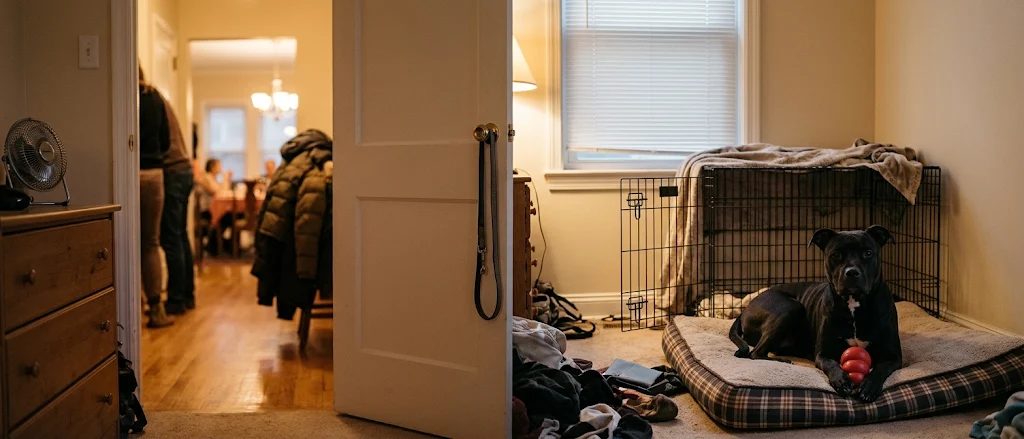
Your dog should be able to spend 4 or 5 hours in that room while the house runs at full volume. Nobody opens the door except the person on dog duty.
Pick the room farthest from the front door and the kitchen. A back bedroom beats a basement next to the beer fridge. Work through this list a few days ahead.
- A door that latches, with a sign taped outside: "Dog resting. Please keep closed."
- Coats and purses go to a different room, since guests wander in looking for their keys
- Crate or bed, a blanket that smells like home and a full water bowl
- A fan or white noise machine running to cover the doorbell and the football game
- 2 long-lasting chews, plus a food toy stuffed and frozen the night before
- Blinds down if the window faces the driveway
- Harness and leash hanging on the inside doorknob for potty trips
- A practice run this weekend: 1 or 2 hours in the room with a chew, so party day isn't the first time
Less trips past that door means less chances for a nosy guest to open it. Tape the sign at eye level.
How Do You Stop a New Dog From Bolting Out the Door When Guests Arrive?
Door dashing never makes the toxic food lists, and it should. To a dog home 4 weeks, the front door is a hole in the wall full of interesting smells.
Holiday doors open constantly, often by guests who don't know your rules. The Virginia-Maryland vets flag exactly that, and they suggest a secure room or a double-door setup during gatherings. In plain English, keep 2 things between your dog and the street every time that door opens.
Arrivals are the worst stretch: half an hour of the door swinging while somebody holds it open with a pie. Goodbyes come a close second.
So your dog goes into the safe room before the first car parks. He stays there until the coats are hung and the door is shut. If he comes out later, he's on a leash in a calm adult's hand, never tied to a chair.
Check the gear before the big day, too. Kansas State University veterinarian Susan Nelson tells owners to keep tags on and microchip contact info current (K-State's holiday pet safety tips). A pet can slip out fast as guests come and go. The doorway backup leash from our pickup-day gear list earns its keep here too.
If your dog does get out, don't chase, since a scared dog runs from a running person. Call your local shelter and your microchip company right away.
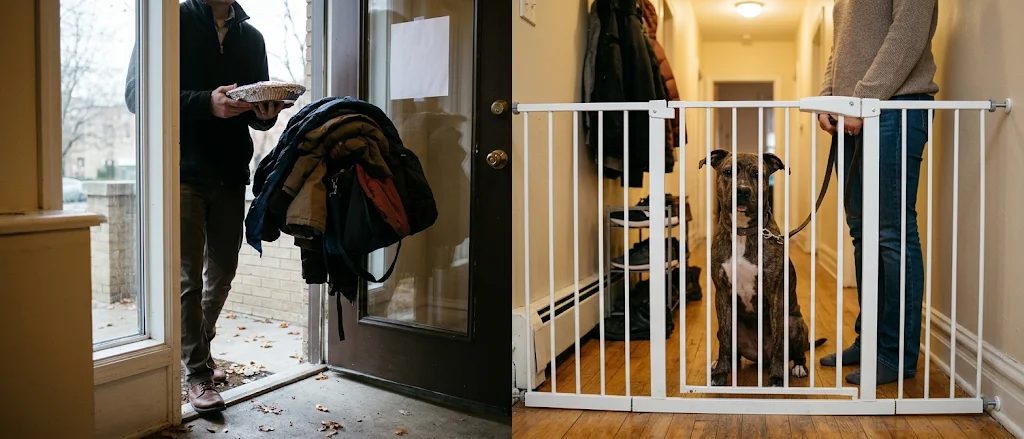
Door manners take practice. Start with the reward-based basics for brand new adopters and work on a sit at the door a few minutes a day.
What Should You Tell Guests Before They Meet Your New Dog?
Set the rules by text a few days ahead, from your couch, not in a doorway holding a casserole.
Here's the text I'd send. Swap in your dog's name.
"Hi! Quick heads-up for Thursday. [Dog's name] has only been home 4 weeks, so he'll be resting in the back bedroom most of the day. Please keep that door shut, use the front door only and close it right behind you. No people food for him, not even 1 bite. If he comes out to say hi, let him sniff you first and don't reach for his head. He's not being rude. He's new. See you Thursday!"
At the door, you only need 1 line: "Come on in, and shut the door behind you. The dog's new."
There's always 1 guest who says he's great with dogs. Smile and say, "I know. He doesn't know that yet."
If somebody starts the "it's all how they're raised" speech about your pit mix, change the subject to pie. Send them the pit bull myths people still repeat later.
Kids get their own rules. They sit on the floor and toss a treat when the dog comes close. No hugging, and nobody follows the dog into the safe room.
If your adoption paperwork had a "no small kids" note on the kennel card, he stays in the safe room. No debate.
How Do You Dog-Proof a House That Smells Like a Buffet?
Every holiday post has a toxic food list, so mine's in the table below. The bigger problem is access.
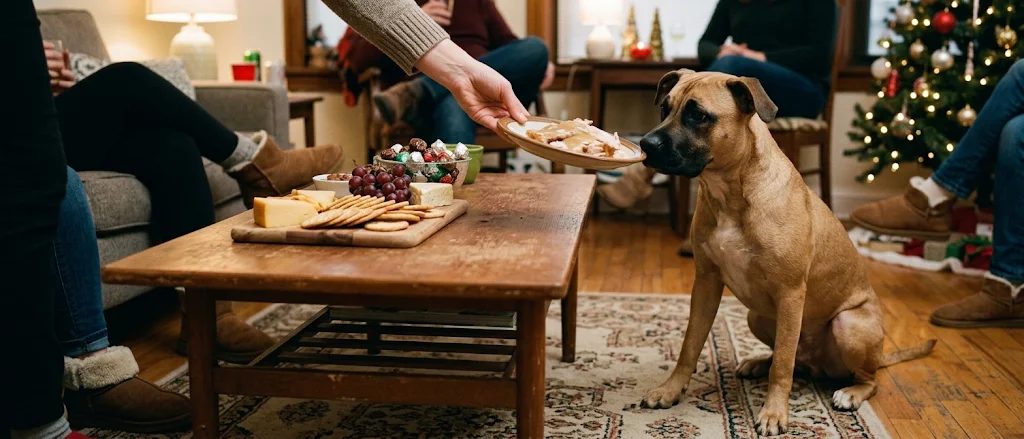
A pit mix on his hind legs reaches most counters. The coffee table sits at nose height, plates ride on laps and the trash can is full of turkey skin. Your house is now 1 long, low buffet.
Washington State University's guide to holiday meals and pets says its veterinary teaching hospital sees more vomiting and diarrhea in pets over the holidays. High-fat food like gravy and turkey leftovers can trigger pancreatitis. Ham and turkey bones sometimes need surgery to come back out.
The Virginia-Maryland vets have a name for the other problem: "multiple-meal syndrome." That's 10 guests each slipping the dog 1 little bite. Put 1 person in charge of treats and tell everybody else no.
Trash goes behind a closed door or out to the garage. Your dog stays in the safe room during the meal itself, when plates are lowest and attention is thinnest.
If something goes down the hatch, call your vet or an emergency vet right away. The ASPCA Animal Poison Control Center is at (888) 426-4435, and a fee may apply. Save it in your phone tonight.
If his stomach revolts after a sneaky plate, our guide to soft stool in a newly adopted dog covers when it's a vet call.
| Food | Why It's a Problem | What to Do |
|---|---|---|
| Turkey skin, fat trimmings, gravy and buttery sides | High-fat food can trigger pancreatitis, with vomiting, diarrhea and belly pain | Regular dog food only. 1 person hands out treats. |
| Turkey and ham bones | Cooked poultry bones splinter, and bones can block the gut and sometimes need surgery | Carcass goes straight to a lidded trash can behind a closed door |
| Stuffing, gravy and anything with onion or garlic | Onions and garlic are toxic to dogs | Plates stay at the back of the counter, never on the coffee table |
| Chocolate, especially dark and baking chocolate | Toxic to dogs, and darker chocolate carries more risk | Dessert table out of reach. Cookie tins get lids. |
| Sugar-free gum, candy and baked goods with xylitol | Can crash a dog's blood sugar and, in larger amounts, cause liver failure | Coats and purses go in a closed room the dog can't reach |
| Grapes, raisins and fruitcake | On veterinary lists of holiday foods to keep away from pets | No fruit bowls or cheese boards on low tables |
| Raw yeast dough | On veterinary lists of holiday foods to keep away from pets | Let dough rise in a closed oven or high cabinet |
| Eggnog, punch and other alcohol | Alcohol is toxic to dogs | Drinks stay off low tables and the floor |
Sources: Washington State University Veterinary Teaching Hospital, Kansas State University Veterinary Health Center and Virginia-Maryland College of Veterinary Medicine. If your dog eats any of these, call your vet, an emergency vet or the ASPCA Animal Poison Control Center at (888) 426-4435 (a fee may apply).
Should a New Rescue Dog Skip the Holiday Party Entirely?
I'll take a side: when in doubt, skip. Nobody's holiday got ruined because the dog stayed in the bedroom.
Your dog will show you which plan fits if you run a few small tests the week before. Ring your own doorbell and time how long he takes to settle. Have 1 friend over for an hour, and notice whether a neighbor's treat on a walk gets taken or ignored.
Watch for stress signs while you test: lip licking, yawning when he isn't tired and a tucked tail. Refusing a treat he normally inhales counts, and so do damp paw prints that vanish off the kitchen tile.
A growl is information, not bad manners. Don't punish it. Calmly walk your dog back to the safe room and let him reset.
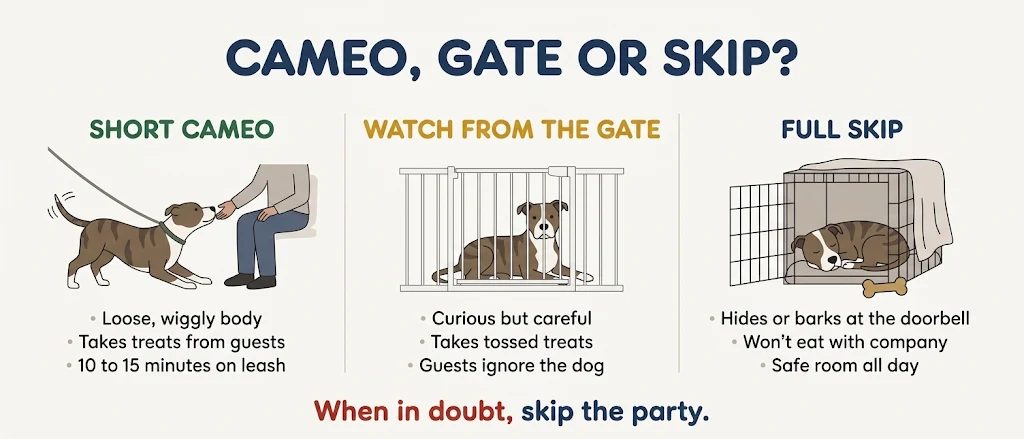
K-State's Susan Nelson says even social pets should have a quiet room or crate during company. For a dog home 4 weeks, I'd go further, and the table below sorts dogs into a short cameo, a gated view or a full skip.
| Plan | Fits a Dog Who | What It Looks Like | How Long |
|---|---|---|---|
| Short cameo | Greets visitors with a loose, wiggly body, takes treats from strangers and shakes off the doorbell fast | A leashed hello with 2 or 3 calm adults after arrivals are done, then back to the safe room with a chew | 10 to 15 minutes |
| Watch from the gate | Is curious but careful, watches from across the room and takes tossed treats | Behind a baby gate in a side room while guests ignore the dog and toss treats over | Until the dog walks away, stiffens or stops taking treats |
| Full skip | Hides or barks at the doorbell, won't eat with company or has a flight risk or "no small kids" note | Long sniff walk first, then the safe room all day with chews, a fan and hourly potty breaks on leash | The whole gathering |
These tiers come from our own experience, not a veterinary standard. A dog who growls, snaps or panics around guests needs a talk with your vet or a certified behavior consultant before the holidays.
Whatever plan you pick, the days after a party matter too. Our step-by-step return to quiet days at home helps a rattled dog reset after a busy week.
What's the Best Plan for a Dog Who Needs to Skip the Party?
Skipping the party isn't a punishment. It's the better party, with chews and nobody touching your ears.
Burn Energy Before Guests
Take a long, slow sniff walk an hour or 2 before anyone arrives. In a Chicago December, a pit mix may need a coat for it, so check how much cold a short-coated rescue dog can take first. Then serve dinner early, in the safe room.
Give the Room a Job
Hand over the frozen food toy as the first car pulls up. Swap in a fresh chew at dinner, when the noise peaks. The person on dog duty takes a quiet potty break about once an hour, leash on, through the back door if you have one.
Skip the Boarding Kennel
WSU's vets mention boarding as an option for some anxious pets, depending on the pet's history. For a dog who left a kennel 4 weeks ago, I'd pass. A night back on concrete isn't a vacation.
A trusted friend's quiet apartment can work, but only if your dog already knows that friend.
Call the Vet Early
If your dog panics at the doorbell or loud noise, talk to your vet now, not on December 23. Ask about situational anxiety medication and whether to try it on a quiet day first.
Plan New Year's Eve the same way. Neighborhood fireworks in Chicago start early and run late, so close the blinds and run the fan. Keep potty breaks on leash, since a spooked dog slips a collar faster then you'd think.
What Holiday Shifts at the Shelter Taught Me
I've volunteered with Chicago shelter dogs since 2017, first at The Anti-Cruelty Society and now at Chicago Animal Care and Control.
If a full adoption doesn't fit this month, bringing a shelter dog home as a December foster still gets a dog off the concrete.
Give Your Dog a Boring Holiday
Dog holiday safety for a new rescue dog comes down to a closed door, a clear guest plan and permission to skip the party. Next year your dog might be the one greeting everybody at the door. For everything else in your first months together, start with the Let Them Be Dog resources for new adopters.
Common questions
Can my rescue dog have a little turkey on Thanksgiving?
A small piece of plain turkey is probably not a big deal for a healthy dog, according to Washington State University veterinarians. Turkey skin, fat, gravy, bones and anything seasoned with onion or garlic are the real dangers. A rescue dog home only a few weeks often has a touchy stomach, so skipping holiday turkey entirely is the safer choice.
Is it okay to crate my dog during a holiday party?
Crating a dog during a holiday party works well when the dog already rests calmly in a crate. A crate inside a closed back room blocks escape routes and keeps curious guests away. A dog who panics in a crate usually does better in a small gated room with a chew and a fan running.
Should I bring my new rescue dog to a relative's house for the holidays?
Leaving a new rescue dog home in a familiar safe room usually beats bringing the dog to a relative's house. A strange house adds new smells, new rules and new exits on top of the crowd. A rescue dog who has to travel needs a leash on indoors, a quiet room to retreat to and a short visit.
What if a guest wants to bring their dog to a holiday gathering?
A guest's dog should stay home when a rescue dog has lived in the house for only a few weeks. A first meeting between 2 dogs belongs on a calm walk on neutral ground, not in a crowded kitchen full of dropped food.
Can I give my rescue dog calming medication for a holiday party?
Calming medication for a holiday party should come only from the dog's own veterinarian. Kansas State University veterinarian Susan Nelson suggests asking a vet about anti-anxiety medication for pets that get very stressed by company. Asking the vet weeks ahead leaves time to test the medication on a quiet day before the party.
What should I do if my dog eats chocolate or a sugar-free treat?
A dog who eats chocolate or anything sweetened with xylitol needs a call to a veterinarian, an emergency vet or an animal poison hotline right away. The ASPCA Animal Poison Control Center answers at (888) 426-4435, and a fee may apply. Keeping the wrapper or package helps the vet figure out how much the dog ate.
About the Author
I’m Jeff Molitor and I adopted my first dog at 39 (Cooper Wonder) and have volunteered with Chicago shelter dogs since 2017, first at The Anti-Cruelty Society and now at Chicago Animal Care and Control. I help with dog handling, agility, adoption showings and support, photography and marketing. I love all dogs, but I gravitate toward momma dogs, seniors, black pibbles and the ones with cropped ears. Basically whoever’s been overlooked the longest. Jeff is dad to Oscar Wonder (pibble) and Gary Wonder (our cat).
This article shares what we have learned from our own experience. It is not medical advice, and we are not veterinarians. If you have any concerns about your dog's health, please check with your vet.