Meeting and Choosing a Shelter Dog
Adopting a Dog Who Was Returned: What the Return Note Does and Doesn't Tell You
Published · By Jeff Molitor
Adopting a returned dog is often a smart choice, because the return note shows real home behavior that most kennel dogs never get to show.
The short answer
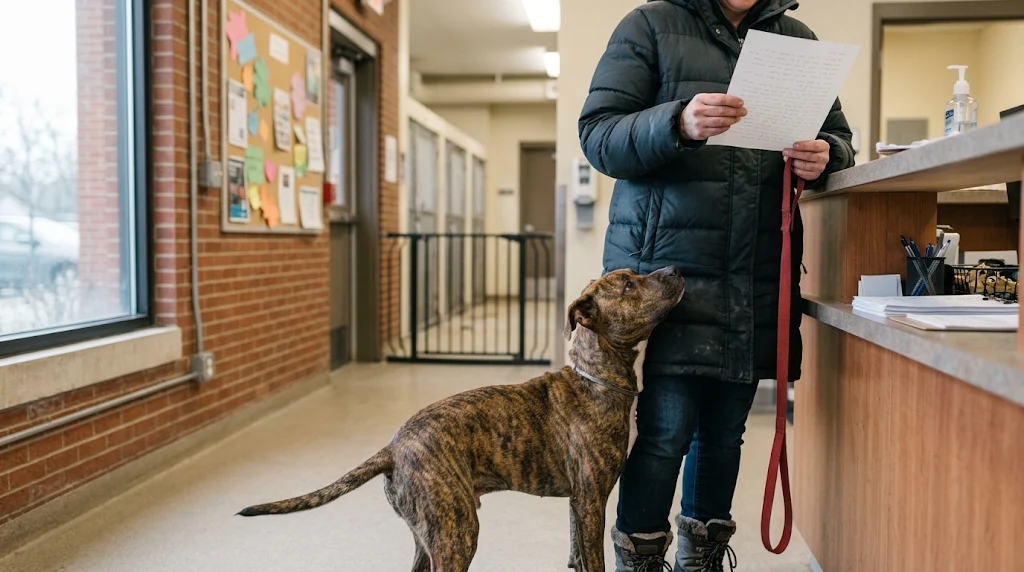
Adopting a dog that was returned to the shelter is often a smart choice, because the dog comes with real home behavior notes. A return note shows how a dog handled a real schedule, real visitors and real household noise. A returned shelter dog deserves the same fair look as any other dog, plus a few extra questions.
A dog who was returned to the shelter comes back with something most shelter dogs never get: a report card from a real home. Adopting a returned dog means you get to read that report card before you sign anything.
I've done adoption showings in Chicago since 2017. Return notes can tell you if a dog sleeps in or hates the vacuum.
This Let Them Be Dog guide is for the adopter holding a return note and wondering what it really says. Short answer: more than you'd think, and less than you'd fear.
Should I Adopt a Dog That Was Returned to the Shelter?
I'd go further than "often," honestly. A returned dog is one of the few dogs in the building who shows up with evidence.
Think about what you know about a typical kennel dog. You know her weight, a guess at her age and how she acts behind a gate with 60 dogs barking. That's mostly it, and the kennel version of a dog is usually the loudest version.
A returned dog lived somewhere. Somebody watched her deal with a doorbell, a delivery driver, a Tuesday night alone and a Saturday full of guests. Then they wrote it down, usually in a hurry and sometimes in a mood.
That's home data. Most shelter dogs don't get any until after you sign the papers.
Shelters collect the same kind of information on purpose through foster programs, and foster notes are the closest thing a shelter has to a test drive. A return is basically a foster stay nobody planned. Messier, sure. Still data.
So I'd absolutely consider adopting a returned dog. I'd just read the note like a detective, not like a judge.
| What You Want to Know | Returned Dog | Kennel-Only Dog |
|---|---|---|
| Housetraining | Often noted after days or weeks in a real home | Usually unknown until you get her home |
| Time alone | The note may say how she handled an empty apartment | Kennels never leave a dog truly alone |
| Visitors and doorbells | Real reactions to real guests | Mostly guesses from the meet room |
| Other pets | Sometimes tested with a resident dog or cat | Playgroup notes at best |
| Triggers | Often named, like skateboards or kids on bikes | Rarely seen from inside a kennel |
| Stress level right now | Higher at first, since she just lost a home | Steady kennel stress |
| Who wrote the notes | A family, plus shelter staff and volunteers | Shelter staff and volunteers only |
Based on our experience at Chicago shelters. Every return note is different, so ask the adoption counselor what's behind each line.
A returned dog gets a second first week, and it counts just as much as the first one. Start with the homepage plan for a quiet first 2 weeks before pickup day.
What Does a Return Note Actually Tell You?
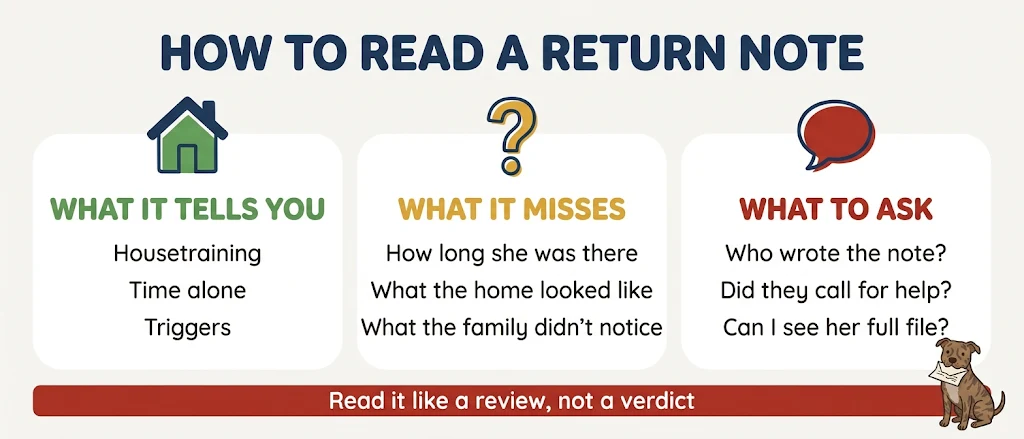
A return note covers more than the kennel card ever will, and it's usually in plain English. Here's what I look for first.
House Manners Get Tested
Housetraining is the big one. A note that says "no accidents in 2 weeks" beats any guess a shelter can make.
Same goes for counter surfing, crate comfort (paid link) and whether she stays off the bed when asked (paid link). Or doesn't.
As an Amazon Associate I earn from qualifying purchases.
Alone Time Gets Tested
Kennels never leave a dog truly alone. Homes do.
If a dog cried for 20 minutes and then slept (paid link), that's pretty normal. If she chewed through a door frame (paid link), that's a different conversation, and you want it before you sign.
As an Amazon Associate I earn from qualifying purchases.
Triggers Get Named
Real homes have mail carriers, toddlers, skateboards, cats in windows and the neighbor's yappy terrier. A return note often names the 1 thing that set a dog off.
That's a gift. You can't plan around a trigger nobody has seen yet.
The Good Stuff Sneaks In
People returning a dog almost always add something nice, even on a lousy day. Great with kids. Loves car rides (paid link). Sleeps until 7.
As an Amazon Associate I earn from qualifying purchases.
Read those lines as closely as the complaints. They were written by someone with zero reason to oversell.
What Does Each Return Reason Mean for Your Home?
Returns are common, and volunteers feel every single one. I covered how often adoptions come undone, and why volunteers take it so hard in another post, so I won't repeat those numbers. This part is for you, the next adopter.
Here's the short version from the research side. Lauren Powell, an animal welfare scientist at the University of Pennsylvania, wrote up a study of 24,000 adoption records at Charleston Animal Society for The Association for Animal Welfare Advancement. Across dogs and cats, about 35% of returns came down to behavior that didn't fit the home.
About 18% were animals who didn't get along with the pets already there. Medium and large adult dogs came back the most.
Other pets come up a lot. A 2020 study of 959 dogs at an Alberta shelter found "dog aggression risk," a mix of breed, size and aggression toward dogs, was higher in returned dogs. Fear aggression and separation anxiety didn't stand out.
That's good news for plenty of people. If the note says "doesn't like our other dog" and you don't have another dog, you just crossed off the biggest risk in that study.
The decoder table below reads each reason against your own life.
| The Note Says | What It Often Means | Ask the Counselor | Could Fit |
|---|---|---|---|
| "Not good with our other dog" | Didn't click with 1 specific dog, or a real dog-to-dog issue | Was it 1 fight or constant tension? Any playgroup notes? | An only-dog home |
| "Chased the cat" | Prey drive, or just too much excitement (paid link) | Did she stalk, chase or make contact? | A cat-free home |
| "Too much energy" | Under-walked or bored, often in a small space (paid link) | How many walks a day, and how many hours alone? | An active adopter or someone who works from home |
| "Cries or destroys things when left" | Boredom, or true separation panic | What happened, how long was she alone and did it improve? | Someone home most of the day while training |
| "Barks or lunges on leash (paid link)" | Leash reactivity, often worse on busy city blocks | At what, and from how far away? | A quieter street, plus a reward-based trainer (paid link) |
| "Landlord said no" or "We're moving" | A lease or life problem, not a dog problem | Is anything else on the note? | Most homes that allow her breed and size |
| "Couldn't afford her" | A budget surprise | Are any medical needs adding to the cost? | An adopter who has priced vet care and food |
| "Not housetrained" | Not taught yet, or stressed by a new place | Accidents every day, or only the first week? (paid link) | A patient adopter with a steady schedule |
| "Growled or snapped at our kid" | Fear, pain or a child who didn't give her space | What was the child doing right before? | An adult-only home, after a talk with behavior staff |
| "Bit someone" | Needs details before anything else | Did the bite break skin? What led up to it? | Only after a full talk with behavior staff |
As an Amazon Associate I earn from qualifying purchases.
Return reasons play out differently for every dog. This table reflects our experience reading return notes at Chicago shelters, not any shelter's official policy.
A few reasons need a closer look. Separation trouble is worth a real conversation, because true separation panic looks different from a bored dog eating the blinds.
Housing returns are often about a lease, not the dog. Pit mixes catch the worst of it, thanks to lease and insurance rules that single out bully breeds.
Money returns usually mean somebody skipped the yearly math on vet bills, food and trainers.
Got a resident dog or cat? Read our dog-to-dog and dog-to-cat intro steps before you bring home a dog whose note mentions other pets.
What Doesn't the Return Note Tell You?
Plenty. A return note is 1 family's view from 1 home, usually written on their worst day with the dog.
How Long the Dog Was There
3 days and 3 months are not the same note. A 2024 Virginia Tech analysis of returns at 3 shelters found 66% of returned dogs came back within the first 30 days.
A dog back in under a week barely unpacked. Her note is mostly about stress, not personality. A dog who lived somewhere for 6 months showed that family her real self, so give that note more weight.
What the Home Looked Like
The same Virginia Tech analysis found dogs adopted into urban homes were more likely to come back. That's not a shock to anyone who's walked a nervous dog past an L stop at rush hour.
Ask about stairs, elevators, roommates, kids, other pets and hours alone. A 4th-floor walk-up can tell you more than a 6-line note does.
What the Family Didn't Notice
People aren't always great at describing their own dog. A 2021 Penn study in Frontiers in Veterinary Science compared what 427 surrendering owners said against a detailed behavior questionnaire.
69.3% of those owners said their dog had no behavior problems when asked directly. The questionnaire told a different story.
The researchers didn't think owners were lying, since promising confidentiality made no difference. They more likely just didn't see the problem as a problem. A return note can miss things the same way, in both directions.
What Happened Before
The note only covers the last home. Ask for the original intake notes, any playgroup notes and how a single bad moment can harden into a shelter label.
What Should You Ask the Adoption Counselor About a Returned Dog?
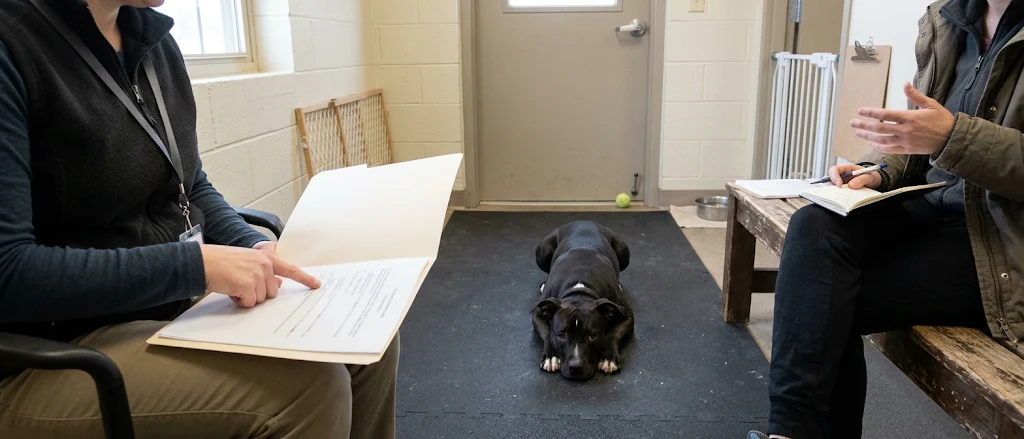
An adoption counselor is your best translator. They've usually talked to the family who brought the dog back, and they've watched the dog since.
Don't be shy here. Counselors would much rather answer 10 questions now than process a second return next month. A second return is hard on everybody, the dog most of all.
There's another reason to ask about support. Powell's write-up mentions a study where less than half of returning adopters contacted the shelter's behavior team first. So a note might describe a problem nobody actually tried to fix.
Here are the questions I'd bring to anyone adopting a returned dog. They're built for return notes, so they skip the basic meet and greet stuff.
- Who wrote this note, the family or a staff member who talked with them?
- How long did she live in the home?
- What did the home look like? Stairs, kids, other pets, hours alone, yard or no yard.
- Did the family call for help before bringing her back, and what did they try?
- Which line on this note worries staff the most, and why?
- Has she done any of this at the shelter, before or after the return?
- How has she acted since she came back?
- Is this her first return?
- Can I see her full file, including intake notes and the first adoption notes?
- Would the family take a message from me? Some shelters will pass one along.
Write the answers down. Seriously, you'll forget half of it by the parking lot.
A return note tells you what to work on, and reward-based training is how you work on it. Brush up on the positive training basics we use with every new dog before pickup day.
Is a Returned Dog Damaged Goods?
No, and I wish that phrase would retire already.
Coming back is hard on a dog, and I won't pretend otherwise. She lost her couch, her routine and her people. Then she landed back in a loud kennel row.
Some returned dogs shut down for a few days (paid link). Others bounce off the walls. Neither one is the dog you'll live with.
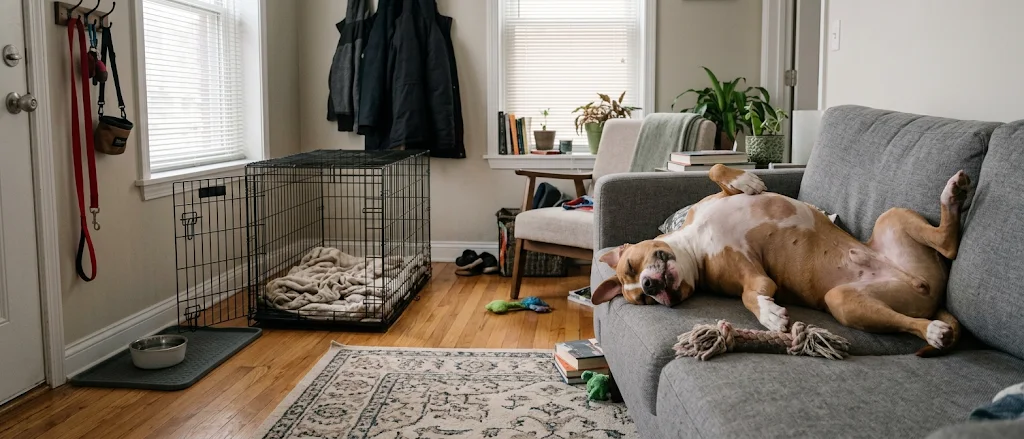
She'll need 2 slow, boring weeks of decompression (paid link) in your home, same as any rescue. A returned dog does have an edge some intake dogs don't, though. She's lived in a house recently, so doors, stairs, the TV and the fridge aren't news.
As an Amazon Associate I earn from qualifying purchases.
Do expect a wobble. Plenty of dogs settle, relax and then test you a bit, and the week 3 slump catches a lot of adopters off guard.
That wobble might be exactly where the last adoption fell apart. Now you know it's coming, anyways.
When Should a Return Note Make You Walk Away?
Sometimes the note really is telling you no, and that's okay.
I'd pause hard on a bite that broke skin, especially to a person. Same if the note describes real fights with the kind of pet you already have, like a dog who went after a cat when you live with 2 cats.
I'd also pause if the trigger is something you can't control. A dog terrified of kids is a tough match if your 3 nieces come over every Sunday.
Walking away isn't failing her. It's protecting her from round 2. Ask the counselor what kind of home would work, then tell a friend who has that home.
And a lot of the time, the scary line isn't that scary. "Growled at our son" might mean a 7-year-old climbed on her while she slept. Ask before you rule her out.
Read the Note, Then Meet the Dog
Adopting a returned dog means you walk in knowing more than almost anyone else in the lobby. Use it, then go meet the dogs who've waited at the end of the row the longest.
Common questions
Is a dog that was returned to the shelter a bad dog?
A dog returned to the shelter is usually not a bad dog, just a dog placed in a home that did not fit. Return reasons often involve other pets, time alone, housing or energy level. A Penn study of 24,000 adoption records found behavior that did not fit the home behind about 35% of returns. The right home can make the same behavior a non-issue.
Can I talk to the person who returned the dog?
Talking to the person who returned a shelter dog is sometimes possible, depending on the shelter's privacy policy. Some shelters will not share contact details but will pass along a message or a list of questions. Adoption counselors who spoke with the returning family can also share what the family described about the dog's time at home.
What should I do if a return note is vague or blank?
A vague or blank return note means an adopter should ask the adoption counselor for details before deciding. Shelter staff who took in the returned dog often heard more than the paperwork shows. Original intake notes, playgroup notes and the dog's behavior since the return help fill in a thin return note.
Should I adopt a dog that was returned more than once?
Adopting a dog that was returned more than once can still work when the return reasons point to homes that did not fit. Repeated returns for the same behavior suggest the dog needs a specific setup, like an only-dog home. A 2021 Penn study at a South Carolina shelter found pit bull-type dogs were more likely to be returned multiple times.
Is it safe to adopt a returned dog with a bite on the note?
Adopting a returned dog with a bite on the note can be safe, depending on the bite's severity, the context and the adopter's home. A bite that broke skin calls for a full talk with shelter behavior staff before adopting. Adopters should ask what happened right before the bite, who was involved and whether the dog has shown the behavior since.
Do shelters have to tell you why a dog was returned?
Shelter policies on sharing return details vary, so adopters should ask directly for the return reason and the full return notes. Adoption counselors can usually share what the returning family reported. Adopters can also read the adoption contract's return policy, which explains how the shelter handles any future return.
About the Author
I’m Jeff Molitor and I adopted my first dog at 39 (Cooper Wonder) and have volunteered with Chicago shelter dogs since 2017, first at The Anti-Cruelty Society and now at Chicago Animal Care and Control. I help with dog handling, agility, adoption showings and support, photography and marketing. I love all dogs, but I gravitate toward momma dogs, seniors, black pibbles and the ones with cropped ears. Basically whoever’s been overlooked the longest. Jeff is dad to Oscar Wonder (pibble) and Gary Wonder (our cat).
This article shares what we have learned from our own experience. It is not medical advice, and we are not veterinarians. If you have any concerns about your dog's health, please check with your vet.