Life After Adoption
Planes, Trains and Adoptables: How to Help a Rehomed Dog Settle In After Being Passed Around
Published · By Jeff Molitor
A dog who's been passed from home to home holds back for a reason. Here's why rehomed dogs act like polite strangers, and 6 boring steps that help them unpack.
The short answer
A rehomed dog settles into a new home faster when the main person, the routine and the house rules stay the same every day. Dogs with several past homes have learned that rules change, so predictability earns trust faster than extra affection. A 2024 Linköping University study found rehomed dogs carried less long-term stress than dogs still living in a shelter.
A rehomed dog who has been passed from home to home settles in once your house turns boringly predictable. Same person, same rules, same day, for as long as it takes.
I'm Jeff from Let Them Be Dog, and every Thanksgiving I think about Del Griffith.
In Planes, Trains and Automobiles, John Candy's Del spends the whole trip getting handed off from 1 ride to the next. Plenty of shelter dogs live that movie. A family, then a shelter, then a home that lasted 3 weeks, then a transfer, then you.
Our guide to whether a dog with a return or 2 on the paperwork is right for you covers the decision. This one starts the day the dog walks in and won't take his coat off.
How Do You Help a Rehomed Dog Settle Into a New Home?
Slowly. And boringly. Mostly boringly.
Think about what a passed-around dog has actually learned. Every home had a different couch rule, a different word for "come" and a different person in charge of dinner. Some of those homes ended without much warning.
So the dog stops investing. He's polite. He eats, he walks, he sleeps with 1 eye open. He doesn't unpack.
You can't hug that out of him. You can be so predictable that he gets bored of waiting for the next move.
The research is on your side. Cornelia Sulonen, Lina Roth and their team at Linköping University in Sweden compared 20 shelter dogs, 30 rehomed dogs and 33 dogs who'd lived with 1 owner since puppyhood. In a 2024 study of 83 Swedish dogs, dogs still in the shelter had higher hair cortisol, a measure of long-term stress, than dogs already in new homes.
Same study, better news. Owners of the dogs in new homes reported feeling emotionally closer to their dogs than the owners who'd had theirs since puppyhood.
1 move doesn't wreck a dog. A long string of them teaches a dog to stay packed, and your house gets to be the last stop.
Start with the quiet first stretch our homepage lays out, then work through the steps further down. The next few sections cover what the dog is thinking while you do.
Bringing a rehomed dog home this week? Start with a 2-week decompression plan that keeps day 1 boring, and save the welcome party for much later.
Why Does a Dog Who's Been Passed Around Act Like a Polite Stranger?
Picture the roommate who says hi in the kitchen, keeps his door shut and never puts 1 thing in the shared fridge. Nice guy. Totally unknowable.
That's the first stretch with a lot of dogs who've moved a few times. He's fine. He's great, even. He's just not here yet.
I see the kennel version of this every Saturday at Chicago Animal Care and Control. Dogs who've been returned more than once often stop performing for visitors. No jumping, no begging at the gate. They wait to see what you are.
Researchers have watched something similar. Giulia Cimarelli and her team at the University of Veterinary Medicine, Vienna, tested 72 family dogs for a 2021 study in PLOS ONE. About half of them were former shelter dogs.
The former shelter dogs spent more time near the door. They also stuck closer to their owners than to a stranger, which the team read as more wariness about new places and new people.
Adopters tend to miss the next part. The same team found no clear sign those dogs were less bonded to their owners. More careful, sure. Less attached, no.
So the polite phase is a dog doing math on whether this stop is the last one. Rejection has nothing to do with it, even if it feels personal when he picks the far end of the couch.
Why Do Rehomed Dogs Hold Back, Test Boundaries or Cling to 1 Person?
Each of these behaviors makes more sense once you picture the dog's résumé. Each past home was a different job with a different boss, and nobody handed over the employee manual.
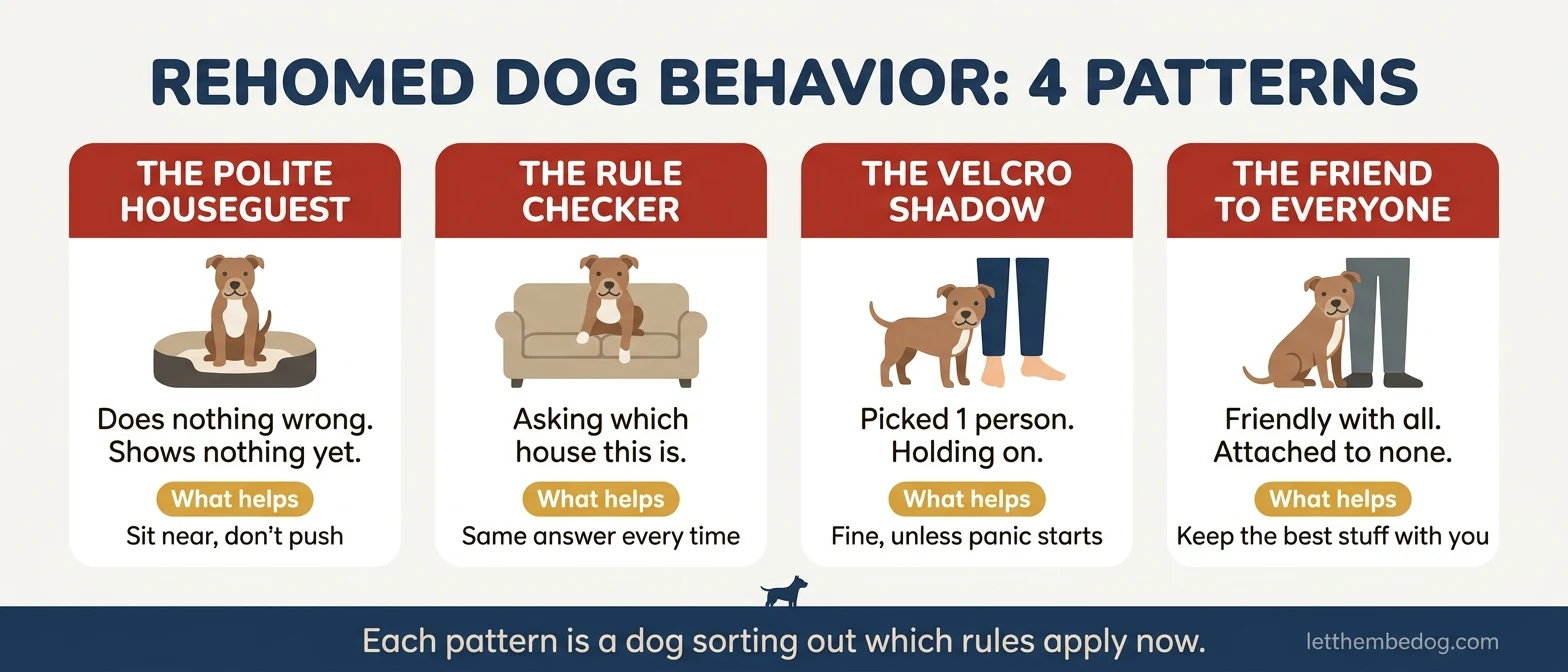
Most dogs with a few moves behind them land in 1 of 4 patterns. Some mix 2 or 3 in the same week, which is fun for everybody.
The Polite Houseguest
This dog does nothing wrong and nothing much at all. He takes treats gently, walks fine and goes back to his bed. No toys, no zoomies, no opinions.
Don't push for a personality. Sit on the floor and read, toss a treat his way now and then and let him come over on his own. Quiet dogs come out of their shell faster when nobody is pulling on it.
The Rule Checker
A dog from 3 homes may have had couch rights in 1, a crate in another and a yard in the third. So he checks. Paws on the counter, then the couch, then your bed at 2 AM.
He's asking which house this is. Most new dogs test rules after a few weeks, and our 3-3-3 guide covers the week the house rules get tested in most new homes. For a dog with a few homes behind him, the fix is the same calm answer from every person, every single time.
The Velcro Shadow
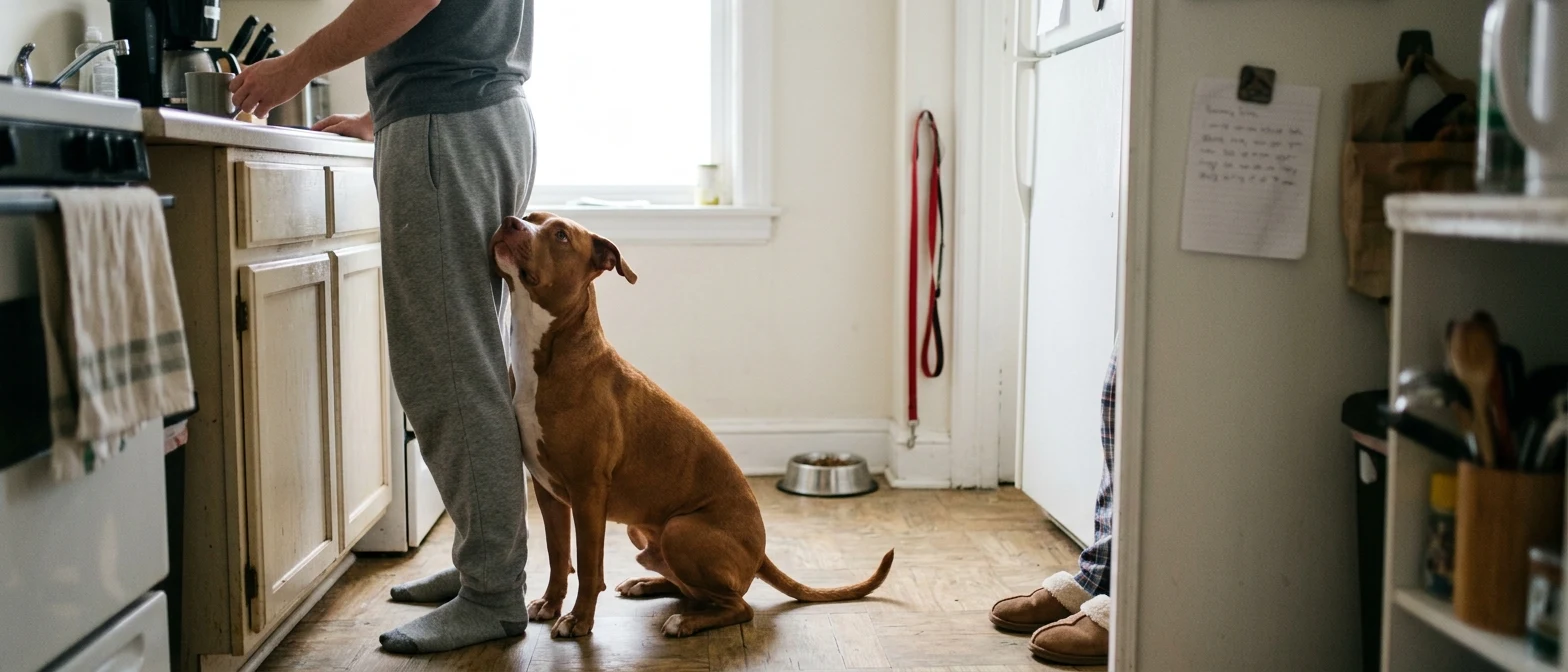
Some dogs pick 1 person by day 2 and follow that person into the bathroom. Partners take this personally. They shouldn't.
A dog who lost people before may hang on hard to the first one who feels safe. Shadowing is usually fine. Panic when that person leaves is different, so read up on when shadowing turns into panic at the door if the howling starts the second the lock clicks.
The Friend to Everyone
Then there's the dog who leans on every stranger at the dog park and barely glances at you. In the Linköping study, shelter dogs spent more time near an unfamiliar researcher than dogs raised with 1 owner did.
Friendly with all, attached to none. That usually shifts once 1 person becomes the safe base. Until then, let new people be boring and keep the best treats and games with you.
| Pattern | What You See | What It Often Means | What Helps |
|---|---|---|---|
| The Polite Houseguest | Takes treats gently, walks fine, no play and no opinions | Waiting to see if this home lasts | Sit nearby, read a book and let the dog come to you |
| The Rule Checker | Paws on the counter, then the couch, then your bed at 2 AM | Asking which rules apply in this house | The same calm answer from every person, every time |
| The Velcro Shadow | Follows 1 person from room to room, even into the bathroom | A first attachment forming | Usually fine. Get help if panic starts when that person leaves. |
| The Friend to Everyone | Leans on every stranger at the dog park and barely glances at you | No safe base yet | Keep the best treats and games with you, and let strangers stay boring |
A rule checker needs rules worth learning. Use reward-based training basics that give a new dog a reason to check in with you, with the same cue words from every person in the house.
Can a Dog Who's Had Several Homes Still Bond With You?
This is the part I want every nervous adopter to hear. Dogs don't run out of bonds.
Márta Gácsi, József Topál and colleagues at the Hungarian Academy of Sciences and Eötvös Loránd University ran a 2001 study of 60 Hungarian shelter dogs. 40 of the dogs got handled by a stranger 3 times, for 10 minutes each time. The other 20 didn't.
Then the dogs went through a version of the Strange Situation Test, the same setup used to study how toddlers bond with parents. The handled dogs looked for more contact with their handler. They had less body contact with an unfamiliar person, and they followed the stranger less when that person left the room.
30 minutes of attention, total. That's shorter than a Red Line delay on a bad day, and it was enough for adult shelter dogs to start picking a person.
Topál and Gácsi later wrote that rehomed adult dogs showed similar attachment behavior toward their old and new caregivers. The Vienna team took that to mean breaking bonds, even more than once, doesn't stop a dog from forming new ones.
The Linköping study backs it up from the owner side. People with rehomed dogs reported more emotional closeness than people with dogs they'd raised from puppies.
Whether your dog can bond is pretty well settled. Whether you'll stay consistent long enough for him to notice is up to you.
6 Ways to Help a Rehomed Dog Unpack
Now the practical part. None of these steps are fancy, and that's on purpose.
Oregon State University researchers Lauren Brubaker and Monique Udell looked at how owners' "parenting style" shaped their dogs. In a 2022 Oregon State University study of 48 dog owners, dogs of owners with high expectations and high responsiveness were the most likely to be securely attached.
That's the sweet spot for a passed-around dog. Warm, plus clear rules that never wobble. Pushovers and drill sergeants both give him something new to figure out.
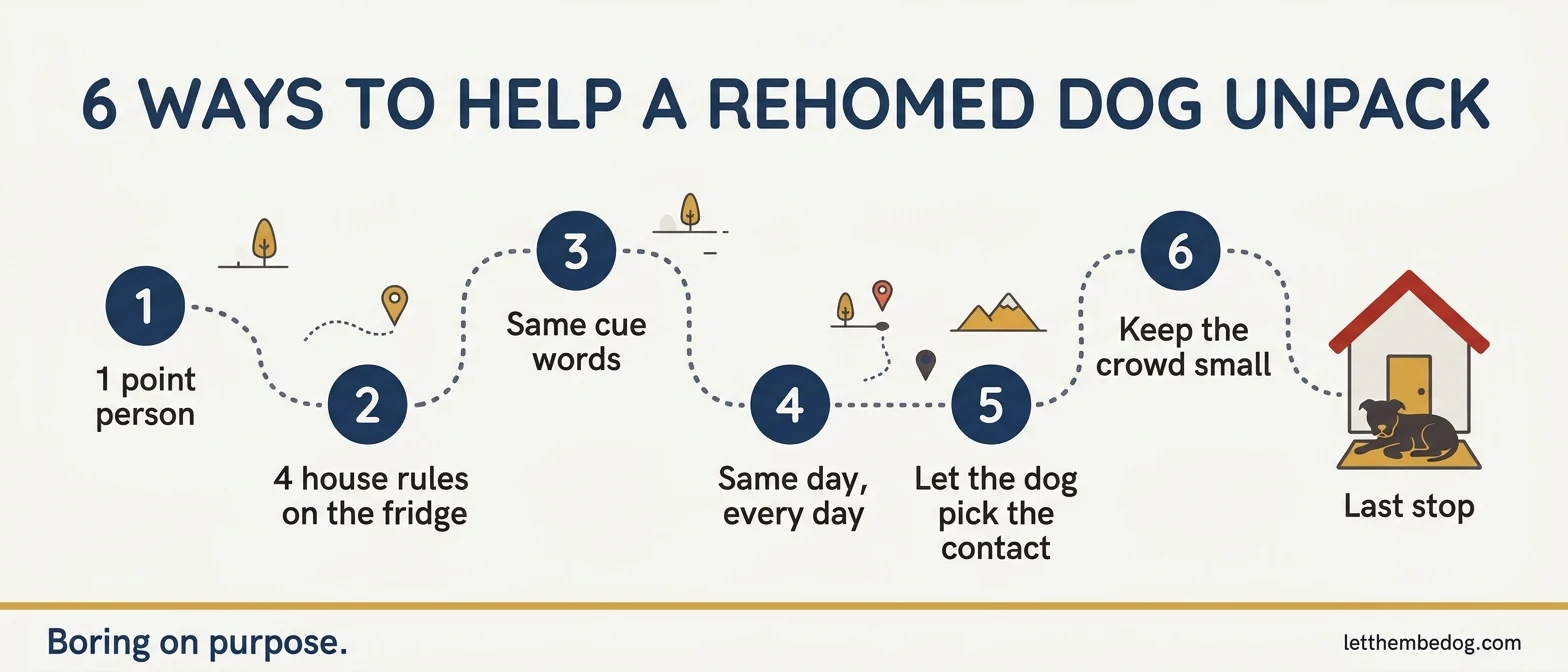
These 6 steps turn that into a normal Tuesday:
- Name 1 point person. For the first stretch, 1 adult handles breakfast, dinner and the main walk. Everyone else is friendly background noise until the dog relaxes around the point person.
- Pick 4 house rules and tape them to the fridge. Couch or no couch, bed or crate, where meals happen, what happens at the door. Every person enforces the same 4 rules the same way.
- Use the same cue words. If 1 person says "come" and another says "here, buddy," the dog hears 2 different houses. Write the words down, and borrow any cues the dog's paperwork lists from an earlier home.
- Run the same day, every day. Meals, walks and bedtime should land within the same half hour. There's no deadline for the rest, and our guide to how long settling in really takes explains why the calendar is a lousy judge.
- Let the dog pick the contact. Pet for 3 seconds, stop and see if he leans back in. A dog who gets a vote on touch learns this house listens.
- Keep the crowd small. New faces every weekend can look like the next handoff to a dog with a few homes behind him. If your dog's first holiday is today, use the holiday crowd plan for a brand new dog and give him a quiet room.
| What Past Homes Taught | What the Dog Does Now | What Your Home Teaches Instead |
|---|---|---|
| Rules change with every home | Tests the counter, the couch and the bed | 4 house rules on the fridge, with the same answer from every person |
| People leave | Sticks to 1 person, or to nobody at all | 1 point person for meals and the main walk |
| Words mean different things | Ignores cues or answers only 1 person | 1 cue sheet that every person in the house uses |
| Bags and visitors mean change | Watches the door and freezes when a suitcase comes out | A small guest list, a safe room and boring arrivals |
| Meals show up whenever | Gulps food or stiffens near the bowl | Set mealtimes in a quiet spot where nobody hovers |
| Touch happens on somebody else's terms | Stiffens or walks off when petted | Pet for 3 seconds, stop and let the dog choose more |
Predictable doesn't have to mean dull for the dog. Mix in sniffing games and chews that let a nervous dog relax on his own terms, on the same schedule every day.
What Should You Avoid With a Dog Who's Been Rehomed Before?
The biggest mistake is a rule that changes depending on who's home. Couch is fine when Dad's watching football and off-limits when Mom gets back. To a dog with 3 homes behind him, that's just a 4th home.
Second biggest is punishment for stuff an earlier home taught. A dog who growls when you reach for his bowl may have learned that in a house with 4 other dogs. Yelling only proves people get scary around food.
Go easy on the "socializing" too. Daycare on day 5, a sitter on day 9 and a family party on day 12 is a lot of strangers. For this dog, every new face can look like the next ride out.
Watch your own scorekeeping. Your last dog took 2 days to love you, or the neighbor's puppy rolls over for anybody. Neither one is the dog on your couch.
And if things feel stuck, call the shelter or rescue before you decide anything. Our volunteer post explains why so many adopted dogs end up back at the shelter, and most of the reasons have fixes.
What Signs Show a Rehomed Dog Is Starting to Unpack?
Our 3-3-3 guide covers the general settling-in signs. These are the ones I watch for in a dog with a few homes behind him, because they're tied to the moving part.
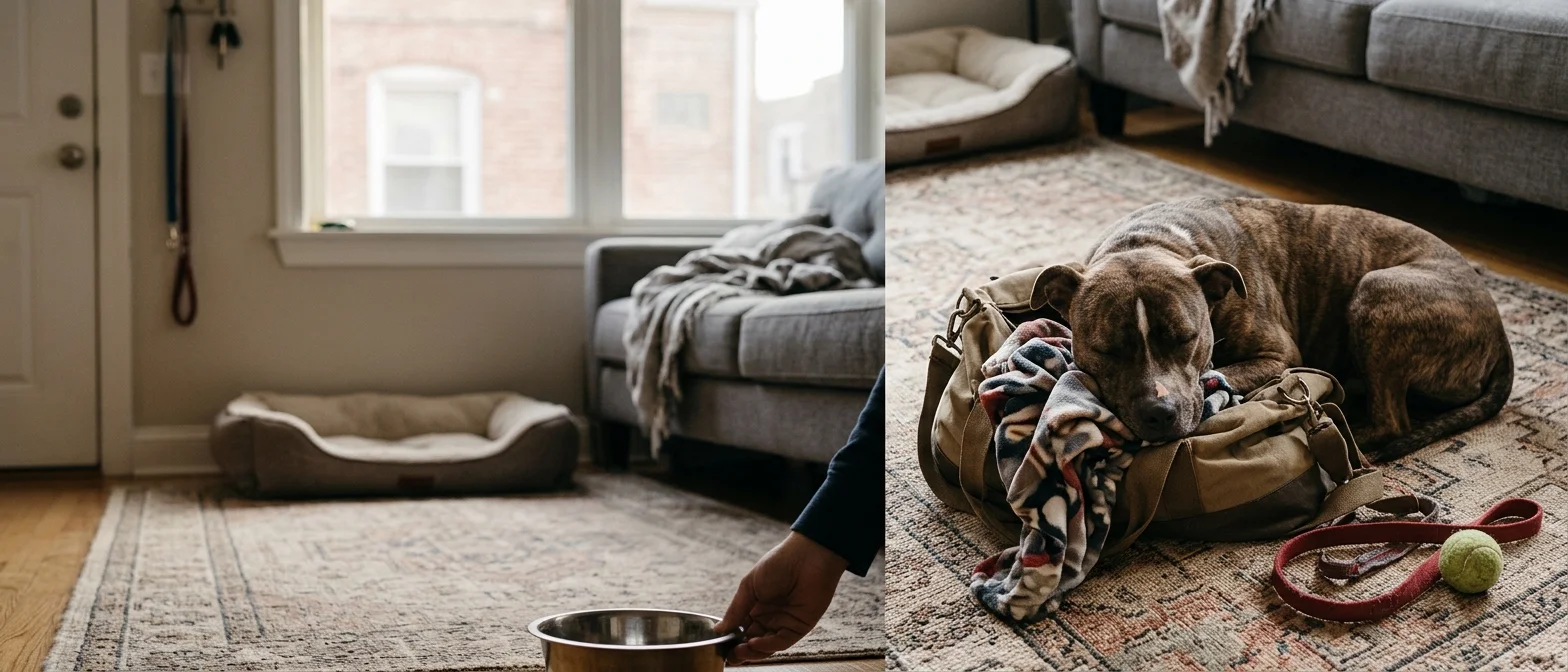
The suitcase stops being scary. A lot of passed-around dogs panic or go flat when a bag comes out, since bags meant somebody was leaving. When yours sniffs the duffel and walks off, that's a big deal.
The front door gets boring. He stops checking it every time a car door slams outside. He's not waiting for his ride anymore.
His stuff spreads out. Chews show up under the couch, by your desk and in his bed. He's unpacking, literally.
He complains. A grumble when you're late with dinner, a paw on your arm when you stop petting. A dog who expects to leave doesn't bother asking for much.
He checks in with you in new places. Remember the Vienna study, where family dogs used their owners as a safe base. When your dog glances back at you at a new park, you've become that base.
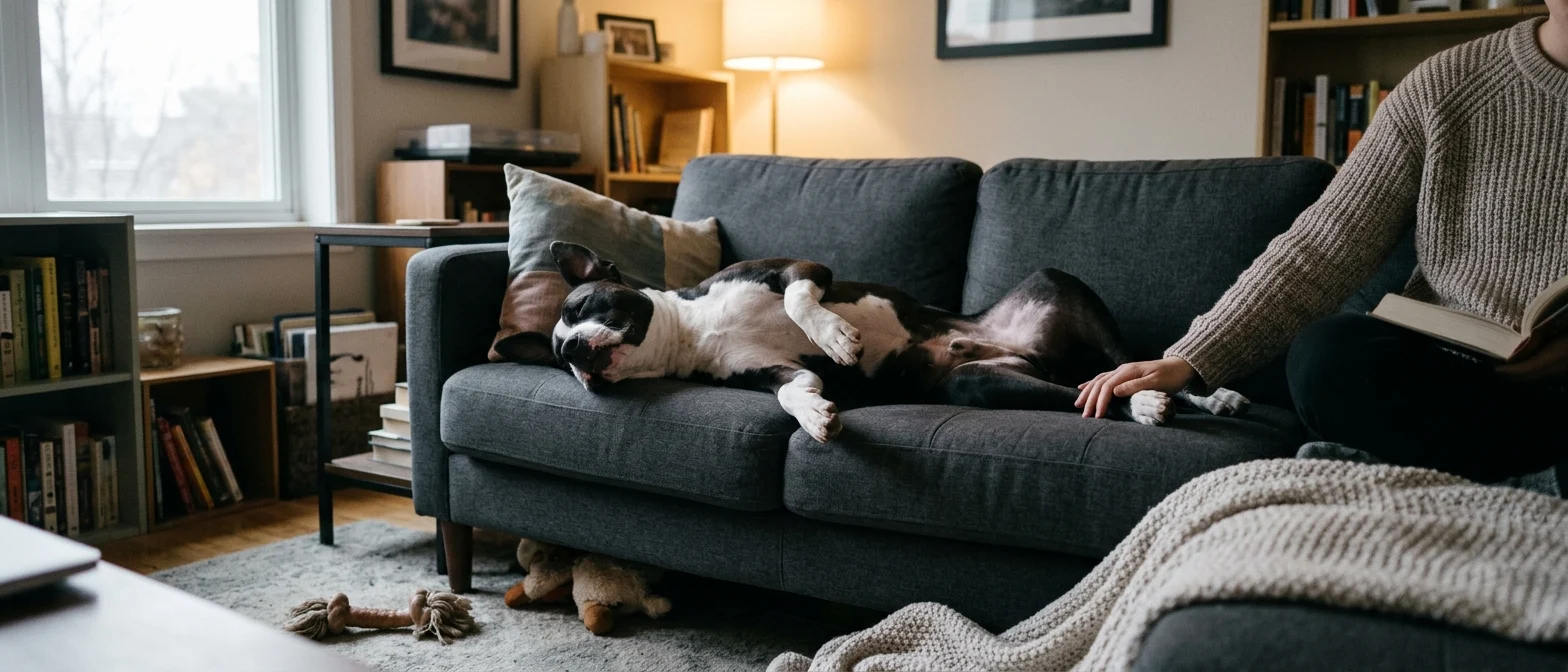
He sleeps like a lump. Belly up, legs out, snoring. Light sleepers are watching for change.
What Dogs With 3 Homes Taught Me at the Shelter
I've walked a lot of dogs whose paperwork reads like a travel itinerary. Words like owner surrender and transfer on a kennel card tell you where a dog has been, but not who the dog is.
Those dogs taught me a couple of things. They're not broken. They're tired of starting over, and they hold off on caring until somebody proves they're staying.
They also taught me that the turn is quiet. No movie moment. Just a dog who finally falls asleep with his back to you because he doesn't need to watch you anymore.
He's Staying for Dinner
Del got his seat at the Thanksgiving table, and your rehomed dog can get his spot on the couch. Stay consistent, stay put and grab the full stack of new-adopter guides on our homepage.
Common questions
Does a rehomed dog remember previous owners?
A rehomed dog can remember previous owners, especially people the dog lived with for months or years. Dogs know familiar people by scent, voice and face, so a dog may perk up at someone who resembles an old owner. Remembering an old family does not stop a dog from bonding with a new family, according to attachment research on rehomed adult dogs.
Should you change a rehomed dog's name?
Changing a rehomed dog's name is fine, and a fresh name can help when the old name was tied to yelling or a rough home. A new name works best when every person says the name the same way and pairs it with treats. A dog who already answers to an old name can keep it, which is 1 less thing to relearn.
Is a rehomed adult dog harder to train than a puppy?
A rehomed adult dog is usually no harder to train than a puppy, and adult dogs often have longer attention spans than puppies. The tricky part is sorting out mixed rules from earlier homes. Consistent cue words and reward-based training from every person in the house help an adult dog learn which rules apply now.
What if a rehomed dog only bonds with 1 person in the house?
A rehomed dog bonding with 1 person first is common, since a dog with past losses often attaches to whoever feels safest. Other family members can build trust by taking over some meals, walks and short play sessions on a set schedule. A dog who growls or guards that 1 person should see a reward-based trainer.
Why is a rehomed dog friendlier with strangers than with the new owner?
A rehomed dog can act friendlier with strangers because a dog used to changing caretakers may treat every new person as a possible connection. In a 2024 Linköping University study, shelter dogs spent more time near an unfamiliar researcher than family dogs did. The pattern often fades as the new owner becomes the dog's safe base.
About the Author
I’m Jeff Molitor and I adopted my first dog at 39 (Cooper Wonder) and have volunteered with Chicago shelter dogs since 2017, first at The Anti-Cruelty Society and now at Chicago Animal Care and Control. I help with dog handling, agility, adoption showings and support, photography and marketing. I love all dogs, but I gravitate toward momma dogs, seniors, black pibbles and the ones with cropped ears. Basically whoever’s been overlooked the longest. Jeff is dad to Oscar Wonder (pibble) and Gary Wonder (our cat).
This article shares what we have learned from our own experience. It is not medical advice, and we are not veterinarians. If you have any concerns about your dog's health, please check with your vet.