Life After Adoption
Thinking About an Emotional Support Animal? Here's What You Need to Know
Published · By Alicia Bradley
An emotional support animal offers comfort without task training. Learn what an ESA letter does, what HUD changed in 2026 and how Illinois law still applies.

The short answer
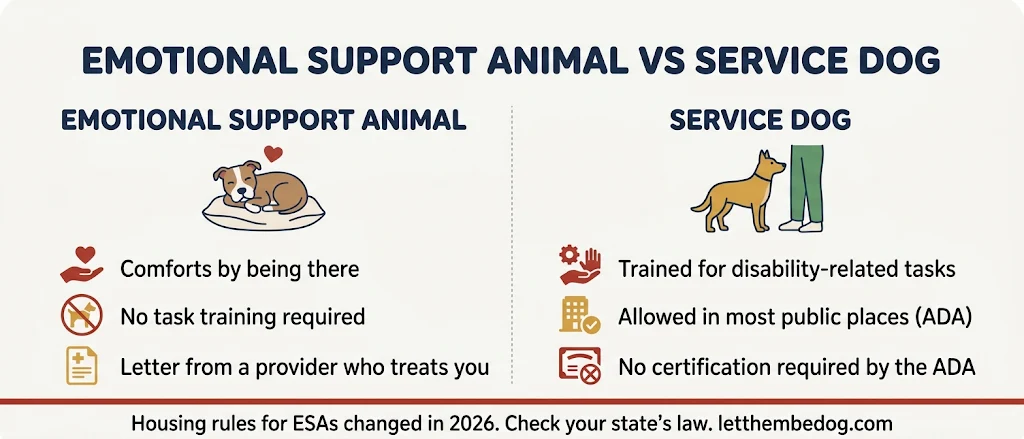
An emotional support animal comforts a person through companionship, while a service animal is trained for disability-related tasks. An ESA letter should come from a licensed provider who treats you. HUD changed its federal housing enforcement in May 2026, so current state law and qualified local guidance matter.
Interested in having your pet become an emotional support animal (ESA)? First, it's important to understand what an ESA is.
What Is an Emotional Support Animal?
An emotional support animal provides a person with emotional support and comfort. This differs from a service animal, which is specifically trained to perform tasks or do work related to a person's disability.
To have your pet recognized as an ESA, you generally need to qualify for an Emotional Support Animal (ESA) letter. An ESA letter is documentation written by a licensed healthcare or mental health professional. It states that you have a qualifying disability or condition and that your animal helps with its symptoms or effects.
| Question | Emotional Support Animal | Service Animal (ADA) |
|---|---|---|
| What it does | Comforts a person with a disability through companionship and presence | Does specific work or tasks tied to the handler's disability |
| Task training | Not required | Required, individually trained |
| Which animals | Not limited to dogs | Dogs, and miniature horses in some cases |
| Stores and restaurants | No ADA access rights. Some state or local laws allow more. | Generally allowed wherever the public can go |
| Federal housing enforcement since May 22, 2026 | HUD no longer presumes untrained ESA requests are reasonable | HUD treats requests for trained animals as presumptively reasonable |
| Illinois housing | Covered under the Illinois Human Rights Act, per the Illinois Attorney General's currently posted guide | Covered |
| Paperwork | A letter from a licensed provider who treats you | The ADA doesn't require certification or registration |
General information as of November 2026, not legal advice. Federal ESA housing enforcement is changing, so check your state's current law.
What an ESA Letter May Provide
Housing accommodations: Under the Fair Housing Act (FHA), people with disabilities may be entitled to reasonable accommodations for an assistance animal in covered housing. For years, that applied even in some housing with no-pet policies. HUD changed how it enforces this for untrained ESAs in May 2026, so your state's law now matters more.
Pet-related fees: Under HUD's old guidance, an assistance animal wasn't treated as a pet, so pet fees and deposits often didn't apply. HUD no longer expects landlords to waive those fees for an untrained ESA. Illinois' currently posted state guide takes a different position, as the 2026 section explains. An owner may still be responsible for damage caused by the animal.
No specialized task training required: Unlike service animals, ESAs do not need to be trained to perform a specific task to provide emotional support. The catch: since May 2026, HUD's federal housing enforcement focuses on animals trained for disability-related tasks.
Keep in mind that ESAs primarily have protections related to housing. Unlike service animals, ESAs generally do not have the same access rights to public places such as restaurants, stores or other businesses. Before bringing your animal to an establishment, research its policies and applicable laws.
What Changed for ESAs in Housing in 2026?
On May 22, 2026, HUD's fair housing office changed how it handles ESA complaints. Its official enforcement memo says it will find reasonable cause and recommend charges only for cases involving animals trained to provide disability-related assistance. Untrained ESA requests are no longer presumed reasonable under that federal enforcement approach.
That also means HUD no longer expects landlords to waive pet fees for an untrained ESA. HUD's new approach also suggests landlords and HOAs won't be expected under that federal enforcement policy to waive breed or size limits for one.
The Fair Housing Act itself didn't change. Tenants can still file a fair housing lawsuit in federal or state court within 2 years, and the memo doesn't touch state or local law. HUD says it plans formal rulemaking, so expect more changes.
Illinois has its own fair housing law, the Illinois Human Rights Act. The Illinois Attorney General's assistance animal FAQ currently posted on the agency's website says it covers animals that provide emotional support, with no special training or certification needed. The same guide says Illinois housing providers can't charge any fee for an assistance animal, including a pet deposit.
That Illinois guide is dated December 2023, before HUD's May 2026 memo. The guide remains available as of November 20, 2026, but its date matters. Confirm current Illinois enforcement with the Attorney General's Disability Rights Bureau or an Illinois fair housing attorney, and check for later HUD rules or court decisions before acting.
Renting in Chicago with a pit mix? An ESA isn't a way around breed rules. Our guide to finding a pit bull friendly apartment in Chicago covers how to get a yes the honest way.
If a landlord turns down your request, you can contact the Illinois Department of Human Rights or the Attorney General's Disability Rights Bureau. This post is general information, not legal advice.
How Can an ESA Help?
An ESA may provide comfort and emotional support to someone experiencing a variety of mental or emotional health challenges. Let's take anxiety for example.
Maybe you frequently experience high levels of anxiety and want the companionship of an ESA to help you manage your symptoms. Below are a few ways interacting with or simply petting an animal could help.
May lower stress hormones and blood pressure: The repetitive motion of gently stroking an animal can become naturally rhythmic and soothing. Johns Hopkins Medicine notes that petting a dog lowers cortisol, a stress hormone, which helps keep blood pressure in check.
Promotes a sense of connection: Interacting affectionately with a pet may promote bonding and the release of chemicals associated with social connection, such as oxytocin.
Helps ground you in the present: Focusing on tangible sensations, such as the warmth of your pet's body, the texture of their fur or the sound of their breathing, can redirect your attention away from anxious thoughts. It can bring you back to the present moment.

How Do You Get Started?
The first step is to make an appointment with a licensed healthcare or mental health professional. They can assess whether you have a qualifying disability or condition and whether an ESA would be therapeutically appropriate for you.
Skip the websites selling instant ESA letters or registrations. Illinois' Assistance Animal Integrity Act requires ESA paperwork to come from someone with a real therapeutic relationship with you. HUD's 2026 memo also criticized its old guidance for helping create an industry that turns pets into ESAs.
While ESAs do not require specialized task training, it is still important that your pet receives positive reinforcement training. It can help your pet learn how to provide support and to strengthen your bond.
Don't Have an Animal Yet?
A calm adult shelter dog can be a lovely fit, and shelter staff usually know which dogs live for a quiet couch. Before you visit, learn what the labels on a kennel card really tell you.
Not sure you're ready? Fostering a shelter dog for a few weeks shows you the real dog before you commit.
Once your new dog is home, give them 2 quiet weeks to settle in. Support goes both ways, and a stressed dog needs time before they can calm anyone else.
Find Your Calm Companion
The best emotional support animal might already be waiting at your local shelter. Meet the seniors and mommas who wait longest for a home, and ask staff which dogs love a quiet evening.
Common questions
What is the difference between an emotional support animal and a service animal?
An emotional support animal helps a person with a disability through comfort and companionship, without any task training. A service animal is a dog individually trained to do work or tasks tied to its handler's disability. The ADA protects service animals in public places but does not cover emotional support animals.
Can an emotional support animal go into stores and restaurants?
Emotional support animals don't have the public access rights the ADA gives trained service dogs. A store or restaurant can apply its normal pet policy to an emotional support animal. Some state or local laws allow emotional support animals in more public places, so check local rules first.
Can a landlord charge a pet fee for an emotional support animal?
Pet fees for an emotional support animal depend on current state law and federal enforcement. HUD stopped expecting landlords to waive them for untrained ESAs in May 2026. The Illinois Attorney General's currently posted December 2023 guide says Illinois housing providers can't charge fees or pet deposits for assistance animals. Confirm current Illinois enforcement before acting. Owners can still owe for animal damage.
Is an online ESA registration or certificate valid?
An online ESA registration or certificate is not the same as an ESA letter from a provider who treats you. Illinois' Assistance Animal Integrity Act requires ESA documentation to come from a provider with a therapeutic relationship with the person. A letter from a treating licensed professional carries far more weight than a certificate bought online.
Does an emotional support dog need training?
An emotional support dog doesn't need task training to provide comfort, but basic manners still matter. Since May 2026, HUD only pursues federal housing complaints when an animal is trained for a disability-related task. Positive reinforcement training helps an emotional support dog stay calm at home and around neighbors.
Can a shelter dog be an emotional support animal?
A shelter dog can be an emotional support animal when a licensed provider who treats the owner documents the need for the dog's support. Adult shelter dogs can suit the role well, because staff and fosters already know their personalities. A quiet first few weeks at home helps a new emotional support dog settle in and bond.
About the Author
Alicia Bradley is a guest contributor to Let Them Be Dog. In this article, she explains how emotional support animals differ from service animals and what prospective ESA owners should ask before getting started.
This article is general information, not legal, medical or mental health advice. Laws on emotional support animals are changing. Talk with a licensed provider about your health and with a fair housing attorney or your state's civil rights agency about your housing rights.